







Question: In this exercise we explore nonlinear effects in ion-acoustic waves (Ex. 21.5), and show that they give rise to solitons that obey the same KdV
In this exercise we explore nonlinear effects in ion-acoustic waves (Ex. 21.5), and show that they give rise to solitons that obey the same KdV equation as governs solitonic water waves. This version of the solitons is only mildly nonlinear. In Sec. 23.6 we will generalize to strong nonlinearity.
(a) Introduce a bookkeeping expansion parameter ε whose numerical value is unity,5 and expand the ion density, ion velocity, and potential in the forms
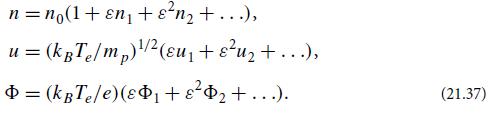
Here n1, u1, and Φ1 are small compared to unity, and the factors of ε tell us that, as the wave amplitude is decreased, these quantities scale proportionally to one another, while n2, u2, and Φ2 scale proportionally to the squares of n1, u1, and Φ1, respectively. Change independent variables from (t , z) to (τ , η), where

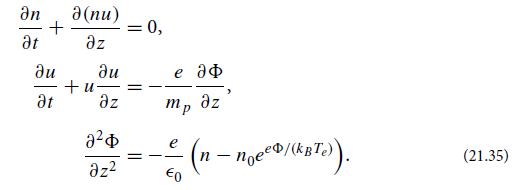
Explain, now or at the end, the chosen powers ε1/2 and ε3/2. By substituting Eqs. (21.37) and (21.38) into the nonlinear equations (21.35), equating terms of the same order in ε, and then setting ε = 1 (bookkeeping parameter!), show that n1, u1, and Φ1 each satisfy the KdV equation (16.32):

(b) In Sec. 16.3 we discussed the exact, single-soliton solution (16.33) to this KdV equation. Show that for an ion-acoustic soliton, this solution propagates with the physical speed (1+ n1o)(kBTe/mp)1/2 (where n1o is the value of n1 at the peak of the soliton), which is greater the larger is the wave’s amplitude.
Equations.



Data from Exercises 21.5.
Ion-acoustic waves can propagate in an unmagnetized plasma when the electron temperature Te greatly exceeds the ion temperature Tp. In this limit, the electron density ne can be approximated by ne = n0 exp[eΦ/(kBTe)], where n0 is the mean electron density, and Φ is the electrostatic potential.
(a) Show that for ion-acoustic waves that propagate in the z direction, the nonlinear equations of continuity, the motion for the ion (proton) fluid, and Poisson’s equation for the potential take the form
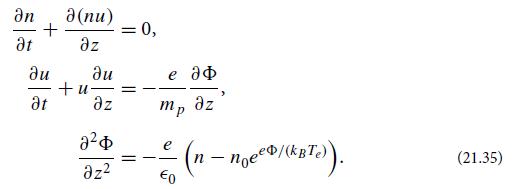
Here n is the proton density, and u is the proton fluid velocity (which points in the z direction).
(b) Linearize Eqs. (21.35), and show that the dispersion relation for small-amplitude ion-acoustic modes is

where λD is the Debye length.
n=no(1+ n +8m + ...), = (ke/mp)/(u + + ), u= = (kBT/e) ( + 8 + ...). (21.37)
Step by Step Solution
3.36 Rating (177 Votes )
There are 3 Steps involved in it
To approach this exercise we need to perform a perturbative expansion and then change variables to simplify the governing equations for ionacoustic wa... View full answer

Get step-by-step solutions from verified subject matter experts
 Study Help