







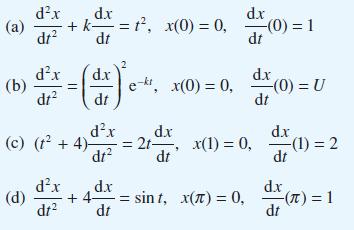
Question: Using the method introduced in Question 24, find the solutions of the following initial-value problems: Data from Question 24 Show that by making the substitution
Using the method introduced in Question 24, find the solutions of the following initial-value problems:
Data from Question 24
Show that by making the substitution
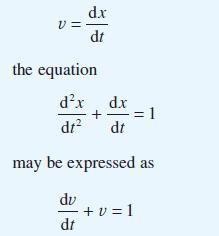
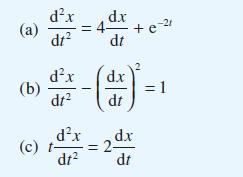
Show that the solution of this equation is v = 1 + Ce–t and hence find x(t). This technique is a standard method for solving second-order differential equations in which the dependent variable itself does not appear explicitly. Apply the same method to obtain the solutions of the differential equations
dx (a) + k- dr (b) dx dt (d) (c) (t + 4) dx dt d.x dt dx dt dx dr = t, x(0) = 0, e-kt, x(0) = 0, dx dt - + 4x = sint, x() = 0, dt dx 2t, x(1) = 0, dt -(0)=1 dx -(0) = U dt dx dt d.x (1)=2 -(T) = 1 dt
Step by Step Solution
3.54 Rating (168 Votes )
There are 3 Steps involved in it
a b c d Hence k Let v Then Hence This is a firstorder lin... View full answer

Get step-by-step solutions from verified subject matter experts
 Study Help