







Question: 7 Suppose demand is a continuous random variable having a probability density function f (d), and c (d, q) is given by Equation (2). Show
7 Suppose demand is a continuous random variable having a probability density function f (d), and c
(d, q) is given by Equation (2). Show that if q units are ordered, the expected cost E(q) may be written as
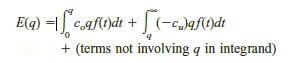
Now use Leibniz’s rule to derive Equation (5).
E(q) =\cqf(t)dt + (-c)qf(t)dt + (terms not involving 9 in integrand)
Step by Step Solution
There are 3 Steps involved in it
1 Expert Approved Answer
Step: 1 Unlock

Question Has Been Solved by an Expert!
Get step-by-step solutions from verified subject matter experts
Step: 2 Unlock
Step: 3 Unlock
 Study Help