







Question: Consider Figure 10.12, in which a point in 0 must move to reach point p = [4 2.5] T , crossing three layers of fluids
Consider Figure 10.12, in which a point in 0 must move to reach point p = [4 2.5]T, crossing three layers of fluids having different densities.
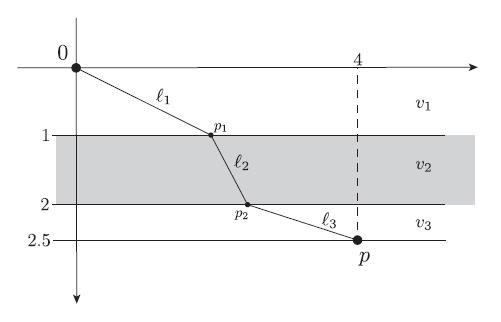
In the first layer, the point can travel at a maximum speed ν1, while in the second layer and third layers it may travel at a lower maximum speeds, respectively ν2 = ν1/η2, and ν3 = ν1/η3, with η2, η3 > 1. Assume ν1 = 1, η2 = 1.5, η3 = 1.2. You have to determine what is the fastest (i.e., minimum time) path from 0 to p. use path leg lengths ℓ1, ℓ2, ℓ3 as variables, and observe that, in this problem, equality constraints of the type ℓi = “something” can be equivalently substituted by inequality constraints ℓi ≥ ”something”.
1 2 0 2.5- br P1 l2 P2 l3 P V1 22 V3
Step by Step Solution
3.47 Rating (177 Votes )
There are 3 Steps involved in it
Let us denote with x 1 x 2 x 3 the horizontal coordinates of points p 1 p 2 and p respectively and w... View full answer

Get step-by-step solutions from verified subject matter experts
 Study Help