







Question: Objects (1left(m_{1}=1.0 mathrm{~kg} ight)) and (2left(m_{2}=3.0 mathrm{~kg} ight)) collide inelastically. The velocities are (v_{1 x, mathrm{i}}=+4.0 mathrm{~m} / mathrm{s}, quad v_{2 x, mathrm{i}}=0, quad v_{1
Objects \(1\left(m_{1}=1.0 \mathrm{~kg}\right)\) and \(2\left(m_{2}=3.0 \mathrm{~kg}\right)\) collide inelastically. The velocities are \(v_{1 x, \mathrm{i}}=+4.0 \mathrm{~m} / \mathrm{s}, \quad v_{2 x, \mathrm{i}}=0, \quad v_{1 x, \mathrm{f}}=-0.50 \mathrm{~m} / \mathrm{s}\), and \(v_{2 x, \mathrm{f}}=+1.5 \mathrm{~m} / \mathrm{s}\).
(a) What is the coefficient of restitution \(e\) ?
(b) Make a table like Table 6.1 showing the kinetic energy converted to internal energy both in the Earth reference frame and in a reference frame moving at \(v_{\mathrm{EM} x}=-1.0 \mathrm{~m} / \mathrm{s}\) relative to Earth.
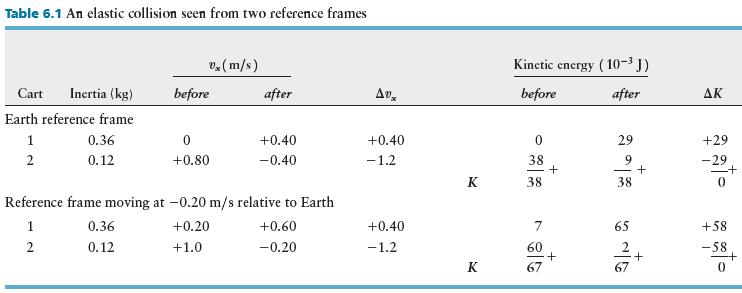
Table 6.1 An elastic collision seen from two reference frames vx (m/s) Cart Inertia (kg) before after Avx before Kinetic energy (10-3 J) after AK Earth reference frame 1 0.36 0 +0.40 +0.40 0 29 +29 2 0.12 +0.80 -0.40 -1.2 38 -29 + + K 38 38 0 Reference frame moving at -0.20 m/s relative to Earth 12 0.36 +0.20 +0.60 0.12 +1.0 -0.20 +0.40 7 65 +58 -1.2 60 K 67 22 2 -58 + + 67 0
Step by Step Solution
3.35 Rating (164 Votes )
There are 3 Steps involved in it

Get step-by-step solutions from verified subject matter experts
 Study Help