







Question: The elementary gas-phase reaction 2A + B C+D is carried out isothermally at 450 K in a PBR with no pressure drop. The specific
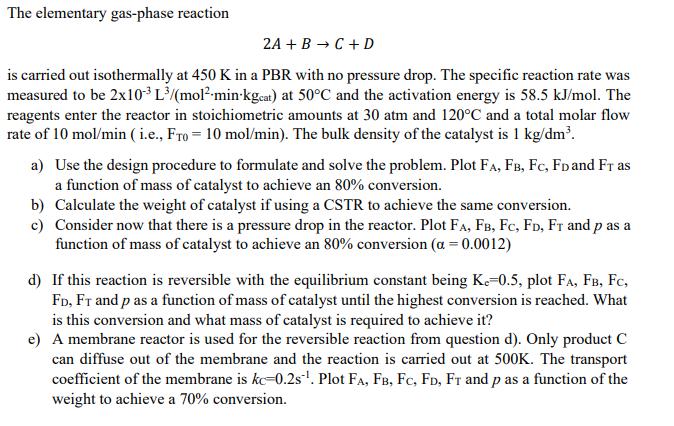
The elementary gas-phase reaction 2A + B C+D is carried out isothermally at 450 K in a PBR with no pressure drop. The specific reaction rate was measured to be 2x10⁻³ L/(mol-min-kgcat) at 50C and the activation energy is 58.5 kJ/mol. The reagents enter the reactor in stoichiometric amounts at 30 atm and 120C and a total molar flow rate of 10 mol/min (i.e., Fro = 10 mol/min). The bulk density of the catalyst is 1 kg/dm. a) Use the design procedure to formulate and solve the problem. Plot FA, FB, FC, FD and FT as a function of mass of catalyst to achieve an 80% conversion. b) Calculate the weight of catalyst if using a CSTR to achieve the same conversion. c) Consider now that there is a pressure drop in the reactor. Plot FA, FB, FC, FD, FT and p as a function of mass of catalyst to achieve an 80% conversion (a = 0.0012) d) If this reaction is reversible with the equilibrium constant being Ke=0.5, plot FA, FB, FC, FD, Fr and p as a function of mass of catalyst until the highest conversion is reached. What is this conversion and what mass of catalyst is required to achieve it? e) A membrane reactor is used for the reversible reaction from question d). Only product C can diffuse out of the membrane and the reaction is carried out at 500K. The transport coefficient of the membrane is kc-0.2s. Plot FA, FB, FC, FD, FT and p as a function of the weight to achieve a 70% conversion.
Step by Step Solution
There are 3 Steps involved in it
The answer provided below has been developed in a clear stepbystep manner This problem involves the design and analysis of a gasphase reaction carried out in a packed bed reactor PBR with and without ... View full answer

Get step-by-step solutions from verified subject matter experts
 Study Help