







Question: Selection rules in the dipole approximation are determined by the integral μ mn x = «Ï * m (Ï) μ x (Ï) Ï n (Ï)
a. Calculate μ12 x and μ15 x in the dipole approximation. Can you see a pattern and discern a selection rule? You may need to evaluate a few more integrals of the type μ 1m x. The standard integral
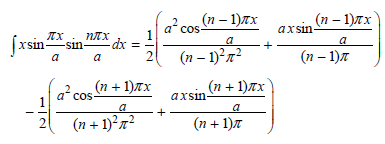
is useful for solving this problem.
b. Determine the ratio μ 12 x / μ 14 x. On the basis of your result, would you modify the selection rule that you determined in part (a)?
axsin - 1)7x ( 1) 2 cos (n 1)TX a co- . Xsn sin- dx = a a. ( - 1?? co (n + 1)Tx ( + 1) ( + 1) axsn- cos (n + 1)7 ( + 1)
Step by Step Solution
3.38 Rating (160 Votes )
There are 3 Steps involved in it
a We first evaluate 12 x The result is ... View full answer

Get step-by-step solutions from verified subject matter experts
 Study Help