New Semester
Started
Get
50% OFF
Study Help!
--h --m --s
Claim Now
Question Answers
Textbooks
Find textbooks, questions and answers
Oops, something went wrong!
Change your search query and then try again
S
Books
FREE
Study Help
Expert Questions
Accounting
General Management
Mathematics
Finance
Organizational Behaviour
Law
Physics
Operating System
Management Leadership
Sociology
Programming
Marketing
Database
Computer Network
Economics
Textbooks Solutions
Accounting
Managerial Accounting
Management Leadership
Cost Accounting
Statistics
Business Law
Corporate Finance
Finance
Economics
Auditing
Tutors
Online Tutors
Find a Tutor
Hire a Tutor
Become a Tutor
AI Tutor
AI Study Planner
NEW
Sell Books
Search
Search
Sign In
Register
study help
physics
elementary particle physics
Introduction to Elementary Particle Physics 2nd edition Alessandro Bettini - Solutions
Consider the decays: (1) B0→D -+ π+; (2) B0→D- + K+; (3) B0→π- + K+; (4) B0 → π- + π+. Find the valence quark composition of each of them, establish the dependence of the partial decay rates on the mixing matrix element and sort them in decreasing order of these rates.
Consider the measured values of the ratio Γ (Σ- → ne- ν̅e ) ≈/Γtot 10-3 and of the upper limit Γ(Σ+ → ne+ ve)/Γtot < 5 x 10⁻⁶. Give the reason for such a difference?
Consider the decays:(1) D+ → K̅0 + π+; (2) D+ → K+ + K̅0; (3) D+ → K+ + π0. Find the valence quark composition and establish whether it is favoured, suppressed or doubly suppressed for each of them.
Consider the measured decay rates Γ (D+ → K̅0e+ ve) = (7±1) x 1010s and Γ (μ+ → e+veν̅μ ) = 1/(2:2 μs). Justify the ratio of the two quantities.
Draw the Feynman diagrams for bottom and charm decays. Estimate the ratio Γ(b → c + e + ve)/ Γ(b → c).
Draw the principal Feynman diagrams for the top quark decay.
Draw the Feynman diagram for anti-bottom quark decay, favoured by the mixing. Write three favoured decay modes of the B+.
Write down a Cabibbo allowed and a Cabibbo suppressed semileptonic decay of the c quark. Write three allowed and three suppressed decays of D+.
How many metres of Fe must a vμ of 1 GeV penetrate to interact, on average, once? How long does this take? Compare that distance with the diameter of the Earth’s orbit. [Note: σ = 0.017 fb, ρ = 7.7x10³ kg m-3, Z = 26, A = 56.]
The GALLEX experiment at the Gran Sasso laboratory measured the ve flux from the Sun by counting the electrons produced in the reaction ve + 71Ga → 71Ge + e–. Its energy threshold is Eth = 233 keV. From the solar luminosity one finds the expected neutrino flux Φ = 6 x 10¹⁴m-2s-1. For a
Consider the neutrino cross-section on an electron and on an ‘average nucleon’ (namely the average between the cross-sections on protons and neutrons) at energies √s >> m, where m is the target mass and h is any hadronic state (the factor 0.2 is due to the quark
Cosmic rays are mainly protons. Their energy spectrum decreases with increasing energy. Their interactions with the atmospheric nuclei produce mesons, which give rise, by decaying, to vμ and ve. In a sample of Nv =106 vμs with 1 GeV energy, how many interact in crossing the Earth along its
What is the minimum momentum of the electron from a μ at rest? What is the maximum momentum?
How can you observe parity violation in the decay π→μv?
We send a π– beam onto a target and we observe the inclusive production of Λ. We measure the momentum pΛ and the polarisation σΛ of the hyperon. How can we check if parity is conserved in these reactions? What do you expect to happen?
Write the reaction (or the reactions, if they are more than one) by which a vμ can produce a single pion hitting: (a) A proton; (b) A neutron. Does the decay μ+→e++γ exist? Does μ+ → e++ e++ e– exist? Give the reason of your answers.
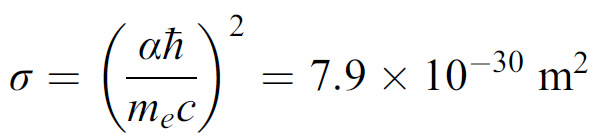
Neglecting the masses, calculate the cross-section of the process: e+e–→τ+τ– at √s = 10 GeV and at √s = 100 GeV.
Consider the decays μ+ → e+ + ve + ν̅μ and τ+ → e+ + ve + ̅vτ . The branching ratios are 100% for the first, 16% for the second. The μ lifetime is τμ = 2.2 μs. Calculate the ττ lifetime.
The PEP was a collider in which the two beams of e+ and e– collided in the CM reference frame. Consider the beam energy Ecm = 29 GeV and the reaction e+ + e- → τ+ + τ –. Find the average distance the τ will fly before decaying.
Draw the Feynman quark diagrams of the following strong and weak decays: π+ → π∘ + e+ + ve; ρ+ → π∘ + π+; K0 → π- + π+; Λ → p + e- + ν̅e:
Draw the Feynman quark diagrams of the following strong and weak decays: K*+ → K° + π+; n → p + e- + ν̅e; π+ → c+ + vμ:
Consider the P-wave c̅c states, which are called χc. Establish their number and the possible values of JPC. Which of them can decay into two gluons (and then into hadrons)?
The SPEAR e+e- collider at Stanford observed two narrow ψ resonances. Consider the second one the ψ(2S), where the expression in parenthesis is the mass in GeV. Bound P-wave cc states called χc were also discovered. Consider in particular the reaction e+e-→ψ(2S)→χ + γ, followed by
Consider a two-gluon system in a colour singlet state, in which the colour wave function is symmetrical. Call S the total spin, L the total orbital momentum, J the total angular momentum, P the parity and C the charge conjugation. Write down the possible values of all these quantities up to L = 1.
Draw the Feynman diagrams for the gluon exchanges for the following couples of vertices: (a) Bq → Gq, Gq → Bq; (b) Gq→Gq, R̅q→R̅q; (c) Gq→Gq, G̅q→G̅q. Specify which gluon(s) is (are) exchanged and the colour charges at both vertices. (d) Explain the meanings of
Draw the Feynman diagrams for the gluon exchanges for the following couples of vertices: (a) Rq → Bq, Bq → Rq; (b) Rq→Bq, R̅q→B̅q; (c) Rq→Rq, R̅q→R̅q. Specify which gluon (s) is (are) exchanged and the colour charges at both vertices. (d) Explain the meanings of
Consider the elastic scattering of an electron of energy E = 15 GeV on a proton. Calling Eʹ the energy of the scattered electron: (a) find the maximum four momentum transfer Q2 and the corresponding recoil kinetic energy of the proton, and (b) the same questions for E = 20 MeV and a 56Fe
A monochromatic photon beam of unknown energy but of known direction scatters on a liquid hydrogen target. The energy of the photons scattered at 20° is measured, finding Eʹ = 12 GeV. What is the energy of the beam?
Consider an electron–proton collision at HERA. The energy of the electron beam is Ee = 28 GeV and of the proton beam Ep = 820 GeV. One electron is observed to scatter at the angle θ = 120° and its energy is measured to be E'e = 223 GeV. Calculate the centre of mass energy and the kinematical
A beam of electrons of energy Ee = 1 GeV hits a liquid hydrogen target. A calorimeter measures the energy of the scattered electrons at the angle θ = 20°. Calculate the energy in case of elastic scattering. Similarly with a liquid He target. Similarly with an iron target (A = 56). [Use
Which of the following reactions is allowed or forbidden by strong interactions? Specify the reason in each case. You may look at the tables for establishing the quark compositions: (a) π- + p → Λ0b+ K0, (b) π- + p → Λ0b+ D0,(c) π- + p → Λ0b+ B0, (d)π- + p → Σ-b+
The proton has uud as valence quarks. Write down the triplet wave function in its spin, isospin and colour factors, taking into account that all the orbital momenta are zero.
A non-charmed baryon has strangeness S = –2 and electric charge Q = 0. What are the possible values of its isospin I and of its third component Iz? What is it usually called if I = 1/2?
Which of the following reactions is allowed or forbidden by strong interactions? Specify the reason in each case. You may look at the tables for establishing the quark compositions: (a) π- + p → Λ+c+ π-, (b) π- + p → Λ+c+ D-,(c) π- + p → Λ+c+ D0, (d) π- + p → Λ+c+
Evaluate the ratio α/αs at Q2 = (10 GeV)2 and at Q2 = (100 GeV)2. Take ΛQCD = 200 MeV, α-1 m2Z= 129 and MZ = 91 GeV.
In the HERA collider an electron beam of energy Ee = 30 GeV hits a proton beam with energy Ep = 820 GeV. The energy and the direction of the scattered electron are measured in order to study the proton structure. Calculate the centre of mass energy √s and the energy Ee,f an electron beam must
In a deep inelastic scattering experiment aimed at studying the proton structure, an E = 100 GeV electron beam hits a liquid hydrogen target. Find the expression of the momentum transfer Q2 as a function of the scattering angle θ in the L frame and of the momentum fraction x. What is the maximum
Consider the scattering of νμ and ν̅μ by nucleons in the quark model, in terms of scattering by quarks. Consider the d, u and s quarks and antiquarks. Write the contributing weak processes with a muon in the final state.
What is the value of the x variable in elastic scattering? Find the expression taking the elastic cross-section as the limit of the inelastic cross-section. E' = E/[1+(1 – cos 0)]
In a deep inelastic scattering experiment aimed at studying the proton structure, an E = 100 GeV electron beam hits a liquid hydrogen target. The energy Eʹ and the direction of the scattered electron are measured. If x and Q2 are, respectively, the momentum fraction and the four-momentum transfer,
Consider the reaction e+ + e- → q + q̅ at a collider with CM energy √s = 20 GeV. Give a typical value of the hadronic jet opening angle in a two-jet event. If θ is the angle of the common jet direction with the beams, what is the ratio between the counting rates at θ = 90° and θ = 30°?
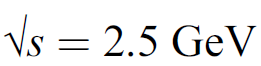
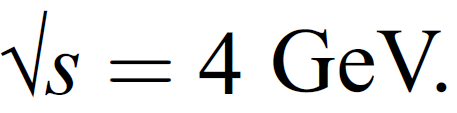
Evaluate R ≡ σ(e+ e- → hadrons) /σ(e+ e- → μ+ μ-)At and at Vs = 2.5 GeV Vs = 4 GeV.
Consider two counter-rotating beams of electrons and positrons stored in the LEP collider both with energy Ee = 100 GeV. The beam intensity slowly decays due to beam–beam interactions and various types of losses. One of the losses (very small indeed) may be the interaction of the electrons with
Consider the decays of the J/ψ into ρπ with their measured branching ratios and Determine the isospin of the J/ψ. J/y → pa pTt (1.69 ± 0.15) x 10-2 all J/w → p°z° 0_0 (0.56 + 0.07) × 10-2 all
Determine the charge conjugation, the lowest value of the orbital momentum and the isospin of the 2π systems in the decays (a) η → π+ π- γ, (b) ω → π+ π- γ and (c) ρ0 → π+ π- γ. State also the ΔI in the decay. (d) State whether the following decays are
Is the decay ω → π+π- allowed by strong interactions? Is it allowed by electromagnetic interactions?
Weakly decaying negative particles may live long enough to come to rest in matter and be captured by a nucleus. Consider the simplest case of the capture by a proton. (a) Evaluate the Bohr radius for the μ ̅ p system (muonium), the π ̅ p system (pionium), the K ̅ p system (kaonium) and
Calculate the energy threshold (Eγ) for the photon conversion into e+e- pair in the electric field of (1) an oxygen nucleus, (2) an electron and (3) for the post production of a μ+μ- pair in the field of a proton. In any case the photon, which has mass equal to zero converts in a pair of mass
If no threshold is crossed α-1 (Q2) is a linear function of ln (|Q|2/μ2) . What is the ratio between the quark and lepton contributions to the slope of this linear dependence for 4 < Q2 < 10 GeV2?
Consider the narrow resonance ϒ (mϒ = 9.460 GeV) that was observed at the e+e- colliders in the channels e+e-→μ+μ- and in e+e-→hadrons. Its width is ΓΥ = 54 keV. The measured ‘peak areas’ are In the Breit–Wigner approximation calculate the partial widths Γμ and Γh.
Calculate the cross-sections of the processes e+e- →μ+μ- and e+e- → hadrons at the J/ψ peak (mψ = 3.097 GeV) and for the ratio of the former to its value in the absence of resonance. Neglect the masses and use the Breit–Wigner approximation [Γe/Γ = 5.9%, Γh/Γ = 87.7%].
Give the values that the cross-section of e+e-→μ+μ- would have in the absence of resonance at the ρ, the ψ, the ϒ and the Z. What is the fraction of the angular cross section θ > 90°?
Draw the diagrams at the next to the tree order for the Compton scattering [in total 17].
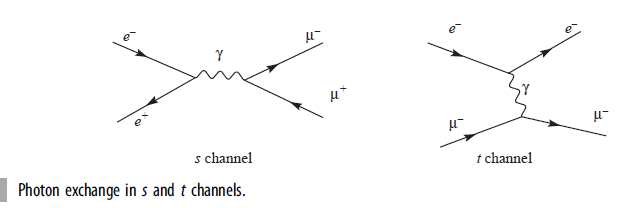
Consider the process e+ + e- → μ+ + μ- at energies much larger than the masses. Evaluate the spatial distance between the two vertices of the diagram Fig. 5.19in the CM reference frame and in the reference frame in which the electron is at rest. s channel t channel Photon exchange in s and t
Calculate the energy difference due to the spin–orbit coupling between the levels P3/2 and P1/2 for n = 2 and n = 3 for the hydrogen atom [Rhc=13.6 eV].
Evaluate the order of magnitude of the radius of the hydrogen atom.
Estimate the speeds of an atomic electron, a proton in a nucleus, and a quark in a nucleon.
Find the threshold energy needed to produce Ω0c (ssc) with a π– or a K– or a K+ beam on a hydrogen target.
Find the threshold energy needed to produce Σ c++ (uuc) with a π– beam on a hydrogen target.
Find the threshold energy needed to produce Λb(udb) with a π– beam on a hydrogen target.
Find the possible values of isospin, parity, charge conjugation, G-parity and spin, up to J = 2, for a ρ0π0 state.
Find the possible values of isospin, parity, charge conjugation, G-parity and total angular momentum J, up to J = 2, for a ρ0ρ0 state. For each value of J specify also the orbital momentum L and the total spin S.
Which of the following reactions is allowed or forbidden by strong interactions? Specify the reason(s) in each case.(a) π- + p → K̅0 + Σ0,(b) π- + p → Ω- + K+ + K0 + π0,(c) π+ + p → Λ + K+ + π+,(d) π- + p → Ξ- + K+ + K0,(e) π- + p → Λ + π-,(f) Ξ0 → Σ+ + π- ,(g) Ξ-
Which of the following reactions is allowed or forbidden by strong interactions? Specify the reason(s) in each case.(a) π - + p → K- + Σ+,(b) π- + p → K0 + Λ,(c) π+ + p → K0 + Σ+,(d) Λ → Σ- + π+,(e) K- + p → K0 + n,(f) Ξ- → Λ + π-,(g) Ω- → Ξ- + π0.
A ‘beauty factory’ is (in particle physics) a high-luminosity electron–positron collider dedicated to the study of the e+e → B0B̅0 process. Its centre of mass energy is at the ϒ(41S3) resonance, namely at 10 580 MeV. This is only 20 MeV above the sum of the masses of the two Bs. Usually,
Consider the cross-section of the process e+e– → f +f – as a function of the centre of mass energy √s near a resonance of mass MR and total width Γ. Assuming that the Breit–Wigner formula correctly describes its line shape, calculate its integral over energy (the ‘peak area’). Assume
Consider a D0 meson produced with energy E = 20 GeV. We wish to resolve its production and the decay vertices at least in 90% of cases. What spatial resolution will we need? Mention adequate detectors.
The mass of the J/ψ is mJ = 3.097 GeV and its width is Γ = 91 keV. What is its lifetime? If it is produced with pJ = 5 GeV in the L reference frame, what is the distance travelled in a lifetime? Consider the case of a symmetric J/ψ → e+e– decay, i.e. with the electron and the positron at
Consider the following quantum number combinations, with, in every case B = 0 and T = 0: Q, S, C, B = 1, 0, 1, 0; Q, S, C, B = 0, 0, –1, 0; Q, S, C, B = 1, 0, 0, 1; Q, S, C, B = 1, 0, 1, 1. Define its valence quark contents.
Consider the following quantum number combinations, with, in every case B = 1 and T = 0: Q, C, S, B = –1, 0, –3, 0; Q, C, S, B = 2, 1, 0, 0; Q, C, S, B = 1, 1, –1, 0; Q, C, S, B = 0, 1, –2, 0; Q, C, S, B = 0, 0, 0, –1. Define its valence quark contents.
A particle has baryon number B = 1, charge Q = +1, charm C = 1, strangeness S = 0, beauty B = 0, top T = 0. Define its valence quark content.
What are the possible charm (C) values of a baryon, in general? What is it if the charge is Q = 1, and what is it if Q = 0?
Knowing that the spin and parity of the deuteron are JP = 1+, give its possible states in spectroscopic notation.
Find the Dalitz plot zeros for the 3π0 states with I = 0 and JP = 0–, 1– and 1+.
Establish the possible total iso spin values of the 2π0 system.
A low-energy anti proton beam is introduced into a bubble chamber. Two exposures are made, one with the chamber full of liquid hydrogen (to study the interactions on protons) and one with the chamber full of liquid deuterium (to study the interactions on neutrons). The beam energy is such that the
Calculate the ratios Γ (K- p+) = Γ (K̅0n)+ and Γ(π- π+) / Γ(K̅0n) for the Σ (1915) that has I = 1.
Calculate the branching ratio Γ(K*+ → K0 + π+) / Γ(K*+ → K+ + π0) assuming, in turn, that the isospin of the K* is IK* = 1/2 or IK* = 3/2.
The ρ0 has spin 1; the f 0 meson has spin 2. Both decay into π+π–. Is the π0γ decay forbidden for one of them, for both, or for none?
State the three reasons forbidding the decay ρ0 → π0π0.
The Σ (1385) hyperon is produced in the reaction K- + p → π- + Σ+ (1385), but is not observed in K+ + p→π+ + Σ+ (1385). Its width is Γ = 50 MeV; its main decay channel is π + Λ. (a) Is the decay strong or weak? (b) What are the strangeness and the isospin of the hyperon?
In a bubble chamber experiment on a K– beam a sample of events of the reaction K– + p → Λ0 + π+ + π– is selected. A resonance is detected both in the Λ0π+ and Λ0π– mass distributions. In both, the mass of the resonance is M = 1385 MeV and its width Γ = 50 MeV. It is called Σ
Find the distance travelled by a K* with momentum p = 90 GeV in a lifetime
From the observation that the strong decay ρ0→π+ π– exists but ρ0→π0 π0 does not, what information can be extracted about the ρ quantum numbers: J, P, C, G, I?
Consider the particles: ω, ϕ, Κ and η. Define which of them is a G-parity eigen state and, in this case, give the eigenvalue.
Evaluate the ratio of cross-sections σ(pp → dπ+)/σ(pn → dπ0) at the same energy.
The quark contents of the following particles are: the beauty hyperon Λb = dub, the charmed meson D0 = cū, the beauty mesons B+ = ub̅, B = ūb and B0 = db̅. Which of the following reactions are allowed: (a) π- p → D0Λb, (b) π-p → B0Λb, (c) π- p → B+
The quark contents of the following charmed particles are: The hyperon Λc is udc, the D+ meson is cd and the Dmeson is cd. Which of the following reactions are allowed: (a) π+ p → D+ p, (b) π+ p → D- Λcπ+ π+, (c) π+ p → D+ Λc, (d) π+ p → D-Λc?
Consider the following p̅p initial states: 1S0, 3S1, 1P1, 3P2, 3P1, 3P2, 1D2, 3D1, 3D2, 3D3. Establish from which of these the reaction p̅p→π+ π-can proceed if the two πs are: (1) in an S wave; (2) in a P wave; (3) in a D wave?
Consider the strong processes K̅K → π+π-(where K̅K means both K+K-and K0K0). (1) What are the possible angular momentum values if the initial total isospin is I = 0? (2) What are they if I = 1?
Establish from which initial states of the pp system amongst 1S0, 3S1, 1P1, 3P0, 3P1, 3P2, 1D2, 3D1, 3D2 and 3D3 the reaction p̅p → nπ° can proceed with parity conservation:(1) for any n; (2) for n=2.
The positronium is an atomic system made by an e- and an e+ bound by the electromagnetic force.(1) Determine the relationship that this condition imposes between the orbital momentum l, the total spin s and the charge conjugation C.(2) Determine the relationship between l, s and n which allows
A π- is captured by a deuteron d (JP = 1+) and produces the reaction π-+ d→n + n.(a) If the capture is from an S wave, what is the total spin of the two neutrons and what is their orbital momentum? (b) Show that if the capture is from a P state, the neutrons are in a singlet.
Express the ratio of cross-sections of the elastic π- p → π- p and the charge exchange π-p → π0n scatterings in terms of the isospin amplitudes A1/2 and A3/2.
Express the ratios between the cross sections of (1) Kp→π+Σ ̅ , (2) Kp→π0Σ0,(3) K ̅ p → π ̅ Σ+ in terms of the isospin amplitudes A0, A1 and A2.
Evaluate the ratio of cross-sections σ (K ̅ + He4 → Σ0H3)/σ (K ̅ + He4 → Σ ̅ He3) at the same energy
Evaluate the ratio of the cross-sections of the processes p + d→He3 + π0 and p + d →H3 + π+ at the same value of the CM energy √s (3He and 3H are an isospin doublet).
Evaluate the ratio between the cross-sections of the reactions π ̅ p → ΛK0 and π+ n → ΛK+, at the same energy.
Evaluate the ratios between the cross-sections at the same energy of (1) πp → K0Σ0, (2) π ̅ p → K+Σ-, (3) π+ p → K+Σ+, taking into account the contributions of both iso spin amplitudes A1/2 and A3/2.
Evaluate the ratios between the cross-sections of the following reactions at the same energy, assuming (unrealistically) that they proceed only through the I = 3/2 channel:π ̅ p → K0Σ0; π ̅ p → K+Σ- ; π+p → K+Σ+:
Showing 100 - 200
of 262
1
2
3
Step by Step Answers

 Get 50% OFF
Claim Now
Get 50% OFF
Claim Now




![E' = E/[1+(1 – cos 0)]](https://dsd5zvtm8ll6.cloudfront.net/si.question.images/images/question_images/1547/1/2/6/2475c3745e7de4341547108874927.jpg)