New Semester
Started
Get
50% OFF
Study Help!
--h --m --s
Claim Now
Question Answers
Textbooks
Find textbooks, questions and answers
Oops, something went wrong!
Change your search query and then try again
S
Books
FREE
Study Help
Expert Questions
Accounting
General Management
Mathematics
Finance
Organizational Behaviour
Law
Physics
Operating System
Management Leadership
Sociology
Programming
Marketing
Database
Computer Network
Economics
Textbooks Solutions
Accounting
Managerial Accounting
Management Leadership
Cost Accounting
Statistics
Business Law
Corporate Finance
Finance
Economics
Auditing
Tutors
Online Tutors
Find a Tutor
Hire a Tutor
Become a Tutor
AI Tutor
AI Study Planner
NEW
Sell Books
Search
Search
Sign In
Register
study help
physics
elementary particle physics
Introduction to Elementary Particle Physics 2nd edition Alessandro Bettini - Solutions
For each of the following reactions establish whether it is allowed or not; if it is not, give the reasons.(a) p → n+e+;(b) μ+→ νμ + e+;(c) e++e→ νμ + νμ;(d) νμ + p → μ++ n(e) νμ + n → μ- + p;(f) νμ + n → e-+ p;(g) e++n → p + νe;(h)
Which of the following processes is allowed and which forbidden by strangeness conservation?(a) π- + p → K+ +p;(b) π- + p → K+ + Σ-;(c) K- p → K+ + Ξ0 + π-;(d) K+ + p → K- + Ξ0 + π -.
Give the reasons forbidding each of the following decays: (a) n → p + e-; (b) n → π+ + e-; (c) n → p + π- ; (d) n → p + γ.
For each of the following reactions establish whether it is allowed or not; if it is not, give the reasons:(1) μ+→e+ + γ;(2) e → νe + γ;(3) p + p→ Σ+ K+;(4) p+p → p+Σ+ + K-;(5) p → e++ νe;(6) p+p → Λ + Σ+;(7) p + n →Λ + Σ+;(8) p + n → Ξº+ p;(9) p → n + e++
For each of the following reactions (a) establish whether it is allowed or not, (b) if it is not, give the reasons (they may be more than one), (c) give the types of interaction that allow it:(1) π-p→π0+ n;(2) π+→μ++ νμ;(3) π+→ μ+ ν̅μ;(4) π0→2γ;(5) π0→3γ;(6) e+ + e
The existence of the anti-hyperons was proven by the discovery of an anti-lambda by M. Baldo-Ceolin and D. J. Prowse in 1958. A beam of negative pions with energy Eπ = 4.6 GeV hit an emulsion stack. What is the final state containing a Λ̅ that can be produced in a π- p collision at minimum
Consider a π- beam impinging on a liquid hydrogen target. Find the threshold energy for K- production.
Consider a π+ beam of momentum p = 200 GeV at a proton accelerator facility. We can build a muon beam by letting the pion decay in a vacuum pipe. Calculate the energy range of the muons.
In 1933, Blacket and Occhialini discovered several e+e- in the electromagnetic showers from cosmic rays in a Wilson chamber. The magnetic field was B = 0.3 T. In one event both the negative and the positive tracks described arcs of radius R = 14 cm. Calculate their energy.
In the event discovered by Anderson, a positive track emerged from the lead plate with measured momentum p = 23 MeV. Calculate its kinetic energy assuming it to be: (a) a proton and (b) a positron.
In the SLAC linear accelerator electrons were accelerated up to the energy Eel = 20 GeV. To produce a high-energy photon beam a LASER beam was back scattered at 180° by the electron beam. Assuming the LASER wavelength λ = 694 nm, what was the scattered photon energy?
A photon of energy Eγ = 511 keV is scattered backwards by an electron at rest. What is the value of the energy of the scattered photon? What is the value if the target electron were moving against the photon with energy Te = 511 keV?
Calculate the energy thresholds (Eν) for the processes (1) νe + n → e- + p, (2) νμ + n → μ- + p and (3) ντ + n → τ- + p.
A hydrogen bubble chamber was exposed to a π- beam of 3 GeV momentum. We observe an interaction with secondaries that are all neutral and two V0s pointing to the primary vertex. Measuring the two tracks of one of them, we find for the positive: p = 121 MeV, θ- = -18.2° and ϕ- = 15°, and for
We wish to produce a monochromatic beam with momentum p = 20 GeV and a momentum spread Δp/p = 1%. The beam is 2 mm wide and we have a magnet with a bending power of BL = 4 Tm and a slit d = 2 mm wide. Calculate the distance l between magnet and slit.
We calculated the energy threshold for the reaction p + p → p + p + p + p on free protons as targets in Problem 1.9. Repeat the calculation for protons that are bound in a nucleus and have a Fermi momentum of pf = 150 MeV. For the incident proton use the approximation pp ⋍ Ep.
Calculate the ratio between the magnetic moments of the electron and the μ and between the electron and the τ.
Consider the decay π0→γγ in the CM. Assume a Cartesian coordinate system x*, y*, z* >, and the polar coordinates ρ*, θ*, ϕ*. In this reference frame, the decay is isotropic. Give the expression of the probability per unit solid angle, P(cosθ*, ϕ*)=dN/dΩ* of observing a photon in the
A photon converts into an e→e-1 pair in a cloud chamber with magnetic field B = 0.2 T. In this case, two tracks are observed with the same radius ρ = 20 cm. The initial angle between the tracks is zero. Find the energy of the photon.
A π+ is produced at an altitude of 30km by a cosmic ray collision with energy Eπ=5GeV. What is the distance at which the pion sees the surface of the Earth in its rest reference frame? What is the distance travelled in the Earth reference frame in a lifetime?
Two μ are produced by a cosmic ray collision at an altitude of 30 km. The two energies are E1 = 5 GeV and E2 = 5 TeV. What are the distances at which each of the muons sees the surface of the Earth in its rest reference frame? What are the distances travelled in the Earth reference frame in a
A π0 decays emitting one gamma of energy E1=150 MeV in the forward direction.What is the direction of the second gamma? What is its energy E2? What is the speed of the π0?
Consider the decay K → μ + ν. Find(a) The energy and momenta of the μ and the ν in the reference of the K at rest;(b) The maximum μ momentum in a frame in which the K momentum is 5 GeV.
Compute the energies and momenta in the CM system of the decay products of π→μ+ν.
Consider the head-on collision of two photons, γ1 and γ2, of energies E1 > E2 respectively. If γ1 is produced by a LASER of wavelength λ=690 nm, what is the minimum value of E2 to produce a positron–electron pair? Compute the velocity of the CM system at threshold as 1 - β. Calculate the
Neutrons originated from radioactive elements in the ambient have kinetic energies up to a few MeV. We want to detect such neutrons with a TPC containing 40Ar. If the neutron energy is low enough, the internal structure of the nucleus is not resolved and it appears as a single object to the neutron
Portable neutron generators are commercially available based on the d–t fusion. These devices contain a source of deuterium ions, an accelerator that accelerate the ions up to about Td=130 keV kinetic energy and a target in which tritium nuclei are chemically bound in a metallic compound
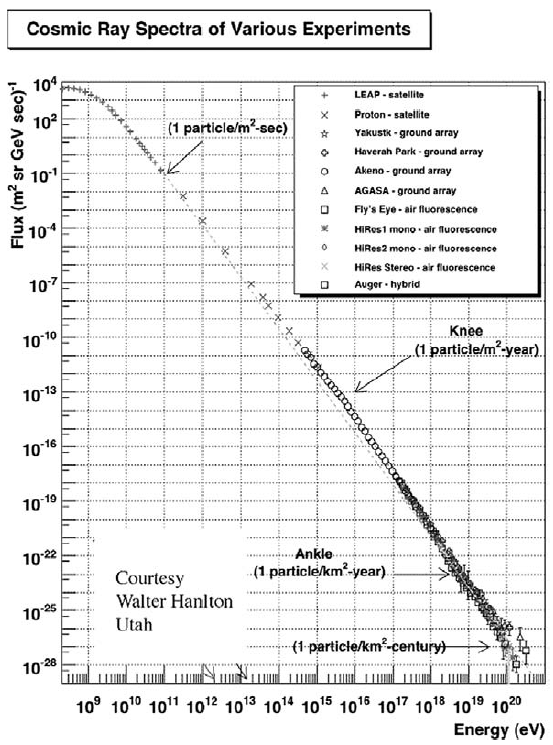
(1) What is the maximum energy of a cosmic-ray proton to remain confined in the Solar System? Assume R=1013 m as the radius of the system and an average magnetic field B=1 nT.(2) What is the maximum energy to remain confined in the Galaxy (R=1021 m, B=0.05 nT)?
Consider a Cherenkov apparatus to be operated as a threshold counter. The pressure of the N2 gas it contains can be varied. The index n depends on the pressure π, measured in pascal, as n=1+3 x 10⁻⁹ π. A beam composed of π+s, K+s and protons all with momentum p crosses the counter. Knowing
Considering the Cherenkov effect in water (n¼1.33), determine: (1) the minimum velocity of a charged particle for emitting radiation, (2) the minimum kinetic energy for a proton and a pion to do so, and (3) the Cherenkov angle for a pion with energy Eπ = 400 MeV.
Superman is travelling along an avenue on Metropolis at high speed. At a crossroad, seeing that the lights are green, he continues. However, he is stopped by the police, claiming he had crossed on red. Assuming both to be right, what was Superman’s speed?
A Cherenkov counter containing nitrogen gas at pressure Π is located on a charged particle beam with momentum p = 20 GeV. The dependence of the refraction index on the pressure Π is given by the law n – 1= 3 x 10⁻⁹Π (Pa). The Cherenkov detector must see the π and not the K. In which range
Consider two particles with masses m1 and m2 and the same momentum p. Evaluate the difference Δt between the times taken to cross the distance L. Let us define the base with two scintillator counters and measure Δt with 300 ps resolution. How much must L be if we want to distinguish π from K at
We wish to measure the total π+p cross-section at 20 GeV incident momentum. We build a liquid hydrogen target (ρ = 60 kg m-3) that is l = 1 m long. We measure the flux before and after the target with two scintillation counters. Measurements are made with the target empty and with the target
In the experiment of O. Chamberlain et al. in which the antiproton was discovered, the antiproton momentum was approximately p = 1.2 GeV. What is the minimum refraction index needed in order to have the antiprotons above the threshold in a Cherenkov counter? How wide is the Cherenkov angle if n =
A particle of mass m, charge q = 1.6 x 10⁻¹⁹ C and momentum p moves in a circular orbit at a constant speed (in absolute value) in the magnetic field B normal to the orbit. Find the relationship between m, p and B.
Find the ratio between the Mott and Rutherford cross-sections for the scattering of the same particles at the same energy at 90°.
If E = 20 GeV electrons scatter elastically emerging with energy E' = 8 GeV, find the scattering angle.
An α particle beam of kinetic energy E = 6 MeV and intensity Ri = 103 s-1 goes through a gold foil (Z = 79, A = 197, ρ = 1.93 X 10⁴ kg m-3) of thickness t = 1 μm. Calculate the number of particles per unit time scattered at angles larger than 0.1 rad.
Geiger and Marsden observed that the alpha (ɑ) particles, after having hit a thin metal foil, not too infrequently bounced back. Calculate the ratio between the scattering probabilities for θ > 90° and for θ > 10°.
A proton with momentum p1 = 3 GeV elastically diffuses on a proton at rest. The diffusion angle of one of the protons in the CM is θ*ac= 10°. Find,(a) The kinematic quantities in the L frame;(b) The kinematic quantities in the CM frame;(c) The angle between the final protons directions in the L
Consider the collision of a ball on an equal ball at rest. Compute the angle between the two final directions at non-relativistic speeds.
A Λ hyperon decays as Λ → p + π- ; its momentum in the L frame is pΛ = 2 GeV. Take the direction of the Λ in the L frame as the x-axis. In the CM frame the angle of the proton direction with x is θ*p= 30. Find(a) The energy and momentum of the Λ and the π in the CM frame;(b) The
Find the expressions of the energies and momenta of the final particles of the decay M → m1 + m2 in the CM if m2 mass is zero.
Electrons with 10 GeVenergy are scattered by protons initially at rest at 30°. Find the maximum energy of the scattered electron.
Consider an electron beam of energy E= 2 GeV hitting an iron target [assume it is made of pure Fe56]. How large is the maximum four-momentum transfer?
A π- beam is brought to rest in a liquid hydrogen target. Here π0 are produced by the ‘charge exchange’ reaction π- + p → π0 + n. Find the energy of the π0, the kinetic energy of the n, the velocity of the π0 and the distance travelled by the π0 in a lifetime.
The primary beam of a synchrotron is extracted and used to produce a secondary monochromatic π- beam. One observes that at the distance l=20 m from the production target 10% of the pions have decayed. Find the momentum and energy of the pions.
A ‘charmed’ meson D0 decays D0→K- π + at a distance from the production point d=3 mm long. Measuring the total energy of the decay products one finds E=30 GeV. How long did the D live in proper time? How large is the π+ momentum in the D rest-frame?
In a monochromatic π beam with momentum pπ a fraction of the pions decays in flight as π→μνμ.We observe that in some cases the muons move backwards. Find the maximum value of pπ for this to happen.
Consider the process γ + p → p + π0 (π0 photoproduction) with the proton at rest.(a) Find the minimum energy of the photon Eγ. The Universe is filled by ‘background electromagnetic radiation’ at the temperature of T = 3 K, and photons with energy Eγ,3K ≈ 1 meV.(b) Find the
Consider the weak interaction lifetimes of π ±: τπ=26 ns, of K± : τK=12 ns and of the Λ: τΛ = 0.26 ns and compute their widths.
Evaluate the energies and momenta in the CM frame of the two final particles of the decays Λ → pπ-, Ξ- → Λπ-.
Consider a particle of mass M decaying into two bodies of masses m1 and m2. Give the expressions of the energies and of the momenta of the decay products in the CM frame.
The Universe contains two types of electromagnetic radiation:(a) the €˜micro-wave background€™ at T = 3 K, corresponding to photon energies E γ, 3K ‰ˆ 1 meV,(b) The Extra galactic Background Light (EBL) due to the stars, with a spectrum that is mainly in
In the LHC collider at CERN two proton beams collide head on with energies Ep = 7 TeV. What energy would be needed to obtain the same centre of mass energy with a proton beam on a fixed hydrogen target? How does it compare with cosmic ray energies?
The Bevatron was designed to have sufficient energy to produce antiprotons. What is the minimum energy of the proton beam for such a process? Take into account that because of baryonic number conservation the reaction is p + p → p + p + p̅ + p.
In the collision of two protons, the final state contains a particle of mass m besides the protons.(a) Give an expression for the minimum (threshold) energy Ep for the process to happen and for the corresponding momentum pp if the target proton is at rest.(b) Give the expression of the minimum
An accelerator produces an electron beam with energy E=20 GeV. The electrons diffused at θ=6° are detected. Neglecting their recoil motion, what is the minimum structure in the proton that can be resolved?
Consider the strong interaction total widths of the following mesons: ρ, Γρ=149 MeV; ω, Γω=8.5 MeV; ϕ, Γϕ=4.3 MeV; K*, ΓK*=51 MeV; J/ψ, ΓJ/ψ=93 keV; and of the baryon Δ, ΓΔ=118 MeV, and compute their lifetimes
Three protons have momenta equal in absolute value and directions at 120ο from one another. What is the mass of the system?
Estimate the energy of a Boeing 747 (mass M=400 t) at cruising speed (850 km h-1) and compare it with the energy released in a mosquito–antimosquito annihilation.
Showing 200 - 300
of 262
1
2
3
Step by Step Answers

 Get 50% OFF
Claim Now
Get 50% OFF
Claim Now