







Question: In an exponential decay function, the base of the exponent is a value between 0 and 1. Thus, for some number b > 1, the
In an exponential decay function, the base of the exponent is a value between 0 and 1. Thus, for some number b > 1, the exponential decay function can be written as
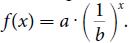
Use this formula, along with the fact that b = en, to show that an exponential decay function takes the form f (x) = a(e)−nx for some positive number n.
f(x) = a ( 1 ) .
Step by Step Solution
★★★★★
3.39 Rating (168 Votes )
There are 3 Steps involved in it
1 Expert Approved Answer
Step: 1 Unlock

The exponential decay function is fx a1b x Suppose f ... View full answer
Question Has Been Solved by an Expert!
Get step-by-step solutions from verified subject matter experts
Step: 2 Unlock
Step: 3 Unlock
 Study Help