







Question: Let (left(X_{t}, mathscr{G}_{t} ight)) be an adapted, real-valued process with right continuous paths and finite left limits. Assume that (mathbb{P}left(X_{t}-X_{s} in A mid mathscr{G}_{S} ight)=mathbb{P}left(X_{t-s}
Let \(\left(X_{t}, \mathscr{G}_{t}\right)\) be an adapted, real-valued process with right continuous paths and finite left limits. Assume that \(\mathbb{P}\left(X_{t}-X_{s} \in A \mid \mathscr{G}_{S}\right)=\mathbb{P}\left(X_{t-s} \in A\right)\) holds for all \(0 \leqslant s
Mimic Lemma 5.4 Remark. This proves that Theorem 19.35.v) entails that the counting measure has stationary independent increments.
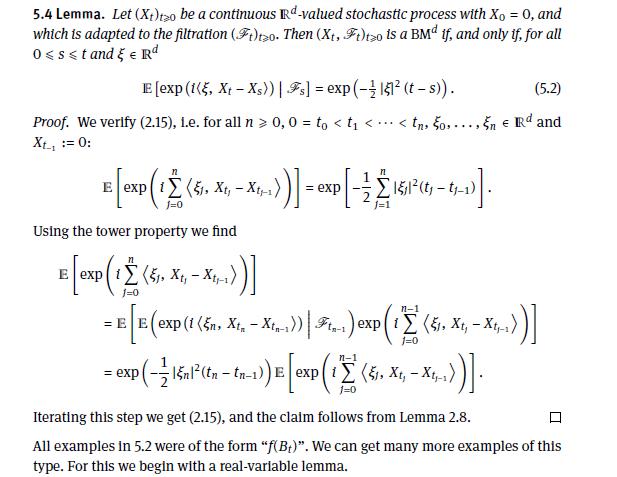
Data From Lemma 5.4
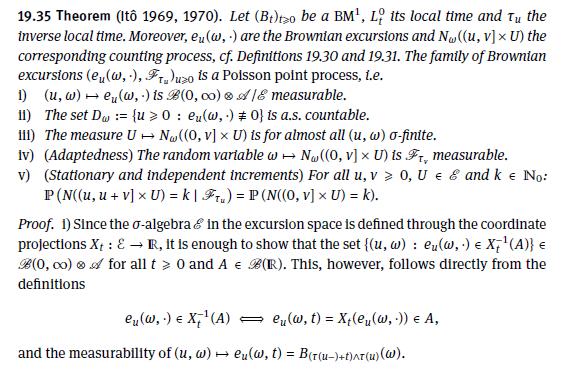
Data From Theorem 19.35
5.4 Lemma. Let (X+) to be a continuous Rd-valued stochastic process with X = 0, and which is adapted to the filtration (F)to. Then (Xt, Ft)tzo is a BMd if, and only if, for all 0 < s < t and e Rd E [exp (1, Xt - Xs)) | Fs] = exp(-11 (ts)). (5.2) Proof. We verify (2.15), 1.e. for all n > 0,0 = to )] 1-0 = exp(-Kulfite-t-1) E exp (( X-X))]. -X-1 )] Iterating this step we get (2.15), and the claim follows from Lemma 2.8. All examples in 5.2 were of the form "f(B+)". We can get many more examples of this type. For this we begin with a real-variable lemma.
Step by Step Solution
3.36 Rating (152 Votes )
There are 3 Steps involved in it

Get step-by-step solutions from verified subject matter experts
 Study Help