







Question: Emoticons (facial feedback) with e-learning. Tung and Deng (2007) studied how emoticons (computerized facial expressions) and sex influenced intrinsic motivation to complete a computer task.
Emoticons (facial feedback) with e-learning. Tung and Deng (2007) studied how emoticons
(computerized facial expressions) and sex influenced intrinsic motivation to complete a computer task. Emoticons were used as feedback for responses during the task. These faces were either static
(presented still for the duration of feedback) or dynamic (presented as a neutral face and changed to the expression corresponding to the feedback). The researchers conducted a 2 × 2 between-subjects ANOVA, with emoticon style (static, dynamic) and sex (male, female) as the factors. The F table gives the data reported in the study
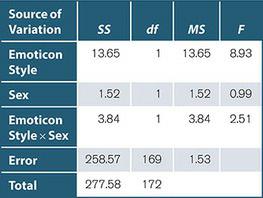
1. Is a significant main effect or interaction evident in this study and, if so, for which factor?
2. Are post hoc tests required? Explain.
Source of Variation SS df MS F Emoticon 13.65 1 13.65 8.93 Style Sex 1.52 1 1.52 0.99 Emoticon 3.84 1 3.84 2.51 Style x Sex Error 258.57 169 1.53 Total 277.58 172
Step by Step Solution
There are 3 Steps involved in it

Get step-by-step solutions from verified subject matter experts
 Study Help