







Question: The s orbital is spherical (nondirectional) because: A-the angular wave function of an s orbital is defined by the quantum number, ell. B-an s orbital
The s orbital is spherical (nondirectional) because: A-the angular wave function of an s orbital is defined by the quantum number, ell. B-an s orbital has angular nodes. C-at a particular distance from the nucleus, the electron probability is the same in all directions. D-the angular wave function for all s orbitals is a constant. E-the angular wave function of an s orbital varies with the principal quantum number (n).
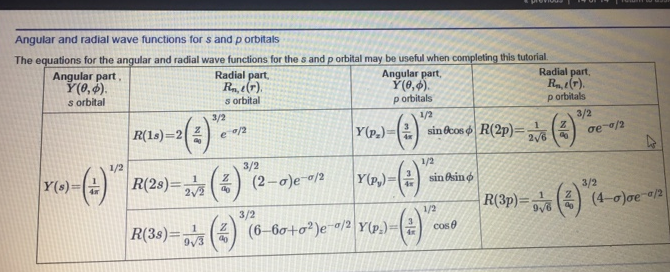
Angular and radial wave functions for s and p orbitals The equations for the angular and radial wave functions for the s and p orbital may be useful when completing this tutorial. Angular part, Y(0,0). s orbital Angular part, Y(0,0). p orbitals 1/2 R(18)=2 Y(s)= Radial part, R, (r). s orbital 3/2 e 9/2 3/2 1/2 1 -(-)" R(28)=2(4) - (-:-) 4 3/2 Y(P)- Y(P) (2-a)e-0/2 -(-)* R(38)=(2) (6-60+02)e-0/2Y(p.)- 1/2 sin cos R(2p) 26 sinsino 1/2 ()* cos Radial part, Rat(r). p orbitals R(3p)= 3/2 e-/2 3/2 (4-0)oe-0/2)
Step by Step Solution
3.48 Rating (151 Votes )
There are 3 Steps involved in it
The correct answer is C at a particular distance from the nucleus the electron proba... View full answer

Get step-by-step solutions from verified subject matter experts
Document Format (2 attachments)

609b38cbd6b67_31444.pdf
180 KBs PDF File

609b38cbd6b67_31444.docx
120 KBs Word File
 Study Help