







Question: Use the solution given in Problem 20 to rewrite the solution of Example 1 in an alternative integral form. Then use the change of variables
Use the solution given in Problem 20 to rewrite the solution of Example 1 in an alternative integral form. Then use the change of variables v = 7)/2vra and the results of Problem 11 in Exercises 14.1 to show that the solution of Example 1 can be expressed as

(reference problem 20)
In Problem use the Fourier integral transforms of this to solve the given boundary-value problem. Make assumptions about boundedness where necessary.
If
![1)]. F{f(x)} = F(a) and F{g(x)} = G(a), f. f(7)g(x 7) dr](https://dsd5zvtm8ll6.cloudfront.net/si.experts.images/questions/2022/08/6308a45685deb_7426308a4566f0cc.jpg)
then the convolution theorem for the Fourier transform is given by

Use this result and


Show that a solution of the boundary-value problem

![[erf(b) - erf(a)].](https://dsd5zvtm8ll6.cloudfront.net/si.experts.images/questions/2022/08/6308a45911d6c_7446308a458ed979.jpg)
(reference example 2)
Example 2 Using the Cosine Transform
The steady-state temperature in a semi-infinite plate is determined from
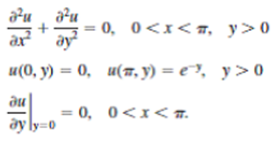
Solve for u (x, y).
(Reference problem 11 of section 14.1)

u(x, t) 120 [err ( x + 1 2kt erf (x-1 2kt 1)]. F{f(x)} = F(a) and F{g(x)} = G(a), f. f(7)g(x 7) dr = F{F(a)G(a)}. F{e-x14p} = 2mpe-pa to k u 2 at -00 < x < , t> 0 0, u(x, 0) = f(x), -0 is u(x, t) 1 2kmt. LJ f(T)e-(x-7)14kt dr. = 0, 0 0 ay ly=0 = 0, 0 VT Le du = (c 2 Show that [erf(b) - erf(a)].
Step by Step Solution
3.52 Rating (155 Votes )
There are 3 Steps involved in it
To tackle this problem we must first rewrite the solution of Example 1 in an alternative integral form using the provided information Lets proceed ste... View full answer

Get step-by-step solutions from verified subject matter experts
 Study Help