







Question: 1. 2. 3. Item 4 In the case below, the original source material is given along with a sample of student work. Determine the type
1.
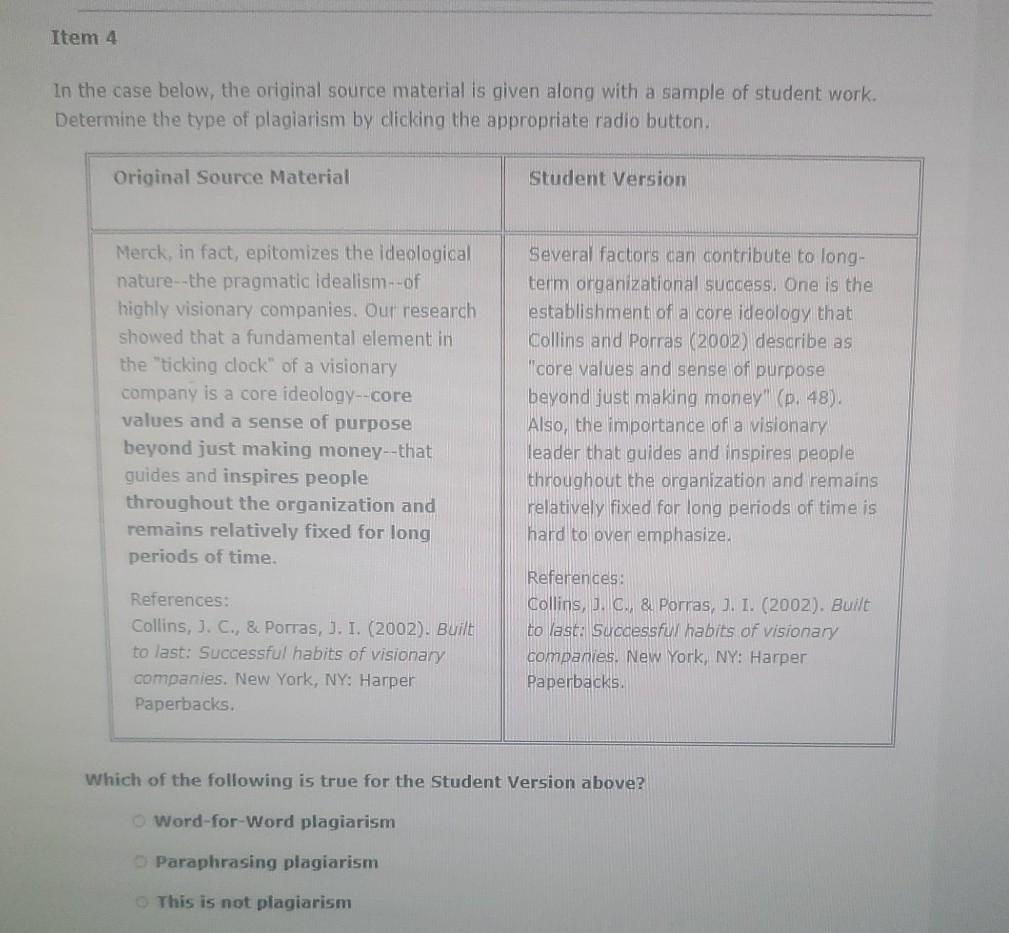
2.
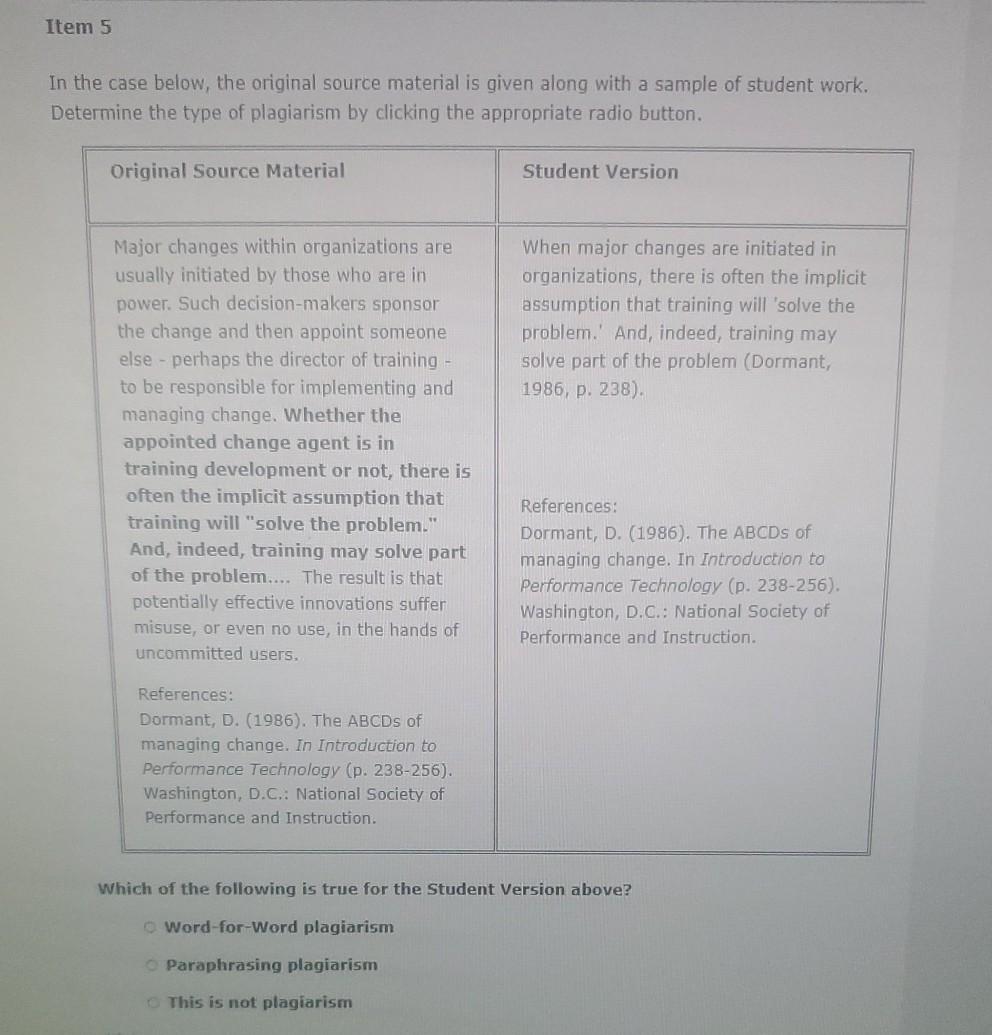
3.
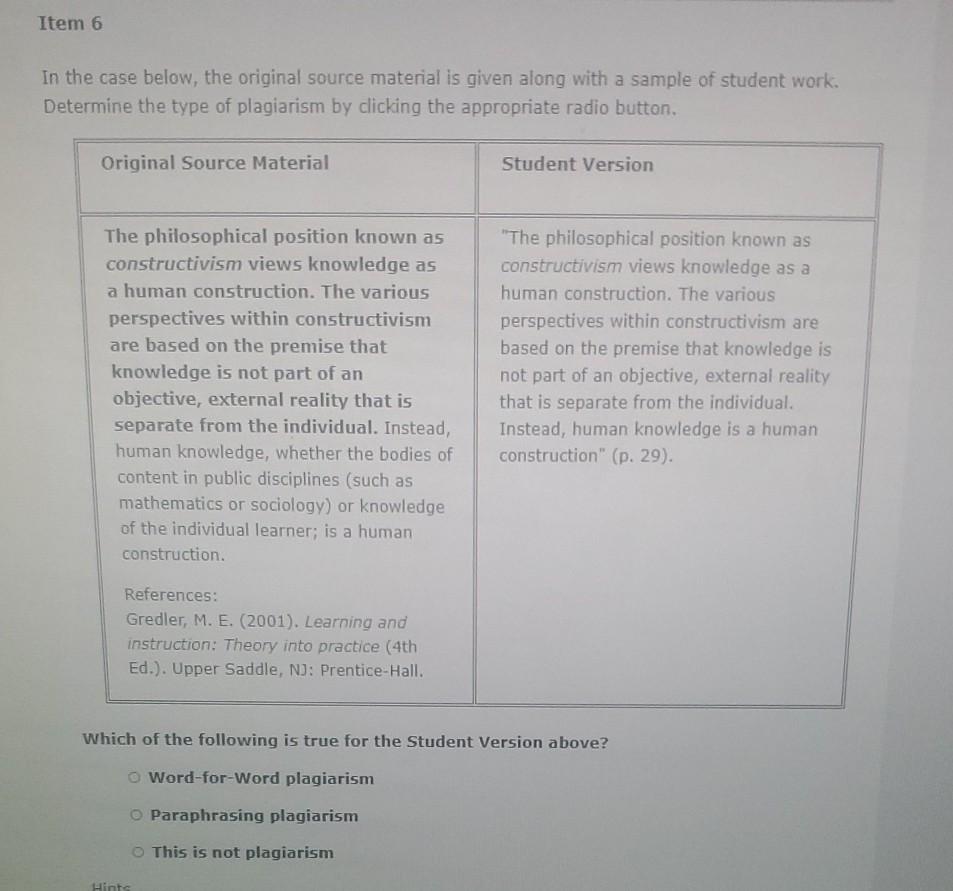
Item 4 In the case below, the original source material is given along with a sample of student work. Determine the type of plagiarism by dicking the appropriate radio button Original Source Material Student Version Merck, in fact, epitomizes the ideological nature--the pragmatic idealism--of highly visionary companies. Our research showed that a fundamental element in the "ticking clock" of a visionary company is a core ideology--core values and a sense of purpose beyond just making money--that guides and inspires people throughout the organization and remains relatively fixed for long periods of time. Several factors can contribute to long- term organizational success. One is the establishment of a core ideology that Collins and Porras (2002) describe as "core values and sense of purpose beyond just making money" (p. 48). Also, the importance of a visionary leader that guides and inspires people throughout the organization and remains relatively fixed for long periods of time is hard to over emphasize. References: Collins, J. C., & Porras, J. I. (2002). Built to last: Successful habits of visionary companies. New York, NY: Harper Paperbacks. References: Collins, J. C., & Porras, J. I. (2002). Built to last: Successful habits of visionary companies. New York, NY: Harper Paperbacks. Which of the following is true for the Student Version above? Word-for-word plagiarism Paraphrasing plagiarism This is not plagiarism Item 5 In the case below, the original source material is given along with a sample of student work. Determine the type of plagiarism by clicking the appropriate radio button. Original Source Material Student Version When major changes are initiated in organizations, there is often the implicit assumption that training will solve the problem.' And, indeed, training may solve part of the problem (Dormant, 1986, p. 238) Major changes within organizations are usually initiated by those who are in power. Such decision-makers sponsor the change and then appoint someone else - perhaps the director of training - to be responsible for implementing and managing change. Whether the appointed change agent is in training development or not, there is often the implicit assumption that training will "solve the problem." And, indeed, training may solve part of the problem.... The result is that potentially effective innovations suffer misuse, or even no use, in the hands of uncommitted users. References: Dormant, D. (1986). The ABCDs of managing change. In Introduction to Performance Technology (p. 238-256). Washington, D.C.: National Society of Performance and Instruction. References: Dormant, D. (1986). The ABCDs of managing change. In Introduction to Performance Technology (p. 238-256). Washington, D.C.: National Society of Performance and Instruction. Which of the following is true for the Student Version above? Word-for-Word plagiarism Paraphrasing plagiarism This is not plagiarism Item 6 In the case below, the original source material is given along with a sample of student work. Determine the type of plagiarism by clicking the appropriate radio button Original Source Material Student Version The philosophical position known as constructivism views knowledge as a human construction. The various perspectives within constructivism are based on the premise that knowledge is not part of an objective, external reality that is separate from the individual. Instead, human knowledge, whether the bodies of content in public disciplines (such as mathematics or sociology) or knowledge of the individual learner; is a human construction. "The philosophical position known as constructivism views knowledge as a human construction. The various perspectives within constructivism are based on the premise that knowledge is not part of an objective, external reality that is separate from the individual. Instead, human knowledge is a human construction" (p. 29). References: Gredler, M. E. (2001). Learning and instruction: Theory into practice (4th Ed.). Upper Saddle, NJ: Prentice-Hall. Which of the following is true for the Student Version above? Word-for-Word plagiarism Paraphrasing plagiarism This is not plagiarism Hinta
Step by Step Solution
There are 3 Steps involved in it
1 Expert Approved Answer
Step: 1 Unlock

Question Has Been Solved by an Expert!
Get step-by-step solutions from verified subject matter experts
Step: 2 Unlock
Step: 3 Unlock
 Study Help