







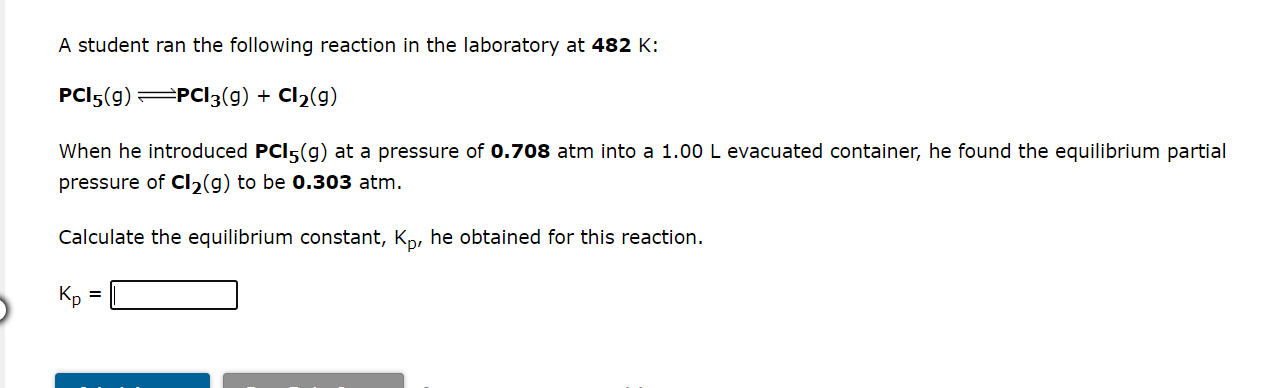
Question: 1. 2. 3. PLEASE ANSWER ALL THREE QUESTIONS AND ALL PARTS. A student ran the following reaction in the laboratory at 482K : PCl5(g)PCl3(g)+Cl2(g) When
1.
2.
3. 
PLEASE ANSWER ALL THREE QUESTIONS AND ALL PARTS.
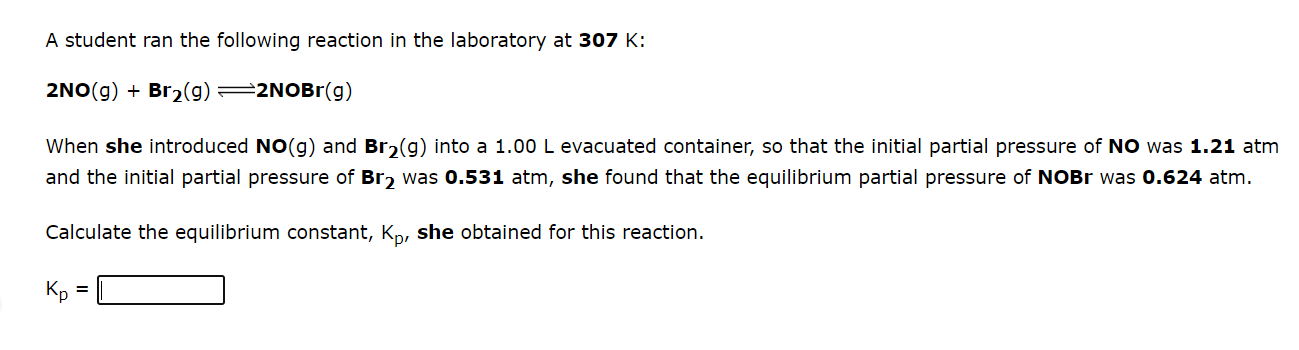
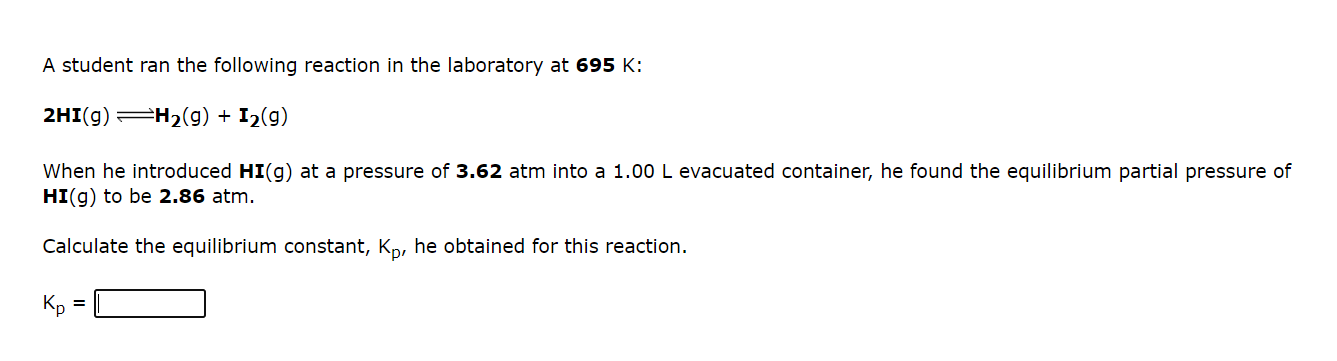
A student ran the following reaction in the laboratory at 482K : PCl5(g)PCl3(g)+Cl2(g) When he introduced PCl5(g) at a pressure of 0.708atm into a 1.00L evacuated container, he found the equilibrium partial pressure of Cl2(g) to be 0.303 atm. Calculate the equilibrium constant, Kp, he obtained for this reaction. A student ran the following reaction in the laboratory at 307K : 2NO(g)+Br2(g)2NOBr(g) When she introduced NO(g) and Br2(g) into a 1.00L evacuated container, so that the initial partial pressure of NO was 1.21 atm and the initial partial pressure of Br2 was 0.531 atm, she found that the equilibrium partial pressure of NOBr was 0.624 atm. Calculate the equilibrium constant, Kp, she obtained for this reaction. A student ran the following reaction in the laboratory at 695K : 2HI(g)H2(g)+I2(g) When he introduced HI(g) at a pressure of 3.62atm into a 1.00L evacuated container, he found the equilibrium partial pressure of HI(g) to be 2.86atm. Calculate the equilibrium constant, Kp, he obtained for this reaction. Kn=
Step by Step Solution
There are 3 Steps involved in it

Get step-by-step solutions from verified subject matter experts
 Study Help