







Question: 1. (2 pts) (a) Does the polar point (3, 3) lie on the polar curver=3 sin(20)? Explain your answer. (b) Does the origin lie
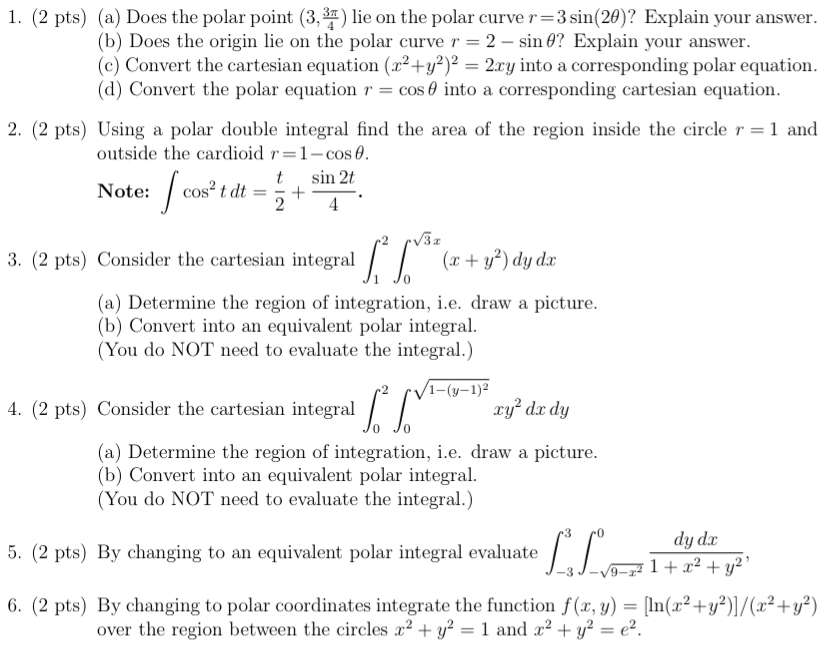
1. (2 pts) (a) Does the polar point (3, 3) lie on the polar curver=3 sin(20)? Explain your answer. (b) Does the origin lie on the polar curve r = 2 sin 0? Explain your answer. (c) Convert the cartesian equation (x+y2) = 2xy into a corresponding polar equation. (d) Convert the polar equation r = cos into a corresponding cartesian equation. 2. (2 pts) Using a polar double integral find the area of the region inside the circle r = 1 and outside the cardioid r=1-cos. t sin 2t Note: [ cos t dt = + 2 4 3x 3 3. (2 pts) Consider the cartesian integral (x + y) dy dr (a) Determine the region of integration, i.e. draw a picture. (b) Convert into an equivalent polar integral. (You do NOT need to evaluate the integral.) 4. (2 pts) Consider the cartesian integral 1-(y-1)2 xy dx dy (a) Determine the region of integration, i.e. draw a picture. (b) Convert into an equivalent polar integral. (You do NOT need to evaluate the integral.) 5. (2 pts) By changing to an equivalent polar integral evaluate LLV= dy dx 1+x+ y' 6. (2 pts) By changing to polar coordinates integrate the function f(x, y) = [ln(x+y)]/(x+ y) over the region between the circles x + y = 1 and x + y = e.
Step by Step Solution
There are 3 Steps involved in it

Get step-by-step solutions from verified subject matter experts
 Study Help