







Question: +2 Consider the function f(x) = Complete parts (a) through (c) below. 4 3 (a) Find the derivative using the quotient rule. Let u(x)
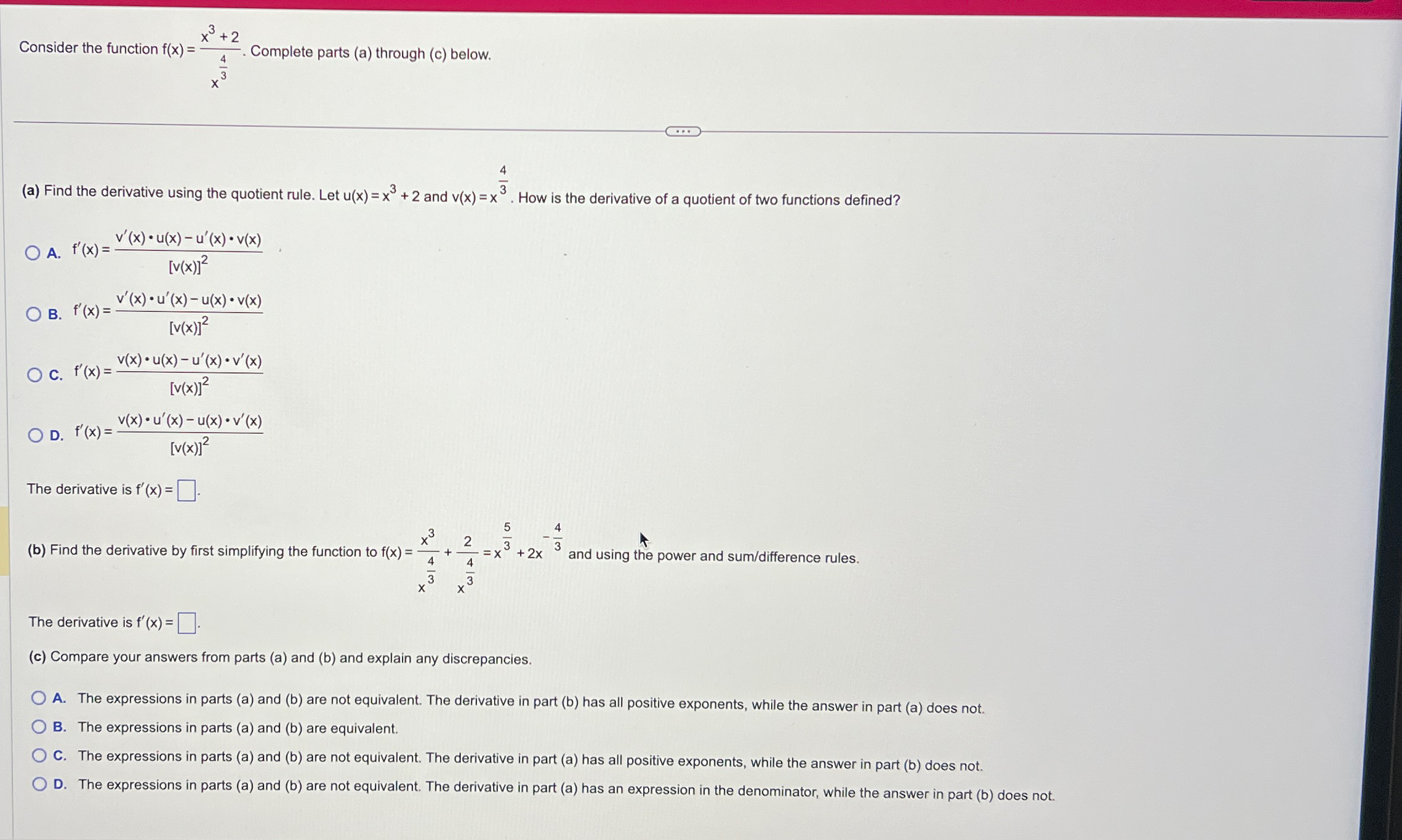
+2 Consider the function f(x) = Complete parts (a) through (c) below. 4 3 (a) Find the derivative using the quotient rule. Let u(x) = x3 + 2 and v(x)=x. How is the derivative of a quotient of two functions defined? OA. f'(x)=- v'(x) u(x)-u'(x) v(x) [v(x)] v'(x) u'(x)-u(x) v(x) OB. f'(x)= [v(x)] c. f'(x)=. v(x) u(x)-u'(x) v'(x) v(x) u'(x)-u(x) v'(x) [v(x)] D. f'(x)=. [v(x)] The derivative is f'(x) = . 5 4 3 2 3 3 (b) Find the derivative by first simplifying the function to f(x)= + =X +2x and using the power and sum/difference rules. 4 3 4 The derivative is f'(x) = . (c) Compare your answers from parts (a) and (b) and explain any discrepancies. A. The expressions in parts (a) and (b) are not equivalent. The derivative in part (b) has all positive exponents, while the answer in part (a) does not. B. The expressions in parts (a) and (b) are equivalent. C. The expressions in parts (a) and (b) are not equivalent. The derivative in part (a) has all positive exponents, while the answer in part (b) does not. D. The expressions in parts (a) and (b) are not equivalent. The derivative in part (a) has an expression in the denominator, while the answer in part (b) does not.
Step by Step Solution
There are 3 Steps involved in it

Get step-by-step solutions from verified subject matter experts
 Study Help