







Question: 1. 2. Use a graphing utility to investigate the function y = log,x. What happens for different values of b? Work with your group
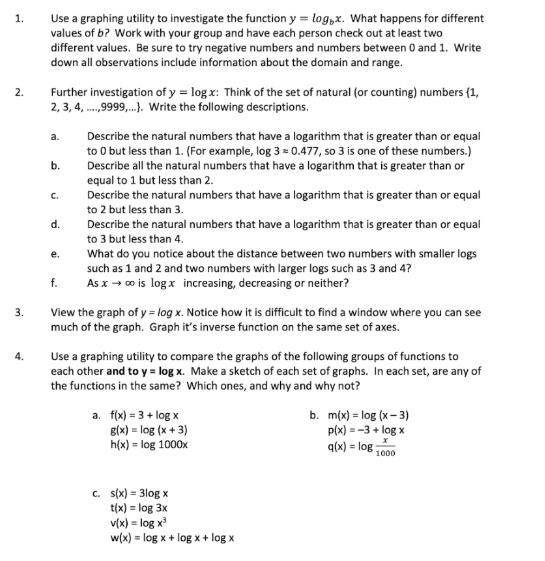
1. 2. Use a graphing utility to investigate the function y = log,x. What happens for different values of b? Work with your group and have each person check out at least two different values. Be sure to try negative numbers and numbers between 0 and 1. Write down all observations include information about the domain and range. Further investigation of y = logx: Think of the set of natural (or counting) numbers (1, 2, 3, 4.,...,.9999... Write the following descriptions. a. b. C. d. e. Describe the natural numbers that have a logarithm that is greater than or equal to 0 but less than 1. (For example, log 3 = 0.477, so 3 is one of these numbers.) Describe all the natural numbers that have a logarithm that is greater than or equal to 1 but less than 2. Describe the natural numbers that have a logarithm that is greater than or equal to 2 but less than 3. Describe the natural numbers that have a logarithm that is greater than or equal to 3 but less than 4. What do you notice about the distance between two numbers with smaller logs such as 1 and 2 and two numbers with larger logs such as 3 and 4? f. As x co is logx increasing, decreasing or neither? 3. 4. View the graph of y = log x. Notice how it is difficult to find a window where you can see much of the graph. Graph it's inverse function on the same set of axes. Use a graphing utility to compare the graphs of the following groups of functions to each other and to y = log x. Make a sketch of each set of graphs. In each set, are any of the functions in the same? Which ones, and why and why not? a. f(x)=3+log x g(x) = log(x+3) h(x) = log 1000x b. m(x) = log (x-3) p(x)=-3+ log x q(x) = log 1000 c. s(x) = 3log x t(x) = log 3x v(x) = log x w(x) = log x + logx + log x
Step by Step Solution
There are 3 Steps involved in it

Get step-by-step solutions from verified subject matter experts
 Study Help