







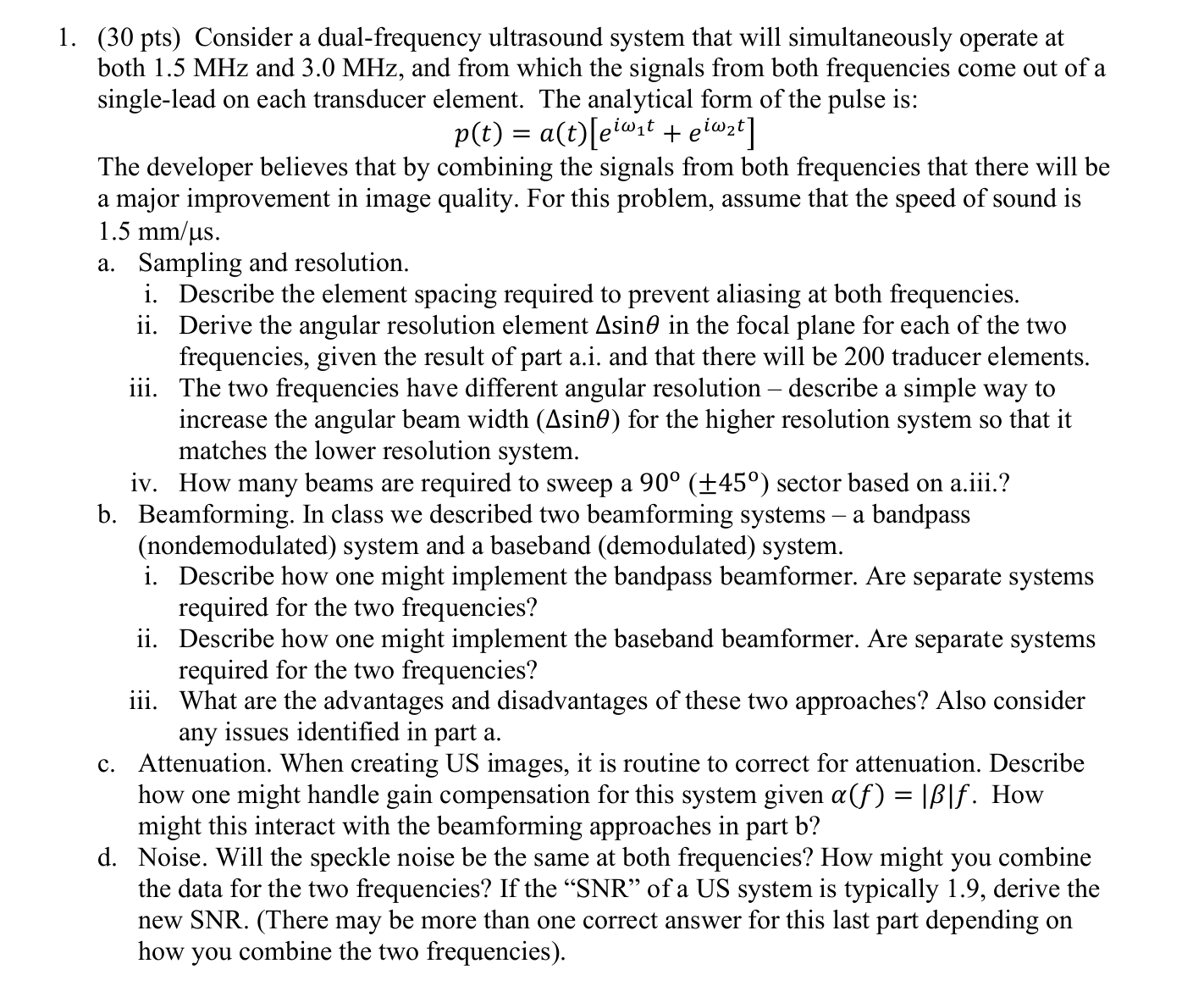
Question: 1 . ( 3 0 pts ) Consider a dual - frequency ultrasound system that will simultaneously operate at both 1 . 5 MHz and
pts Consider a dualfrequency ultrasound system that will simultaneously operate at both MHz and MHz and from which the signals from both frequencies come out of a singlelead on each transducer element. The analytical form of the pulse is:
ptatleftei omega tei omega tright
The developer believes that by combining the signals from both frequencies that there will be a major improvement in image quality. For this problem, assume that the speed of sound is mathrm~mmmu mathrms
a Sampling and resolution.
i Describe the element spacing required to prevent aliasing at both frequencies.
ii Derive the angular resolution element Delta sin theta in the focal plane for each of the two frequencies, given the result of part ai and that there will be traducer elements.
iii. The two frequencies have different angular resolution describe a simple way to increase the angular beam width Delta sin theta for the higher resolution system so that it matches the lower resolution system.
iv How many beams are required to sweep a circleftpm circright sector based on aiii.?
b Beamforming. In class we described two beamforming systems a bandpass nondemodulated system and a baseband demodulated system.
i Describe how one might implement the bandpass beamformer. Are separate systems required for the two frequencies?
ii Describe how one might implement the baseband beamformer. Are separate systems required for the two frequencies?
iii. What are the advantages and disadvantages of these two approaches? Also consider any issues identified in part a
c Attenuation. When creating US images, it is routine to correct for attenuation. Describe how one might handle gain compensation for this system given alphafbeta f How might this interact with the beamforming approaches in part b
d Noise. Will the speckle noise be the same at both frequencies? How might you combine the data for the two frequencies? If the SNR of a US system is typically derive the new SNRThere may be more than one correct answer for this last part depending on how you combine the two frequencies
Step by Step Solution
There are 3 Steps involved in it
1 Expert Approved Answer
Step: 1 Unlock

Question Has Been Solved by an Expert!
Get step-by-step solutions from verified subject matter experts
Step: 2 Unlock
Step: 3 Unlock
 Study Help