







Question: ( 1 3 points, 2 points each parts a - d , 5 points part e ) All parts refer to the same neutral atom.
points, points each parts ad points part All parts refer to the same neutral atom.
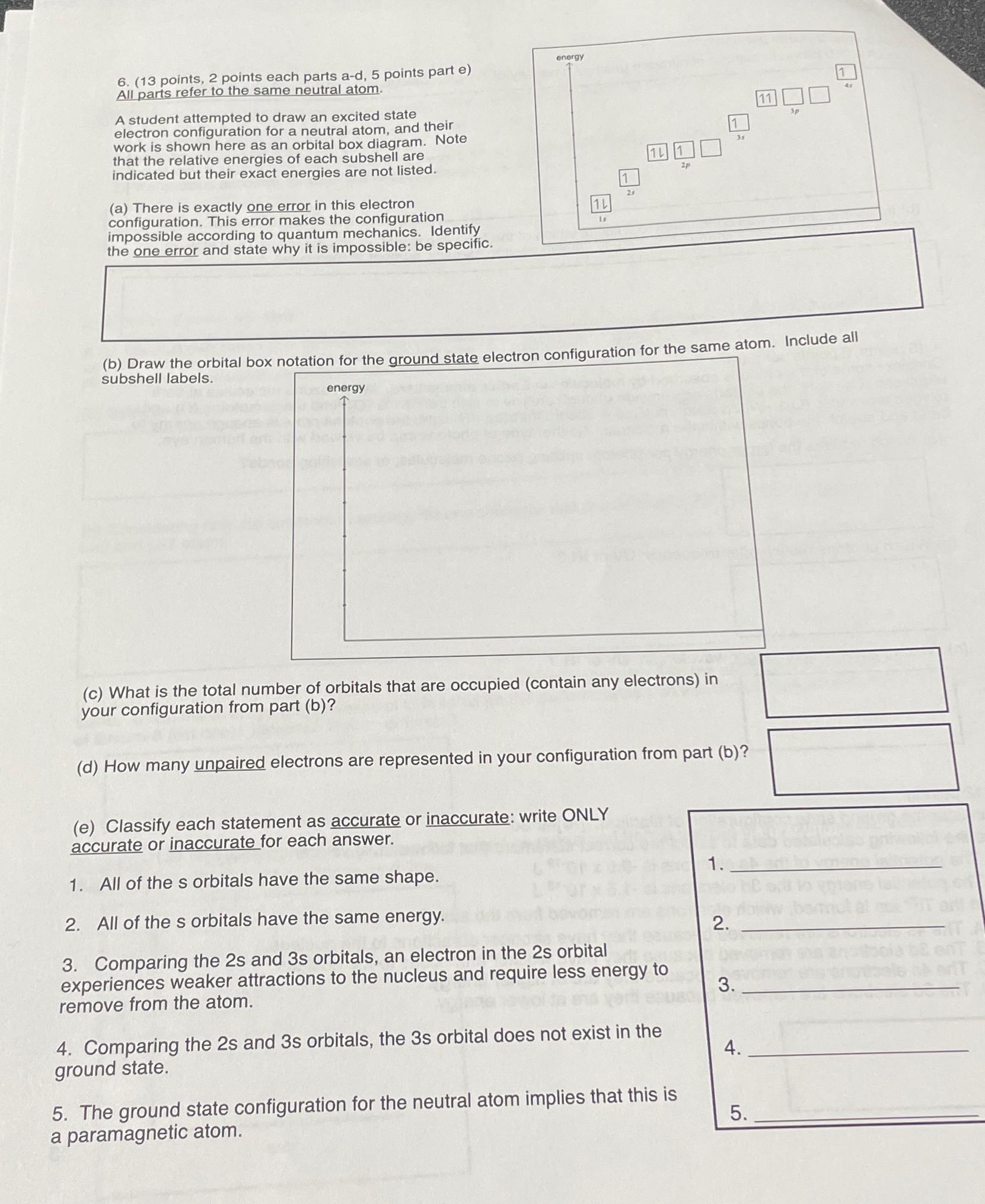
A student attempted to draw an excited state electron configuration for a neutral atom, and their work is shown here as an orbital box diagram. Note that the relative energies of each subshell are indicated but their exact energies are not listed.
a There is exactly one error in this electron configuration. This error makes the configuration impossible according to quantum mechanics. Identify the one error and state why it is impossible: be specific.
b Draw the orbital box subshell labels.
c What is the total number of orbitals that are occupied contain any electrons in your configuration from part b
d How many unpaired electrons are represented in your configuration from part b
e Classify each statement as accurate or inaccurate: write ONLY accurate or inaccurate for each answer.
All of the s orbitals have the same shape.
All of the s orbitals have the same energy.
Comparing the and s orbitals, an electron in the orbital experiences weaker attractions to the nucleus and require less energy to remove from the atom.
Comparing the and s orbitals, the orbital does not exist in the ground state.
The ground state configuration for the neutral atom implies that this is
a paramagnetic atom.
Step by Step Solution
There are 3 Steps involved in it
1 Expert Approved Answer
Step: 1 Unlock

Question Has Been Solved by an Expert!
Get step-by-step solutions from verified subject matter experts
Step: 2 Unlock
Step: 3 Unlock
 Study Help