







Question: 1. (30 points) Answer the following True (T) or False (F) questions; i.e., each question has 3 points if correct, - 2 points if incorrect,
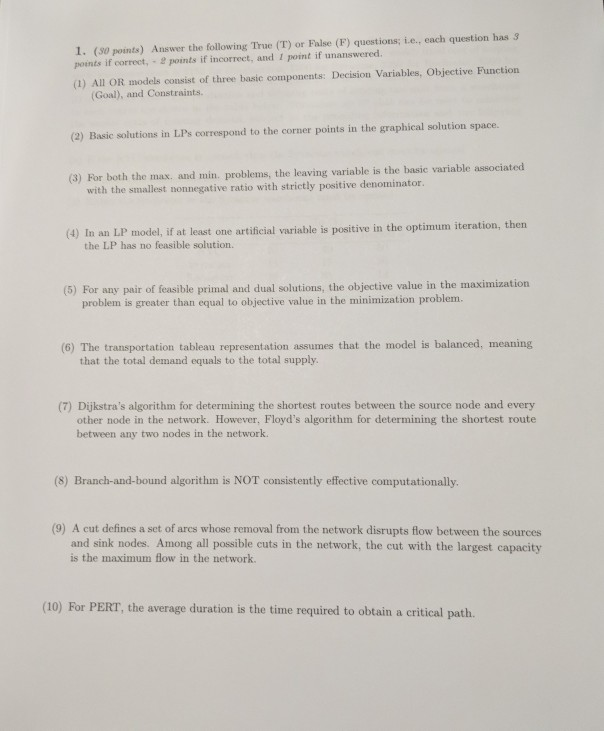
1. (30 points) Answer the following True (T) or False (F) questions; i.e., each question has 3 points if correct, - 2 points if incorrect, and I point if unanswered. (1) All OR models consist of three basic components: Decision Variables, Objective Function (Goal), and Constraints. (2) Basic solutions in LPs correspond to the corner points in the graphical solution space. (3) For both the max. and min. problems, the leaving variable is the basic variable associated with the smallest nonnegative ratio with strictly positive denominator (4) In an LP model, if at least one artificial variable is positive in the optimum iteration, then the LP has no feasible solution (5) For any pair of feasible primal and dual solutions, the objective value in the maximization problem is greater than equal to objective value in the minimization problem. (6) The transportation tableau representation assumes that the model is balanced, meaning that the total demand equals to the total supply. (7) Dijkstra's algorithm for determining the shortest routes between the source node and every other node in the network. However, Floyd's algorithm for determining the shortest route between any two nodes in the network. (8) Branch-and-bound algorithm is NOT consistently effective computationally. (9) A cut defines a set of ares whose removal from the network disrupts flow between the sources and sink nodes. Among all possible cuts in the network, the cut with the largest capacity is the maximum flow in the network. (10) For PERT, the average duration is the time required to obtain a critical path
Step by Step Solution
There are 3 Steps involved in it
1 Expert Approved Answer
Step: 1 Unlock

Question Has Been Solved by an Expert!
Get step-by-step solutions from verified subject matter experts
Step: 2 Unlock
Step: 3 Unlock
 Study Help