







Question: 1 . ( 4 0 ) Farmer John has ( bar { L } = 2 4 ) hours per day to
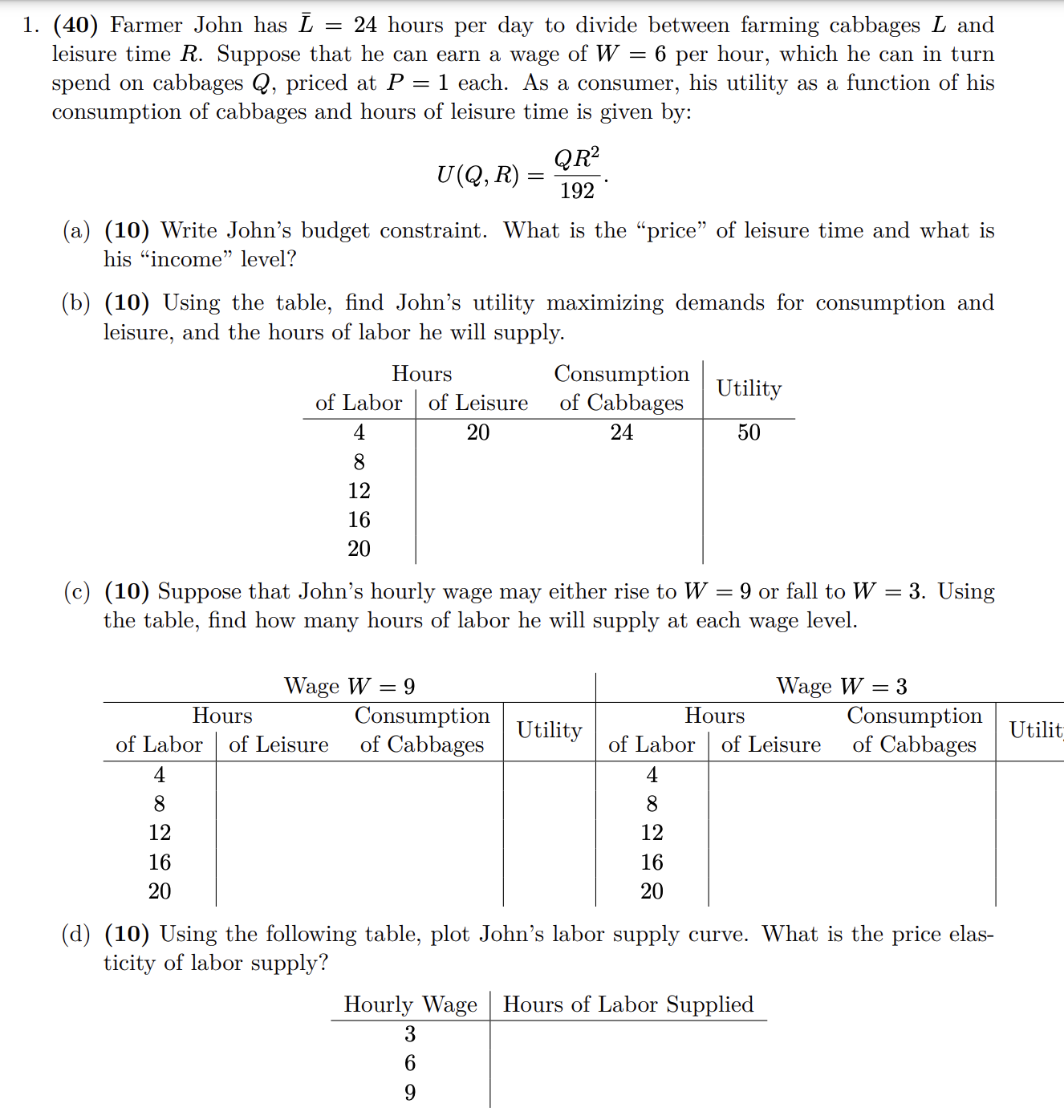
Farmer John has barL hours per day to divide between farming cabbages L and leisure time R Suppose that he can earn a wage of W per hour, which he can in turn spend on cabbages Q priced at P each. As a consumer, his utility as a function of his consumption of cabbages and hours of leisure time is given by:
UQ RfracQ R
a Write John's budget constraint. What is the "price" of leisure time and what is his "income" level?
b Using the table, find John's utility maximizing demands for consumption and leisure, and the hours of labor he will supply.
c Suppose that John's hourly wage may either rise to W or fall to W Using the table, find how many hours of labor he will supply at each wage level.
d Using the following table, plot John's labor supply curve. What is the price elasticity of labor supply?
Step by Step Solution
There are 3 Steps involved in it
1 Expert Approved Answer
Step: 1 Unlock

Question Has Been Solved by an Expert!
Get step-by-step solutions from verified subject matter experts
Step: 2 Unlock
Step: 3 Unlock
 Study Help