







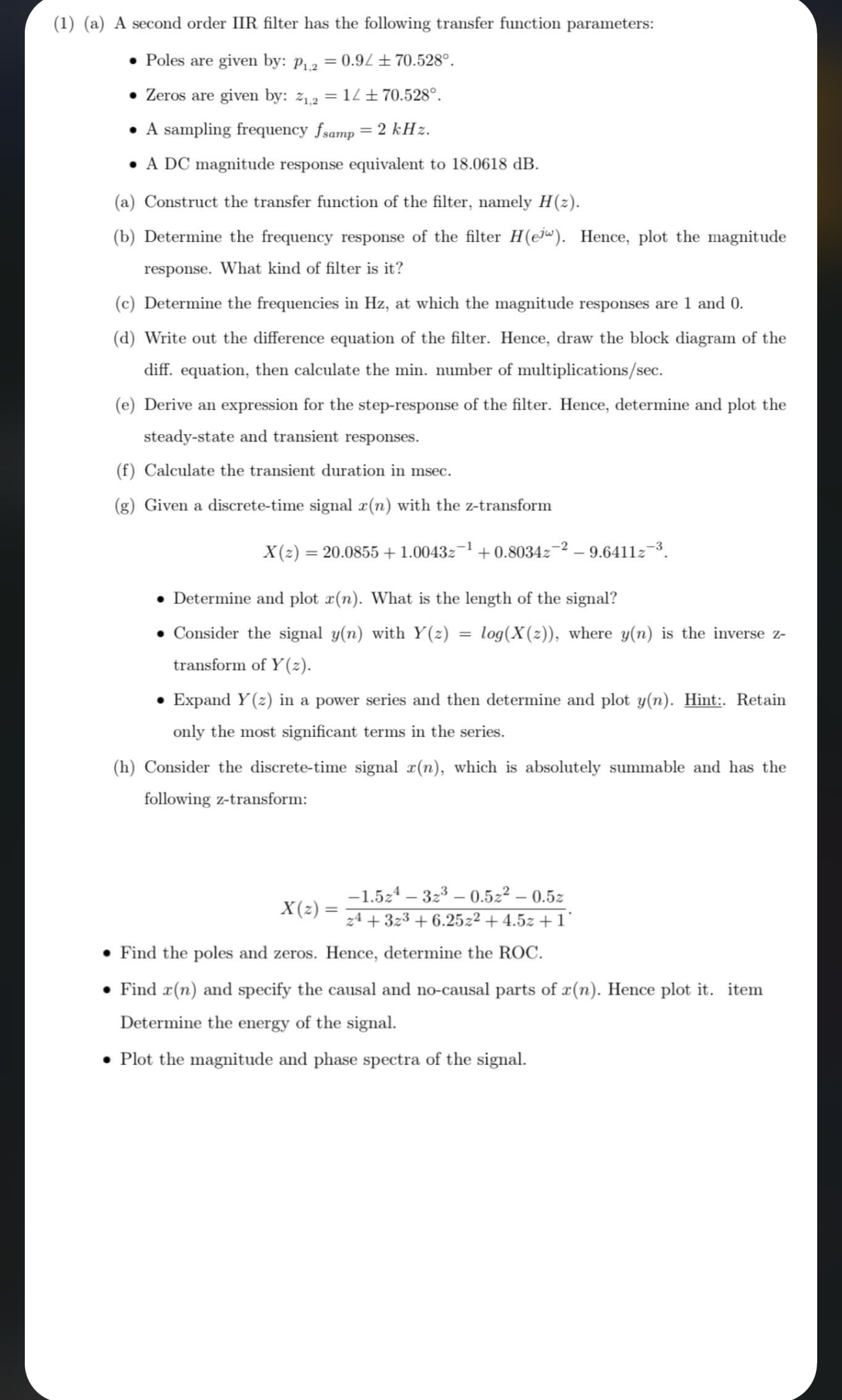
Question: ( 1 ) ( a ) A second order IIR filter has the following transfer function parameters: Poles are given by: p 1 , 2
a A second order IIR filter has the following transfer function parameters:
Poles are given by:
Zeros are given by:
A sampling frequency
A DC magnitude response equivalent to dB
a Construct the transfer function of the filter, namely
b Determine the frequency response of the filter Hence, plot the magnitude response. What kind of filter is it
c Determine the frequencies in Hz at which the magnitude responses are and
d Write out the difference equation of the filter. Hence, draw the block diagram of the diff. equation, then calculate the min. number of multiplicationssec
e Derive an expression for the stepresponse of the filter. Hence, determine and plot the steadystate and transient responses.
f Calculate the transient duration in msec.
g Given a discretetime signal with the ztransform
Determine and plot What is the length of the signal?
Consider the signal with where is the inverse ztransform of
Expand in a power series and then determine and plot Hint:. Retain only the most significant terms in the series.
h Consider the discretetime signal which is absolutely summable and has the following z transform:
Find the poles and zeros. Hence, determine the ROC.
Find and specify the causal and nocausal parts of Hence plot it item Determine the energy of the signal.
Plot the magnitude and phase spectra of the signal.
Step by Step Solution
There are 3 Steps involved in it
1 Expert Approved Answer
Step: 1 Unlock

Question Has Been Solved by an Expert!
Get step-by-step solutions from verified subject matter experts
Step: 2 Unlock
Step: 3 Unlock
 Study Help