







Question: 1. a ) Evaluate the definite integral tan ( x ) dx. 170 14 RC 14 tankx) dx = Jo sincx ) COS(X ) dx
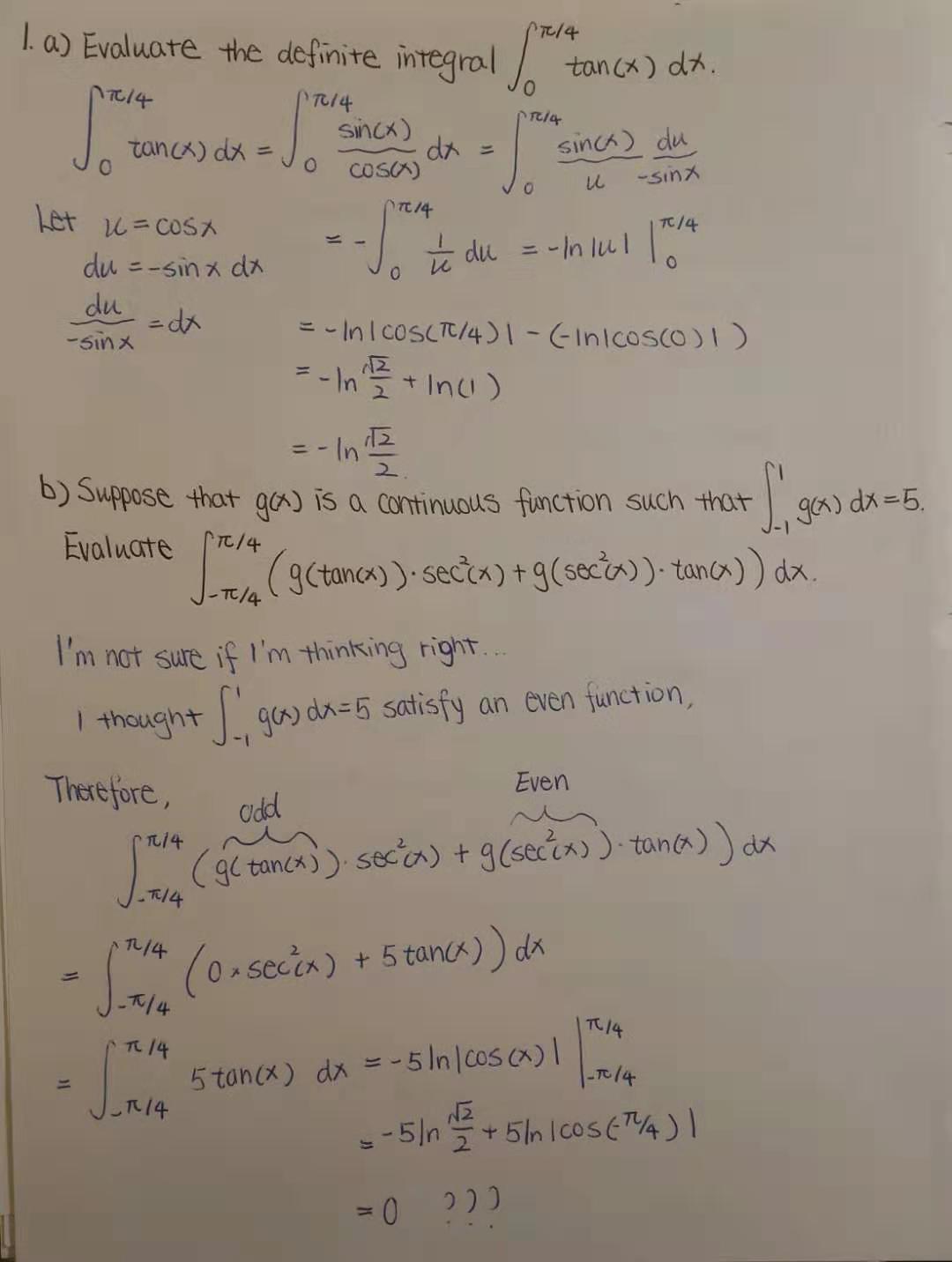
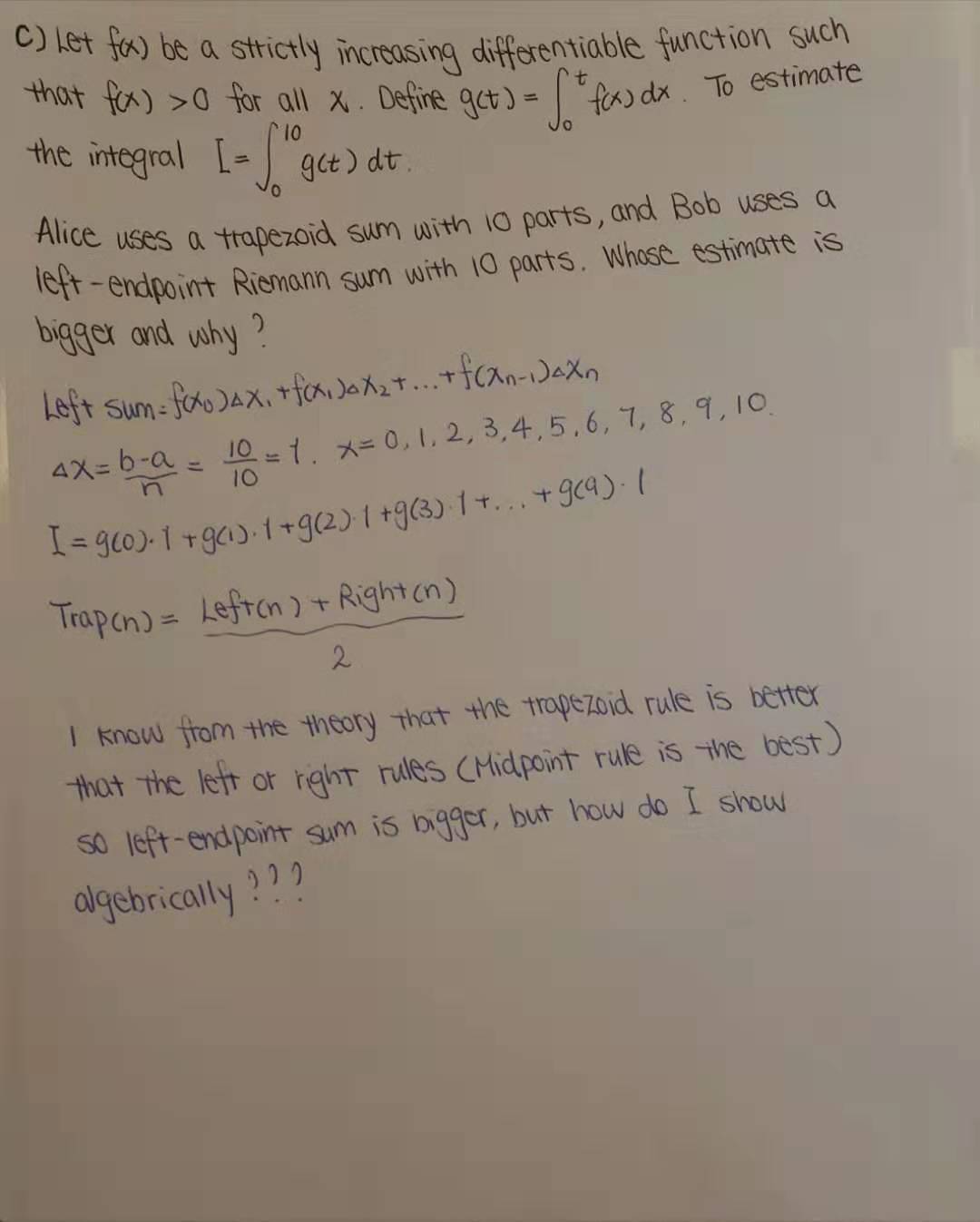
1. a ) Evaluate the definite integral tan ( x ) dx. 170 14 RC 14 tankx) dx = Jo sincx ) COS(X ) dx = since) du O u - sink Let u= cosx TC / 4 du = - sin x dx = - Is due = - Inlul to du - sin x = dx = - In / cos ( TC / 4) 1 - ( Inicosco) 1 ) = - In 7 + In(1 ) = - In 12 b ) Suppose that g(x) is a continuous function such that q(x) dx = 5. Evaluate [7 / 4 ( g ( tancx ) ) . sec ( x ) + g ( sec ( x ) ) . tan(x ) ) dx . I'm not sure if I'm thinking right .. I thought gox) dx = 5 satisfy an even function, Therefore , Even odd 16/ 4 ( g ( tan ( * ) ) . sec (x ) + 9 ( sec( x) ) . tan(x ) ) ax (ox secex ) + 5 tan(x ) ) dx 76 14 1 14 = 5 tan ( x ) dx = - 5 / cos ( x ) | 1 - TC / 4 -1 14 = -5 7+5 /cos (7/4)1 = 0 "70C ) Let fax) be a strictly increasing differentiable function such that fox ) > O for all x. Define get) = fox) dx. To estimate the integral [ = / "get ) dt . Alice uses a trapezoid sum with 10 parts, and Bob uses a left- endpoint Riemann sum with 10 parts. Whose estimate is bigger and why ? Loft sum = foxo JAX, + fox, Jox2 + .. + fCan-1Jaxn 4X = 6-a _ 10= 1 x= 0, 1. 2, 3, 4. 5. 6, 7, 8, 9, 10 10 [ = gco). 1 + 9(1). 1+ 9(2). 1+ 9 (3). 1 +... + 9(9). 1 Trapch ) = Left (n ) + Right (n ) 2 I know from the theory that the trapezoid rule is better that the left or right rules ( Midpoint rule is the best) so left-endpoint sum is bigger, but how do I show algebracally
Step by Step Solution
There are 3 Steps involved in it

Get step-by-step solutions from verified subject matter experts
 Study Help