







Question: 1. A process for sintering ceramic parts leads to a small amount of water formation and weight loss. Process engineers are testing a new sintering
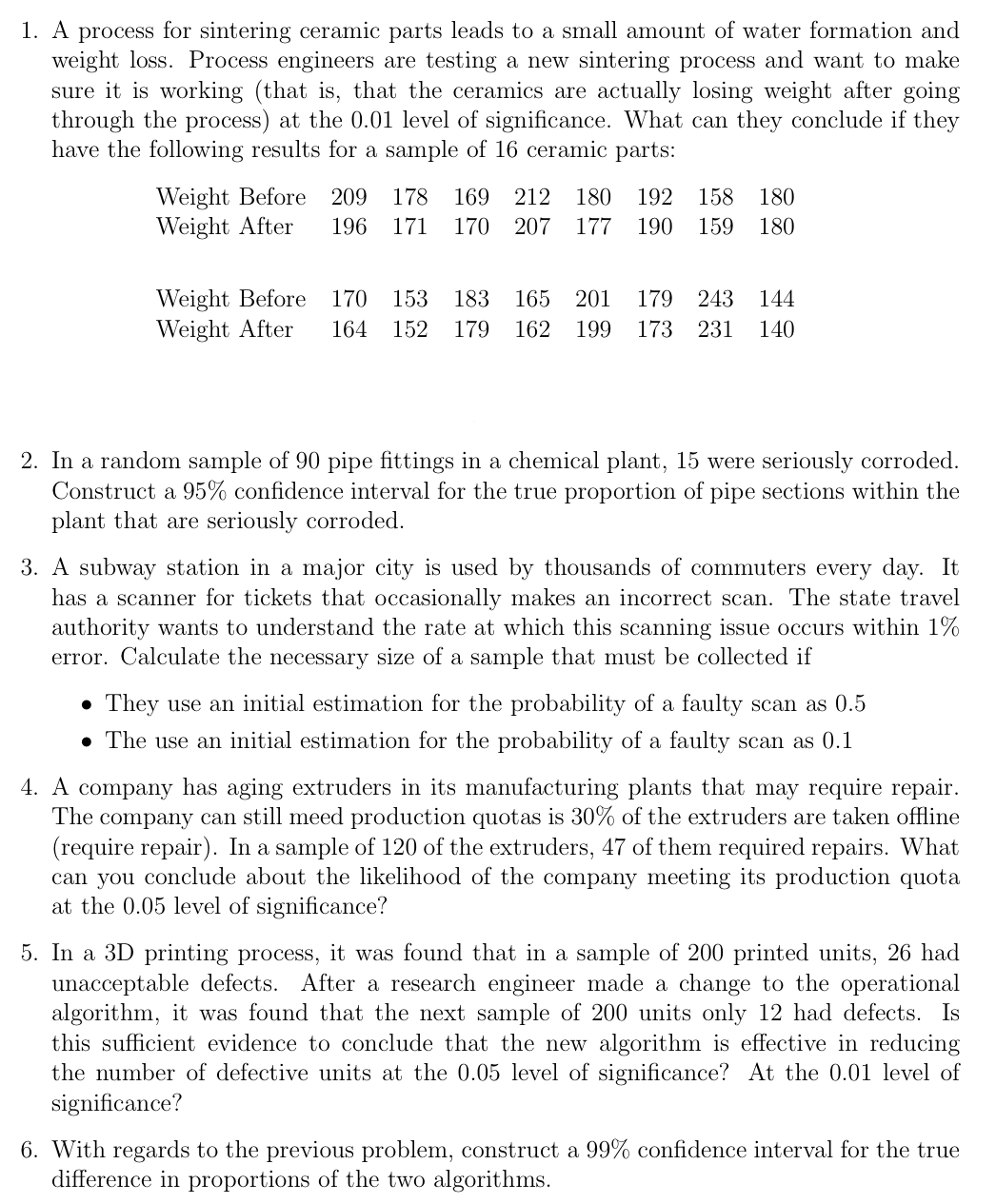
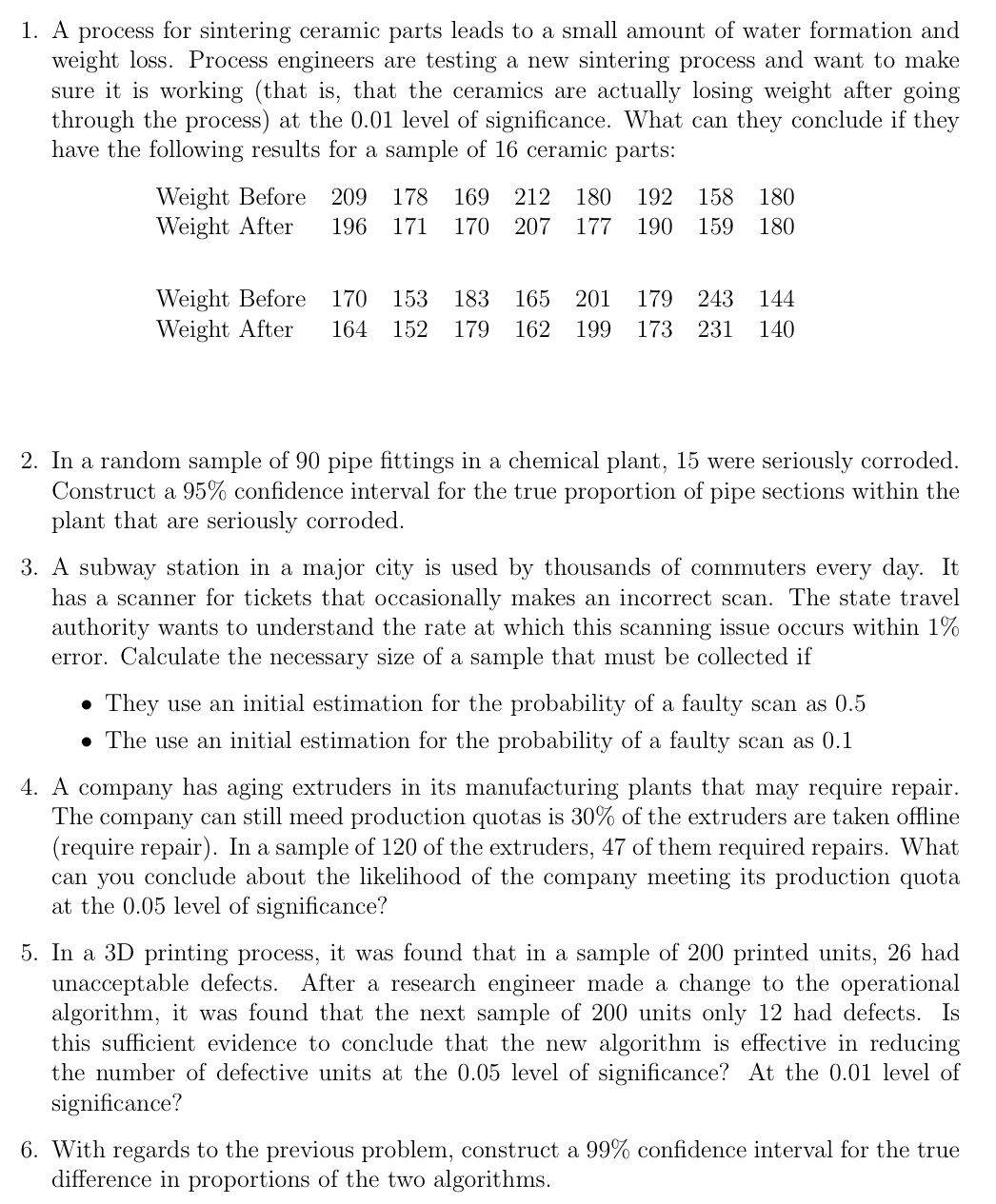
1. A process for sintering ceramic parts leads to a small amount of water formation and weight loss. Process engineers are testing a new sintering process and want to make sure it is working (that is, that the ceramics are actually losing weight after going through the process) at the 0.01 level of significance. What can they conclude if they have the following results for a sample of 16 ceramic parts: Weight Before 209 178 169 212 180 192 158 180 Weight After 196 171 170 207 177 190 159 180 Weight Before 170 153 183 165 201 179 243 144 Weight After 164 152 179 162 199 173 231 140 2. In a random sample of 90 pipe fittings in a chemical plant, 15 were seriously corroded. Construct a 95% confidence interval for the true proportion of pipe sections within the plant that are seriously corroded. 3. A subway station in a major city is used by thousands of commuters every day. It has a scanner for tickets that occasionally makes an incorrect scan. The state travel authority wants to understand the rate at which this scanning issue occurs within 1% error. Calculate the necessary size of a sample that must be collected if . They use an initial estimation for the probability of a faulty scan as 0.5 . The use an initial estimation for the probability of a faulty scan as 0.1 4. A company has aging extruders in its manufacturing plants that may require repair. The company can still meed production quotas is 30% of the extruders are taken offline (require repair). In a sample of 120 of the extruders, 47 of them required repairs. What can you conclude about the likelihood of the company meeting its production quota at the 0.05 level of significance? 5. In a 3D printing process, it was found that in a sample of 200 printed units, 26 had unacceptable defects. After a research engineer made a change to the operational algorithm, it was found that the next sample of 200 units only 12 had defects. Is this sufficient evidence to conclude that the new algorithm is effective in reducing the number of defective units at the 0.05 level of significance? At the 0.01 level of significance? 6. With regards to the previous problem, construct a 99% confidence interval for the true difference in proportions of the two algorithms
Step by Step Solution
There are 3 Steps involved in it

Get step-by-step solutions from verified subject matter experts
 Study Help