







Question: 1. A statement is a sentence which a. asks a question. b. has truth-value. c. commands you to do something. d. expresses emotion. 2.
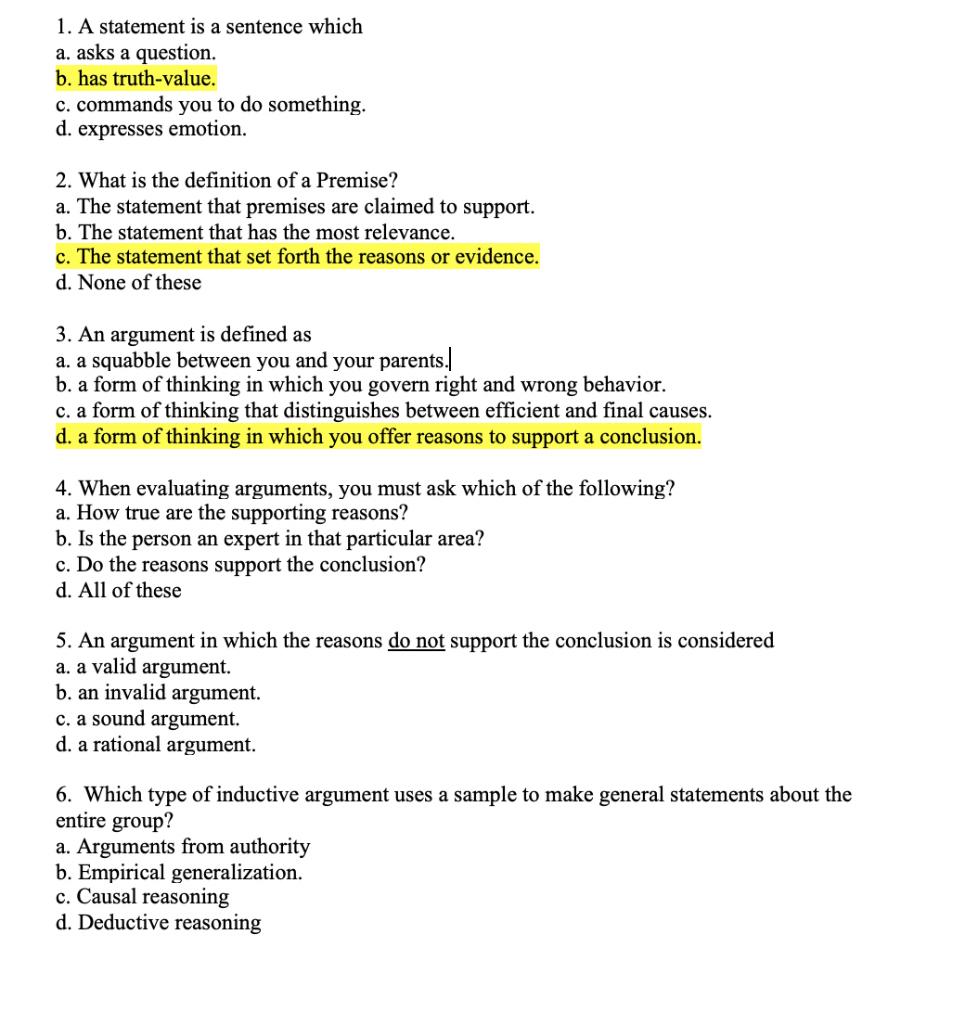
1. A statement is a sentence which a. asks a question. b. has truth-value. c. commands you to do something. d. expresses emotion. 2. What is the definition of a Premise? a. The statement that premises are claimed to support. b. The statement that has the most relevance. c. The statement that set forth the reasons or evidence. d. None of these 3. An argument is defined as a. a squabble between you and your parents. b. a form of thinking in which you govern right and wrong behavior. c. a form of thinking that distinguishes between efficient and final causes. d. a form of thinking in which you offer reasons to support a conclusion. 4. When evaluating arguments, you must ask which of the following? a. How true are the supporting reasons? b. Is the person an expert in that particular area? c. Do the reasons support the conclusion? d. All of these 5. An argument in which the reasons do not support the conclusion is considered a. a valid argument. b. an invalid argument. c. a sound argument. d. a rational argument. 6. Which type of inductive argument uses a sample to make general statements about the entire group? a. Arguments from authority b. Empirical generalization. c. Causal reasoning d. Deductive reasoning
Step by Step Solution
3.43 Rating (156 Votes )
There are 3 Steps involved in it
ANSWER 1 D Expresses emotion Emotions can be expressed verbally through words and tone of voice or by using nonverbal communication including the use of body language or facial expressions Body langua... View full answer

Get step-by-step solutions from verified subject matter experts
 Study Help