







Question: 1- According to your case, what is commoditization? 2- What are some examples of commoditizated products highlighted in the case? 3- What is commoditization the
1- According to your case, what is commoditization?
2- What are some examples of commoditizated products highlighted in the case?
3- What is commoditization the result of?
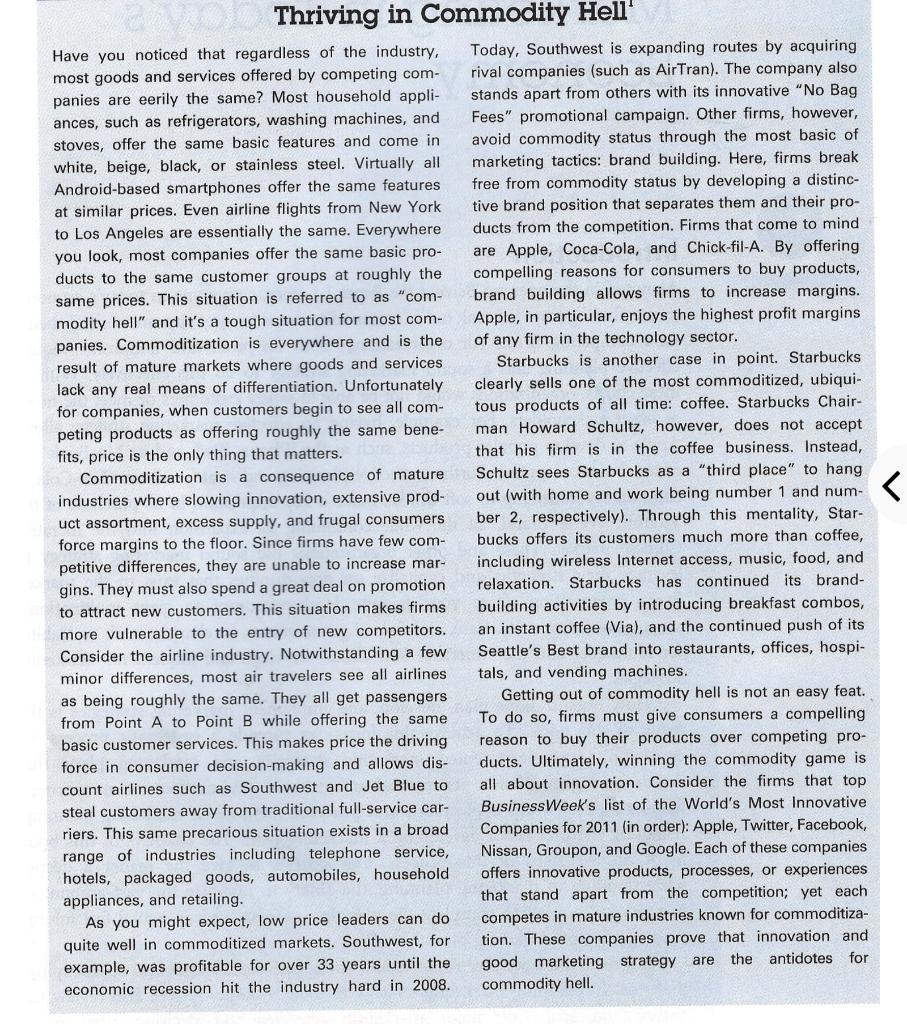
Thriving in Commodity Hell! Have you noticed that regardless of the industry, most goods and services offered by competing com- panies are eerily the same? Most household appli- ances, such as refrigerators, washing machines, and stoves, offer the same basic features and come in white, beige, black, or stainless steel. Virtually all Android-based smartphones offer the same features at similar prices. Even airline flights from New York to Los Angeles are essentially the same. Everywhere you look, most companies offer the same basic pro- ducts to the same customer groups at roughly the same prices. This situation is referred to as "com- modity hell" and it's a tough situation for most com- panies. Commoditization is everywhere and is the result of mature markets where goods and services lack any real means of differentiation. Unfortunately for companies, when customers begin to see all com- peting products as offering roughly the same bene- fits, price is the only thing that matters. Commoditization is a consequence of mature industries where slowing innovation, extensive prod- uct assortment, excess supply, and frugal consumers force margins to the floor. Since firms have few com- petitive differences, they are unable to increase mar- gins. They must also spend a great deal on promotion to attract new customers. This situation makes firms more vulnerable to the entry of new competitors. Consider the airline industry. Notwithstanding a few minor differences, most air travelers see all airlines as being roughly the same. They all get passengers from Point A to Point B while offering the same basic customer services. This makes price the driving force in consumer decision-making and allows dis- count airlines such as Southwest and Jet Blue to steal customers away from traditional full-service car- riers. This same precarious situation exists in a broad range of industries including telephone service, hotels, packaged goods, automobiles, household appliances, and retailing. As you might expect, low price leaders can do quite well in commoditized markets. Southwest, for example, was profitable for over 33 years until the economic recession hit the industry hard in 2008. Today, Southwest is expanding routes by acquiring rival companies (such as Air Tran). The company also stands apart from others with its innovative "No Bag Fees" promotional campaign. Other firms, however, avoid commodity status through the most basic of marketing tactics: brand building. Here, firms break free from commodity status by developing a distinc- tive brand position that separates them and their pro- ducts from the competition. Firms that come to mind are Apple, Coca-Cola, and Chick-fil-A. By offering compelling reasons for consumers to buy products, brand building allows firms to increase margins. Apple, in particular, enjoys the highest profit margins of any firm in the technology sector. Starbucks is another case in point. Starbucks clearly sells one of the most commoditized, ubiqui- tous products of all time: coffee. Starbucks Chair- man Howard Schultz, however, does not accept that his firm is in the coffee business. Instead, Schultz sees Starbucks as a "third place" to hang out (with home and work being number 1 and num- ber 2, respectively). Through this mentality, Star- bucks offers its customers much more than coffee, including wireless Internet access, music, food, and relaxation. Starbucks has continued its brand- building activities by introducing breakfast combos, an instant coffee (Via), and the continued push of its Seattle's Best brand into restaurants, offices, hospi- tals, and vending machines. Getting out of commodity hell is not an easy feat. To do so, firms must give consumers a compelling reason to buy their products over competing pro- ducts. Ultimately, winning the commodity game is all about innovation. Consider the firms that top Business Week's list of the World's Most Innovative Companies for 2011 (in order): Apple, Twitter, Facebook, Nissan, Groupon, and Google. Each of these companies offers innovative products, processes, or experiences that stand apart from the competition; yet each competes in mature industries known for commoditiza- tion. These companies prove that innovation and good marketing strategy are the antidotes for commodity hellStep by Step Solution
There are 3 Steps involved in it
1 Expert Approved Answer
Step: 1 Unlock

Question Has Been Solved by an Expert!
Get step-by-step solutions from verified subject matter experts
Step: 2 Unlock
Step: 3 Unlock
 Study Help