







Question: 1) As a valve is opened, water flows through the diffuser shown in Figure at an increasing flowrate so that the velocity along the
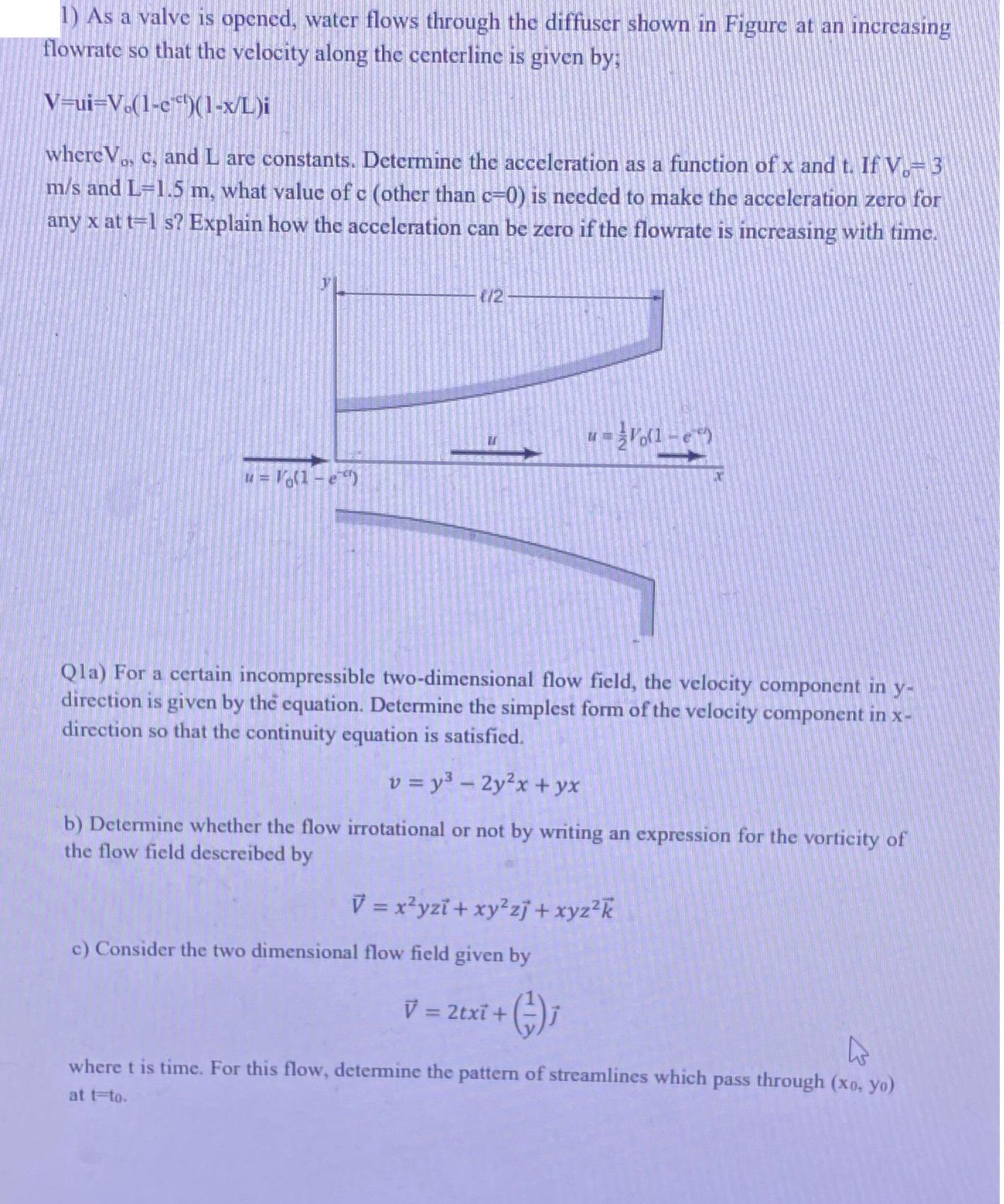
1) As a valve is opened, water flows through the diffuser shown in Figure at an increasing flowrate so that the velocity along the centerline is given by; V-ui-V.(1-c)(1-x/L)i where V., c, and L are constants. Determine the acceleration as a function of x and t. If V. 3 m/s and L=1.5 m, what value of c (other than c-0) is needed to make the acceleration zero for any x at t-1 s? Explain how the acceleration can be zero if the flowrate is increasing with time. u= (1-e 1/2 K c) Consider the two dimensional flow field given by (-); =(1-6) Qla) For a certain incompressible two-dimensional flow field, the velocity component in y- direction is given by the equation. Determine the simplest form of the velocity component in x- direction so that the continuity equation is satisfied. v=y - 2yx + yx b) Determine whether the flow irrotational or not by writing an expression for the vorticity of the flow field descreibed by V = xyzi + xyzj+xyzk V = 2txi + X 4 where t is time. For this flow, determine the pattern of streamlines which pass through (xo, yo) at t-to.
Step by Step Solution
3.51 Rating (168 Votes )
There are 3 Steps involved in it
a To determine the acceleration as a function of x and t we need to differentiate the given velocity equation with respect to time t Lets denote the v... View full answer

Get step-by-step solutions from verified subject matter experts
 Study Help