







Question: 1. Based on the knowledge you have learned from this course, make ONE recommendation on how you think the Company should proceed? Be sure to
 1. Based on the knowledge you have learned from this course, make ONE recommendation on how you think the Company should proceed? Be sure to include why your recommendation is necessary and why it would work? Link to Strategy.
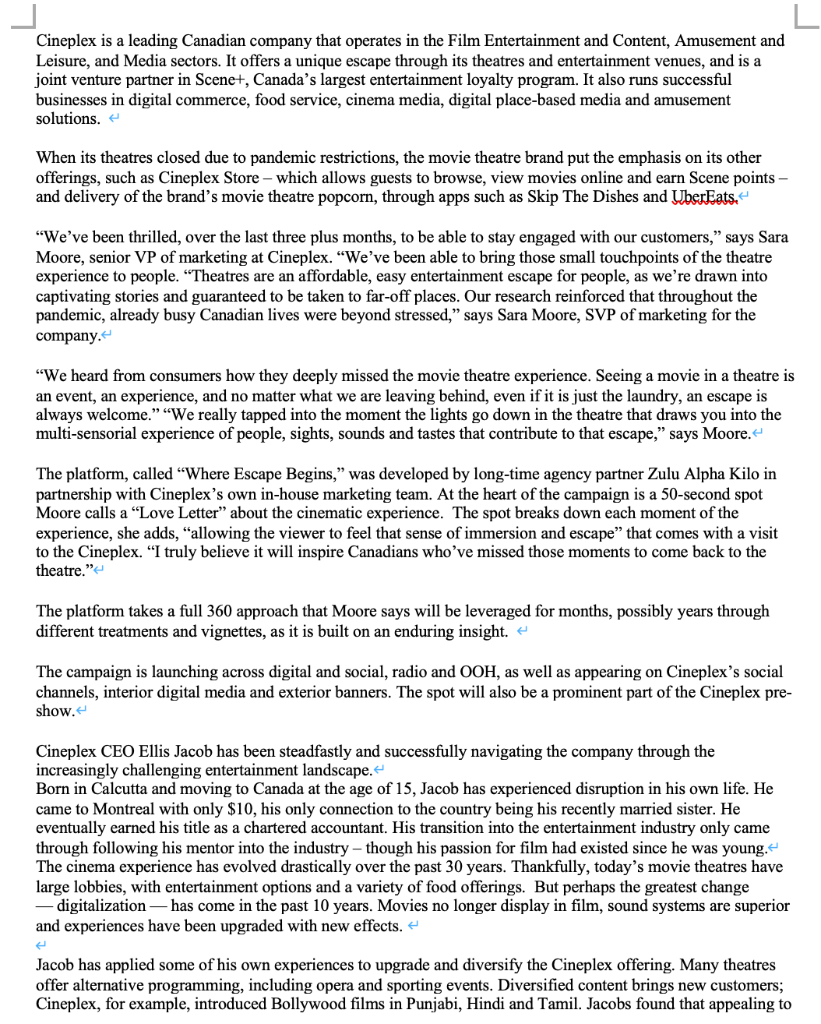
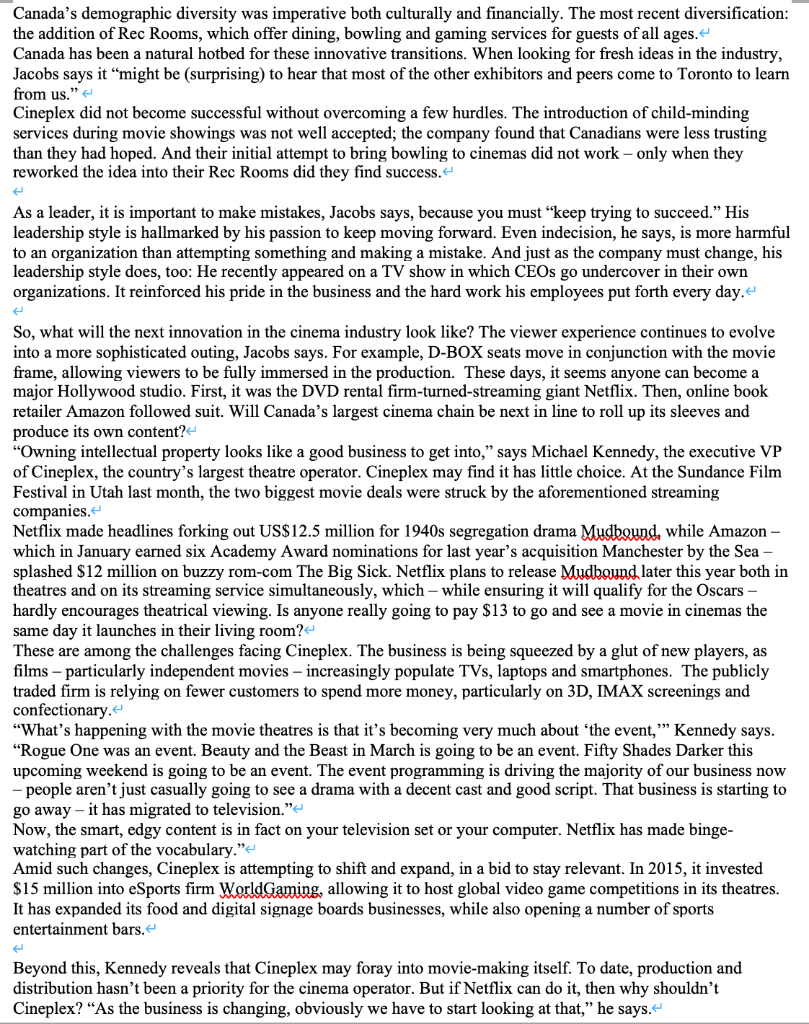
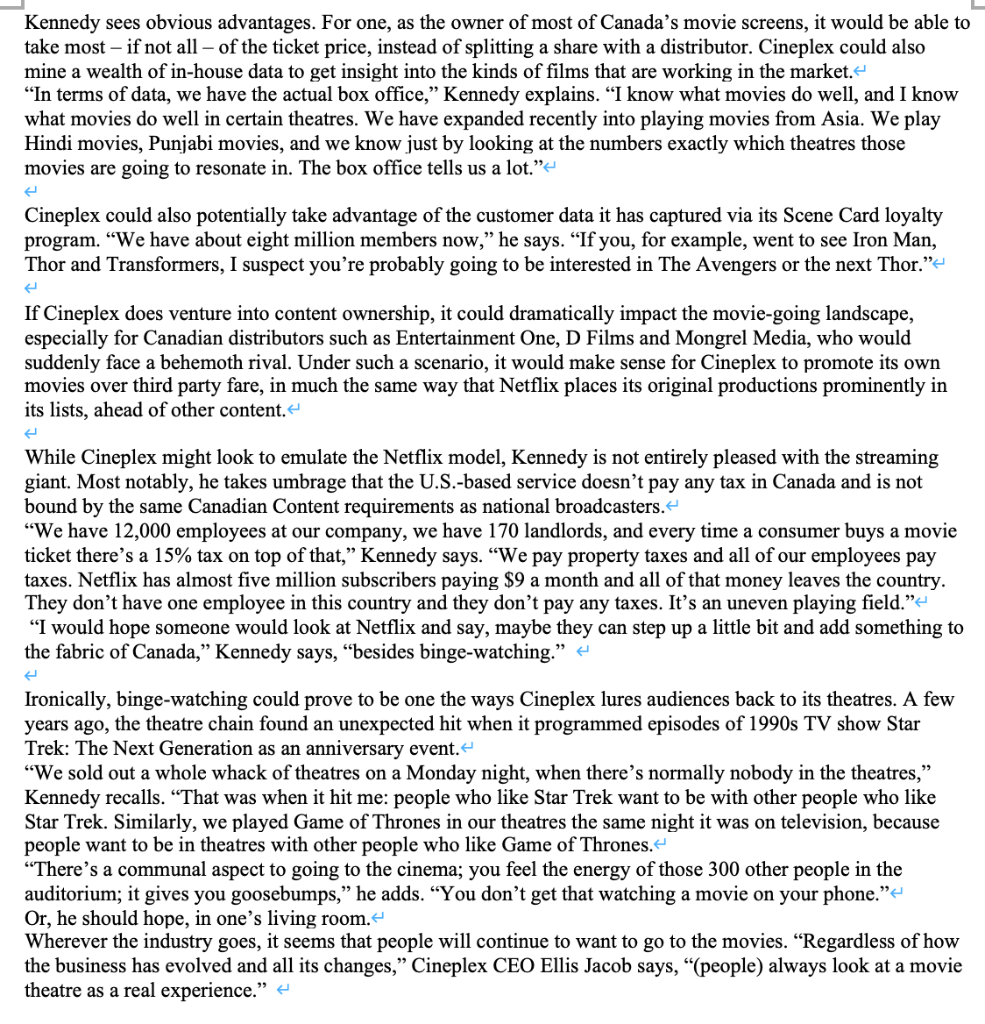
Cineplex is a leading Canadian company that operates in the Film Entertainment and Content, Amusement and Leisure, and Media sectors. It offers a unique escape through its theatres and entertainment venues, and is a joint venture partner in Scene+, Canada's largest entertainment loyalty program. It also runs successful businesses in digital commerce, food service, cinema media, digital place-based media and amusement solutions. When its theatres closed due to pandemic restrictions, the movie theatre brand put the emphasis on its other offerings, such as Cineplex Store - which allows guests to browse, view movies online and earn Scene points - and delivery of the brand's movie theatre popcorn, through apps such as Skip The Dishes and UberEats. "We've been thrilled, over the last three plus months, to be able to stay engaged with our customers," says Sara Moore, senior VP of marketing at Cineplex. We've been able to bring those small touchpoints of the theatre experience to people. Theatres are an affordable, easy entertainment escape for people, as we're drawn into captivating stories and guaranteed to be taken to far-off places. Our research reinforced that throughout the pandemic, already busy Canadian lives were beyond stressed, says Sara Moore, SVP of marketing for the company. "We heard from consumers how they deeply missed the movie theatre experience. Seeing a movie in a theatre is an event, an experience, and no matter what we are leaving behind, even if it is just the laundry, an escape is always welcome. We really tapped into the moment the lights go down in the theatre that draws you into the multi-sensorial experience of people, sights, sounds and tastes that contribute to that escape, says Moore. The platform, called Where Escape Begins," was developed by long-time agency partner Zulu Alpha Kilo in partnership with Cineplex's own in-house marketing team. At the heart of the campaign is a 50-second spot Moore calls a "Love Letter" about the cinematic experience. The spot breaks down each moment of the experience, she adds, "allowing the viewer to feel that sense of immersion and escape that comes with a visit to the Cineplex. "I truly believe it will inspire Canadians who've missed those moments to come back to the theatre." The platform takes a full 360 approach that Moore says will be leveraged for months, possibly years through different treatments and vignettes, as it is built on an enduring insight The campaign is launching across digital and social, radio and OOH, as well as appearing on Cineplex's social channels, interior digital media and exterior banners. The spot will also be a prominent part of the Cineplex pre- show. Cineplex CEO Ellis Jacob has been steadfastly and successfully navigating the company through the increasingly challenging entertainment landscape. Born in Calcutta and moving to Canada at the age of 15, Jacob has experienced disruption in his own life. He came to Montreal with only $10, his only connection to the country being his recently married sister. He eventually earned his title as a chartered accountant. His transition into the entertainment industry only came through following his mentor into the industry - though his passion for film had existed since he was young. The cinema experience has evolved drastically over the past 30 years. Thankfully, today's movie theatres have large lobbies, with entertainment options and a variety of food offerings. But perhaps the greatest change digitalization - has come in the past 10 years. Movies no longer display in film, sound systems are superior and experiences have been upgraded with new effects. Jacob has applied some of his own experiences to upgrade and diversify the Cineplex offering. Many theatres offer alternative programming, including opera and sporting events. Diversified content brings new customers; Cineplex, for example, introduced Bollywood films in Punjabi, Hindi and Tamil. Jacobs found that appealing to Canada's demographic diversity was imperative both culturally and financially. The most recent diversification: the addition of Rec Rooms, which offer dining, bowling and gaming services for guests of all ages. Canada has been a natural hotbed for these innovative transitions. When looking for fresh ideas in the industry, Jacobs says it "might be surprising) to hear that most of the other exhibitors and peers come to Toronto to learn from us." Cineplex did not become successful without overcoming a few hurdles. The introduction of child-minding services during movie showings was not well accepted; the company found that Canadians were less trusting than they had hoped. And their initial attempt to bring bowling to cinemas did not work - only when they reworked the idea into their Rec Rooms did they find success. As a leader, it is important to make mistakes, Jacobs says, because you must "keep trying to succeed." His leadership style is hallmarked by his passion to keep moving forward. Even indecision, he says, is more harmful to an organization than attempting something and making a mistake. And just as the company must change, his leadership style does, too: He recently appeared on a TV show in which CEOs go undercover in their own organizations. It reinforced his pride in the business and the hard work his employees put forth every day. So, what will the next innovation in the cinema industry look like? The viewer experience continues to evolve into a more sophisticated outing, Jacobs says. For example, D-BOX seats move in conjunction with the movie frame, allowing viewers to be fully immersed in the production. These days, it seems anyone can become a major Hollywood studio. First, it was the DVD rental firm-turned-streaming giant Netflix. Then, online book retailer Amazon followed suit. Will Canada's largest cinema chain be next in line to roll up its sleeves and produce its own content? "Owning intellectual property looks like a good business to get into, says Michael Kennedy, the executive VP of Cineplex, the country's largest theatre operator. Cineplex may find it has little choice. At the Sundance Film Festival in Utah last month, the two biggest movie deals were struck by the aforementioned streaming companies. Netflix made headlines forking out US$12.5 million for 1940s segregation drama Mudbound, while Amazon - which in January earned six Academy Award nominations for last year's acquisition Manchester by the Sea - splashed $12 million on buzzy rom-com The Big Sick. Netflix plans to release Mudbound later this year both in theatres and on its streaming service simultaneously, which while ensuring it will qualify for the Oscars - hardly encourages theatrical viewing. Is anyone really going to pay $13 to go and see a movie in cinemas the same day it launches in their living room? These are among the challenges facing Cineplex. The business is being squeezed by a glut of new players, as films particularly independent movies - increasingly populate TVs, laptops and smartphones. The publicly traded firm is relying on fewer customers to spend more money, particularly on 3D, IMAX screenings and confectionary. "What's happening with the movie theatres is that it's becoming very much about the event,'" Kennedy says. Rogue One was an event. Beauty and the Beast in March is going to be an event. Fifty Shades Darker this upcoming weekend is going to be an event. The event programming is driving the majority of our business now - people aren't just casually going to see a drama with a decent cast and good script. That business is starting to go away - it has migrated to television." Now, the smart, edgy content is in fact on your television set or your computer. Netflix has made binge- watching part of the vocabulary. Amid such changes, Cineplex is attempting to shift and expand, in a bid to stay relevant. In 2015, it invested $15 million into eSports firm World Gaming, allowing it to host global video game competitions in its theatres. It has expanded its food and digital signage boards businesses, while also opening a number of sports entertainment bars. Beyond this, Kennedy reveals that Cineplex may foray into movie-making itself. To date, production and distribution hasn't been a priority for the cinema operator. But if Netflix can do it, then why shouldn't Cineplex? "As the business is changing, obviously we have to start looking at that, he says. Kennedy sees obvious advantages. For one, as the owner of most of Canada's movie screens, it would be able to take most - if not all of the ticket price, instead of splitting a share with a distributor. Cineplex could also mine a wealth of in-house data to get insight into the kinds of films that are working in the market. In terms of data, we have the actual box office, Kennedy explains. I know what movies do well, and I know what movies do well in certain theatres. We have expanded recently into playing movies from Asia. We play Hindi movies, Punjabi movies, and we know just by looking at the numbers exactly which theatres those movies are going to resonate in. The box office tells us a lot." Cineplex could also potentially take advantage of the customer data it has captured via its Scene Card loyalty program. We have about eight million members now, he says. If you, for example, went to see Iron Man, Thor and Transformers, I suspect you're probably going to be interested in The Avengers or the next Thor. If Cineplex does venture into content ownership, it could dramatically impact the movie-going landscape, especially for Canadian distributors such as Entertainment One, D Films and Mongrel Media, who would suddenly face a behemoth rival. Under such a scenario, it would make sense for Cineplex to promote its own movies over third party fare, in much the same way that Netflix places its original productions prominently in its lists, ahead of other content. While Cineplex might look to emulate the Netflix model, Kennedy is not entirely pleased with the streaming giant. Most notably, he takes umbrage that the U.S.-based service doesn't pay any tax in Canada and is not bound by the same Canadian Content requirements as national broadcasters. We have 12,000 employees at our company, we have 170 landlords, and every time a consumer buys a movie ticket there's a 15% tax on top of that, Kennedy says. We pay property taxes and all of our employees pay taxes. Netflix has almost five million subscribers paying $9 a month and all of that money leaves the country. They don't have one employee in this country and they don't pay any taxes. It's an uneven playing field. I would hope someone would look at Netflix and say, maybe they can step up a little bit and add something to the fabric of Canada, Kennedy says, besides binge-watching." + Ironically, binge-watching could prove to be one the ways Cineplex lures audiences back to its theatres. A few years ago, the theatre chain found an unexpected hit when it programmed episodes of 1990s TV show Star Trek: The Next Generation as an anniversary event. We sold out a whole whack of theatres on a Monday night, when there's normally nobody in the theatres, Kennedy recalls. That was when it hit me: people who like Star Trek want to be with other people who like Star Trek. Similarly, we played Game of Thrones in our theatres the same night it was on television, because people want to be in theatres with other people who like Game of Thrones. There's a communal aspect to going to the cinema; you feel the energy of those 300 other people in the auditorium; it gives you goosebumps, he adds. You don't get that watching a movie on your phone.+ Or, he should hope, in one's living room. Wherever the industry goes, it seems that people will continue to want to go to the movies. Regardless of how the business has evolved and all its changes, Cineplex CEO Ellis Jacob says, (people) always look at a movie theatre as a real experience." +
Step by Step Solution
There are 3 Steps involved in it
1 Expert Approved Answer
Step: 1 Unlock

Question Has Been Solved by an Expert!
Get step-by-step solutions from verified subject matter experts
Step: 2 Unlock
Step: 3 Unlock
 Study Help