Question: 1. Case Brief the case using the provided format. ROGERS v. TENNESSEE Supreme Court of the United States 532 U.S. 451 (2001) Justice O'Connor delivered
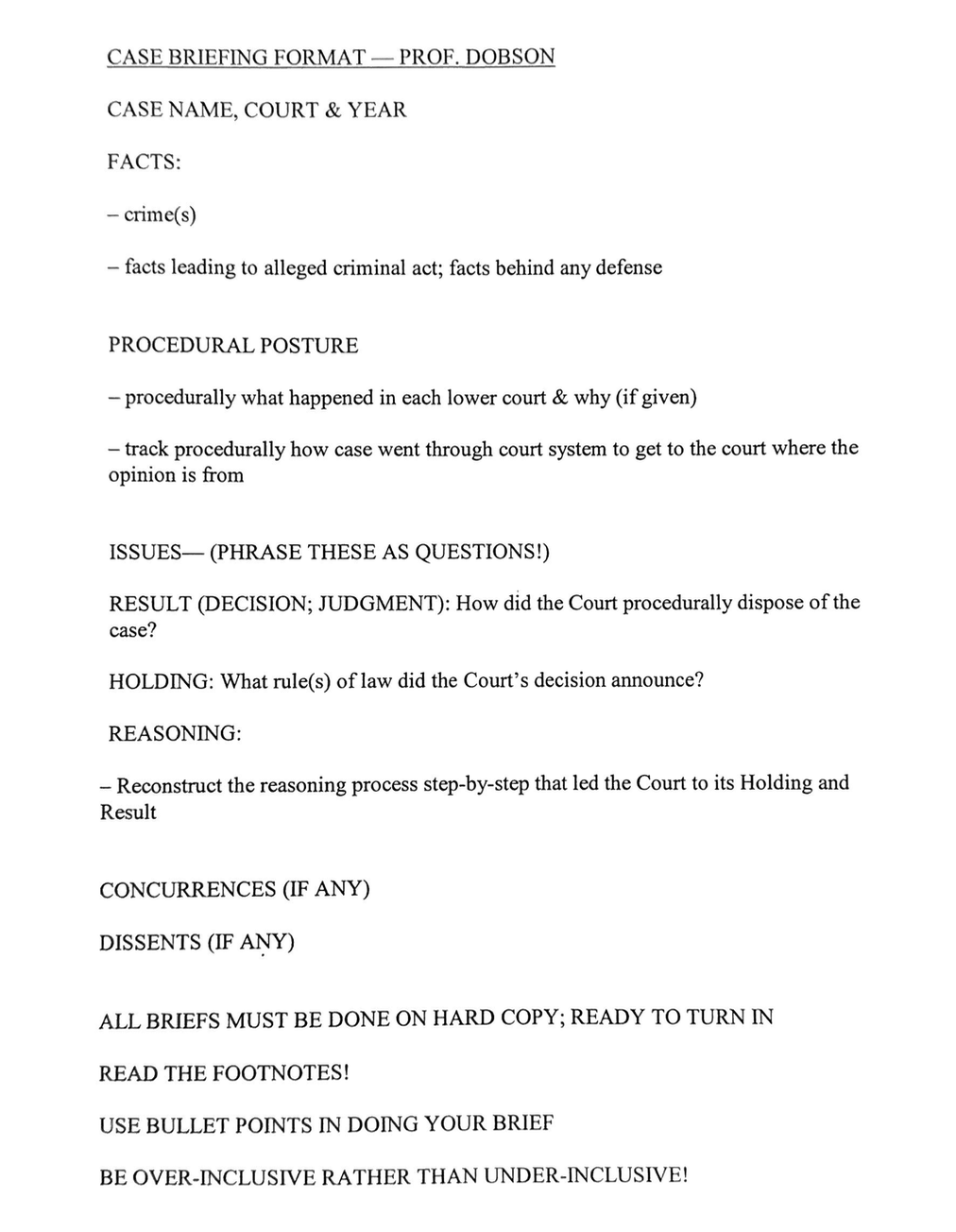
1. Case Brief the case using the provided format.
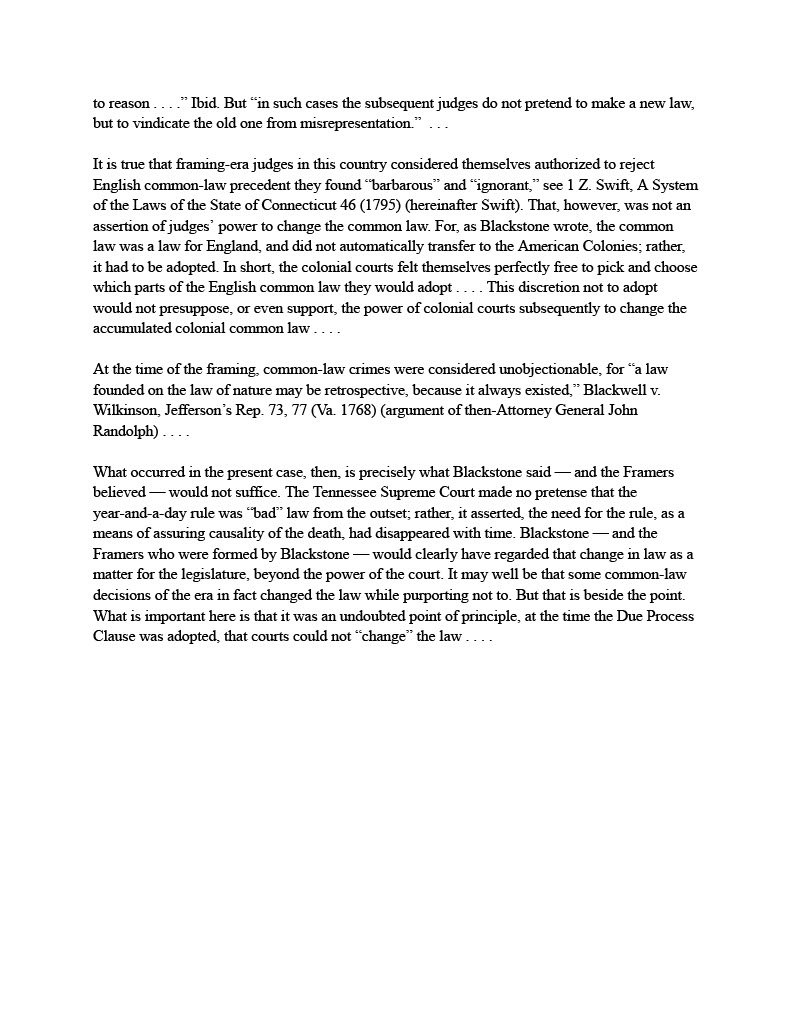
ROGERS v. TENNESSEE Supreme Court of the United States 532 U.S. 451 (2001) Justice O'Connor delivered the opinion of the Court . . . . At common law, the year and a day rule provided that no defendant could be convicted of murder unless his victim had died by the defendant's act within a year and a day of the act. The Supreme Court of Tennessee abolished the rule as it had existed p. 175at common law in Tennessee and applied its decision to petitioner to uphold his conviction. The question before us is whether, in doing so, the court denied petitioner due process of law in violation of the Fourteenth Amendment. H Petitioner Wilbert K. Rogers was convicted in Tennessee state court of second degree murder. [Defendant stabbed James Bowdery in the heart, causing cardiac arrest, leading to brain damage and a coma. Bowdery died of a kidney infection, a common complication of comas, after 15 months.] Based on this evidence, the jury found petitioner guilty under Tennessee's criminal homicide statute. The statute, which makes no mention of the year and a day rule, defines criminal homicide simply as "the unlawful killing of another person which may be first degree murder, second degree murder, voluntary manslaughter, criminally negligent homicide or vehicular homicide." Tenn. Code Ann. $39-13-201 (1997). Petitioner appealed his conviction . . . arguing that, despite its absence from the statute, the year and a day rule persisted as part of the common law of Tennessee and, as such, precluded his conviction . The Supreme Court of Tennessee affirmed . . . . The court observed that it had recognized the viability of the year and a day rule in Tennessee in Percer v. State, 118 Tenn. 765, 103 S.W. 780 (1907), and that, "[djespite the paucity of case law" on the rule in Tennessee, "both parties agree that the . . . rule was a part of the common law of this State." .. . After reviewing the justifications for the rule at common law, however, the court found that the original reasons for recognizing the rule no longer exist. Accordingly, the court abolished the rule as it had existed at common law in Tennessee. The court disagreed with petitioner's contention that application of its decision abolishing the rule to his case would violate the Ex Post Facto Clauses of the State and Federal Constitutions. Those constitutional provisions, the court observed, refer only to legislative Acts. The court then noted that in Bouie v. City of Columbia . . . this Court held that due process prohibits retroactive application of any "judicial construction of a criminal statute [that] is unexpected and indefensible by reference to the law which has been expressed prior to the conduct inissue." ... The court concluded, however, that application of its decision to petitioner would not offend this principle. We . . . now affirm. II Although petitioner's claim is one of due process, the Constitution's Ex Post Facto Clause figures prominently in his argument. The Clause provides simply that "[nJo State shall pass any . . . ex post facto Law." Art. I, $10, cl. 1. The most well-known and oft-repeated explanation of the scope of the Clause's protection was given by Justice Chase, who long ago identified, in dictum, four types of laws to which the Clause extends: "Ist. Every law that makes an action done before the passing of the law, and which was innocent when done, criminal; and punishes such action. 2d. Every law that aggravates a crime, or makes it greater than it was, when committed. 3d. Every p. 176law that changes the punishment, and inflicts a greater punishment, than the law annexed to the crime, when committed. 4th. Every law that alters the legal rules of evidence, and receives less, or different, testimony, than the law required at the time of the commission of the offense, in order to convict the offender." Calder v. Bull, 3 Dall. 386, 390 (1798) (seriatim opinion of Chase, J.). As the text of the Clause makes clear, it "is a limitation upon the powers of the Legislature, and does not of its own force apply to the Judicial Branch of government." Marks v. United States, 430 U.S. 188, 191 (1977) (citation omitted). We have observed, however, that limitations on ex post facto judicial decisionmaking are inherent in the notion of due process. In Bouie v. City of Columbia, [378 U.S. 347 (1964)] . we considered the South Carolina Supreme Court's retroactive application of its construction of the State's criminal trespass statute to the petitioners in that case. The statute prohibited "entry upon the lands of another . . . after notice from the owner or tenant prohibiting such entry . . .. The South Carolina court construed the statute to extend to [ Black] patrons of a drug store who had received no notice prohibiting their entry into the store, but had refused to leave the store when asked. Prior to the court's decision, South Carolina cases construing the statute had uniformly held that conviction under the statute required proof of notice before entry. None of those cases, moreover, had given the "slightest indication that that requirement could be satisfied by proof of the different act of remaining on the land after being told to leave." We held that the South Carolina court's retroactive application of its construction to the store patrons violated due process. Reviewing decisions in which we had held criminal statutes "void for vagueness" under the Due Process Clause, we noted that this Court has often recognized the "basic principle that a criminal statute must give fair warning of the conduct that it makes a crime." Deprivation of the right to fair warning, we continued, can result both from vaguestatutory language and from an unforeseeable and retroactive judicial expansion of statutory language that appears narrow and precise on its face . . . . We found that the South Carolina court's construction of the statute violated this principle because it was so clearly at odds with the statute's plain language and had no support in prior South Carolina decisions. . . . Petitioner contends that the Ex Post Facto Clause would prohibit the retroactive application of a decision abolishing the year and a day rule if accomplished by the Tennessee Legislature. He claims that the purposes behind the Clause are so fundamental that due process should prevent the Supreme Court of Tennessee from accomplishing the same result by judicial decree . .. . To the extent petitioner argues that the Due Process Clause incorporates the specific prohibitions of the Ex Post Facto Clause as identified in Calder, petitioner misreads Bouie . . . . Its rationale rested on core due process concepts of notice, foreseeability, and, in particular, the right to fair warning as those concepts bear on the constitutionality of attaching criminal penalties to what previously had been innocent conduct . .. . Contrary to petitioner's suggestion, nowhere in the opinion did we go so far as to incorporate jot-for-jot the specific categories of Calder into due process limitations on the retroactive application of judicial decisions . In the context of common law doctrines (such as the year and a day rule), there often arises a need to clarify or even to reevaluate prior opinions as new circumstances and fact patterns present themselves. Such judicial acts, whether p. 177they be characterized as "making" or 'finding" the law, are a necessary part of the judicial business in States in which the criminal law retains some of its common law elements. Strict application of ex post facto principles in that context would unduly impair the incremental and reasoned development of precedent that is the foundation of the common law system. The common law, in short, presupposes a measure of evolution that is incompatible with stringent application of ex post facto principles . Accordingly, we conclude that a judicial alteration of a common law doctrine of criminal law violates the principle of fair warning, and hence must not be given retroactive effect, only where it is "unexpected and indefensible by reference to the law which had been expressed prior to the conduct in issue." III Turning to the particular facts of the instant case, the Tennessee court's abolition of the year and a day rule was not unexpected and indefensible. The year and a day rule is widely viewed as an outdated relic of the common law. Petitioner does not even so much as hint that good reasons exist for retaining the rule, and so we need not delve too deeply into the rule and its history here. Suffice it to say that the rule is generally believed to date back to the 13th century ... ; that the primary and most frequently cited justification for the rule is that 13th century medical science was incapable of establishing causation beyond a reasonable doubt when a great deal of time hadelapsed between the injury to the victim and his death; and that, as practically every court recently to have considered the rule has noted, advances in medical and related science have so undermined the usefulness of the rule as to render it without question obsolete . . . For this reason, the year and a day rule has been legislatively or judicially abolished in the vast majority of jurisdictions recently to have addressed the issue ... . Common law courts frequently look to the decisions of other jurisdictions in determining whether to alter or modify a common law rule in light of changed circumstances, increased knowledge, and general logic and experience . . . . Finally, and perhaps most importantly, at the time of petitioner's crime the year and a day rule had only the most tenuous foothold as part of the criminal law of the State of Tennessee. The rule did not exist as part of Tennessee's statutory criminal code. And while the Supreme Court of Tennessee concluded that the rule persisted at common law, it also pointedly observed that the rule had never once served as a ground of decision in any prosecution for murder in the State . The judgment of the Supreme Court of Tennessee is accordingly affirmed. Justice Scalia, with whom Justice Stevens and Justice Thomas join, and with whom Justice Breyer joins as to Part II, dissenting. The Court today approves the conviction of a man for a murder that was not murder . . . when the offense was committed. It thus violates a principle - encapsulated in the maxim nulla poena sine lege - which "dates from the ancient Greeks" and has been described as one of the most "widely held value-judgment[s] in the entire history of human thought." J. Hall, General Principles of Criminal Law 59 (2d ed. 1960). Today's opinion produces, moreover, a curious constitution that p. 178only a judge could love. One in which (by virtue of the Ex Post Facto Clause) the elected representatives of all the people cannot retroactively make murder what was not murder when the act was committed; but in which unelected judges can do precisely that . . . . . . . At the time of the framing, common-law jurists believed (in the words of Sir Francis Bacon) that the judge's "office is jus dicere, and not jus dare; to interpret law, and not to make law, or give law." Bacon, Essays, Civil and Moral, in 3 Harvard Classics 130 (C. Eliot ed. 1909) (1625). Or as described by Blackstone, ... "judicial decisions are the principal and most authoritative evidence, that can be given, of the existence of such a custom as shall form a part of the common law." 1 W. Blackstone, Commentaries on the Laws of England *69 (1765) (emphasis added). Blackstone acknowledged that the courts' exposition of what the law was could change. Stare decisive said, "admits of exception, where the former determination is most evidently contraryto reason . . . .~ Ibid. But \"in such cases the subsequent judges do not pretend to make a new law, but to vindicate the old one from musrepresentation. . . . It 1s true that framing-era judges m this country considered themselves authonzed to reject English common-law precedent they found \"barbarous and \"ignorant.\" see 1 Z. Swift, A System of the Laws of the State of Connecticut 46 (1793) (heremafter Swaft). That, however, was not an assertion of judges' power to change the common law. For, as Blackstone wrote, the common law was a law for England, and did not automatically transfer to the Amernican Colomes; rather, it had to be adopted. In short, the colonial courts felt themselves perfectly free to pick and choose whuch parts of the English common law they would adopt . . . . This discretion not to adopt would not presuppose, or even support, the power of colonial courts subsequently to change the accumulated colomal commeon law . . . . At the time of the framming, common-law crimes were considered unobjectionable, for \"a law founded on the law of nature may be retrospective, because 1t always existed.\" Blackwell v. Wilkinson, Jefferson's Rep. 73, 77 (Va. 1768) (argument of then-Attormey General John Randolph) . What occurred in the present case, then, 1s precisely what Blackstone said and the Framers believed would not suffice. The Tennessee Supreme Court made no pretense that the year-and-a-day rule was \"bad\" law from the outset; rather, 1t asserted, the need for the rule, as a means of assuring causality of the death, had disappeared with time. Blackstone and the Framers who were formed by Blackstone would clearly have regarded that change 1 law as a matter for the legislature, beyond the power of the court. It may well be that some common-law decisions of the era in fact changed the law while purporting not to. But that 1s beside the point. What 1s important here 1s that 1t was an undoubted point of principle, at the time the Due Process Clause was adopted, that courts could not \"change the law . . . . CASE BRIEFING FORMAT PROF. DOBSON CASE NAME, COURT & YEAR FACTS: crime(s) facts leading to alleged criminal act; facts behind any defense PROCEDURAL POSTURE procedurally what happened in each lower court & why (if given) track procedurally how case went through court system to get to the court where the opinion is from ISSUES (PHRASE THESE AS QUESTIONS!) RESULT (DECISION; JUDGMENT): How did the Court procedurally dispose of the case? HOLDING: What rule(s) of law did the Court's decision announce? REASONING: Reconstruct the reasoning process step-by-step that led the Court to its Holding and Result CONCURRENCES (IF ANY) DISSENTS (IF ANY) ALL BRIEFS MUST BE DONE ON HARD COPY; READY TO TURN IN READ THE FOOTNOTES! USE BULLET POINTS IN DOING YOUR BRIEF BE OVER-INCLUSIVE RATHER THAN UNDER-INCLUSIVE
Step by Step Solution
There are 3 Steps involved in it
1 Expert Approved Answer
Step: 1 Unlock
Question Has Been Solved by an Expert!
Get step-by-step solutions from verified subject matter experts
Step: 2 Unlock
Step: 3 Unlock
Students Have Also Explored These Related Law Questions!









 Study Help