







Question: 1 ) Computing Network Sizes In this question, you will analyze the size of a state - of - the - art architecture discussed in
Computing Network Sizes
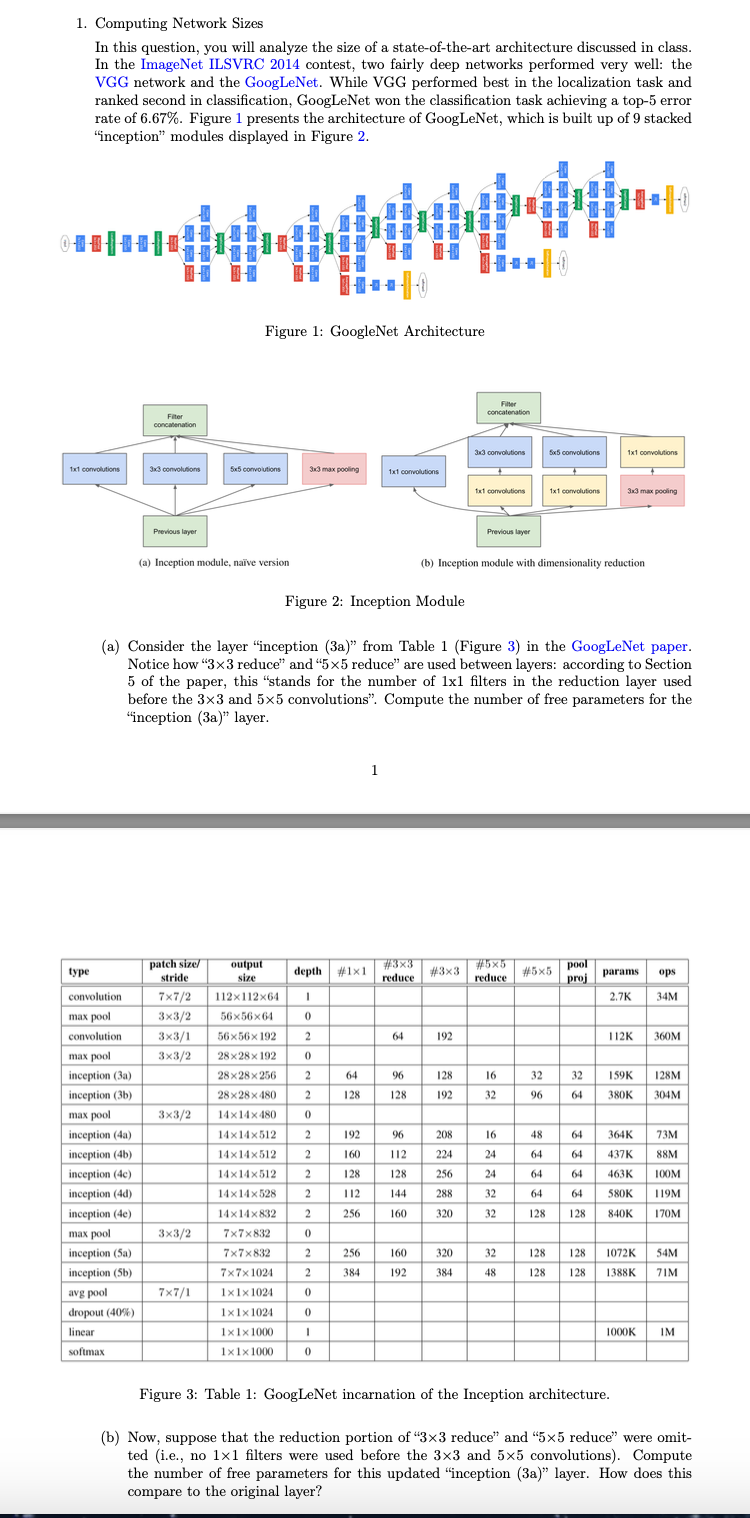
In this question, you will analyze the size of a stateoftheart architecture discussed in class. In the ImageNet ILSVRC contest, two fairly deep networks performed very well: the VGG network and the GoogLeNet. While VGG performed best in the localization task and ranked second in classification, GoogLeNet won the classification task achieving a top error rate of Figure presents the architecture of GoogLeNet, which is built up of stacked inception modules displayed in Figure
a Consider the layer inception a from Table Figure in the GoogLeNet paper. Notice how reduce and reduce are used between layers: according to Section of the paper, this stands for the number of x filters in the reduction layer used before the and convolutions Compute the number of free parameters for the inception a layer.
b Now, suppose that the reduction portion of reduce and reduce were omit ted ie no filters were used before the and convolutions Compute the number of free parameters for this updated inception a layer. How does this compare to the original layer?
Step by Step Solution
There are 3 Steps involved in it
1 Expert Approved Answer
Step: 1 Unlock

Question Has Been Solved by an Expert!
Get step-by-step solutions from verified subject matter experts
Step: 2 Unlock
Step: 3 Unlock
 Study Help