







Question: 1. Consider the extensive form below. (4,4)- u L t R [0.3] d (4,1) -(3,3) (2,2)- (3,3) u L R [0.4] d (1,3) -(2,2) (1,1).
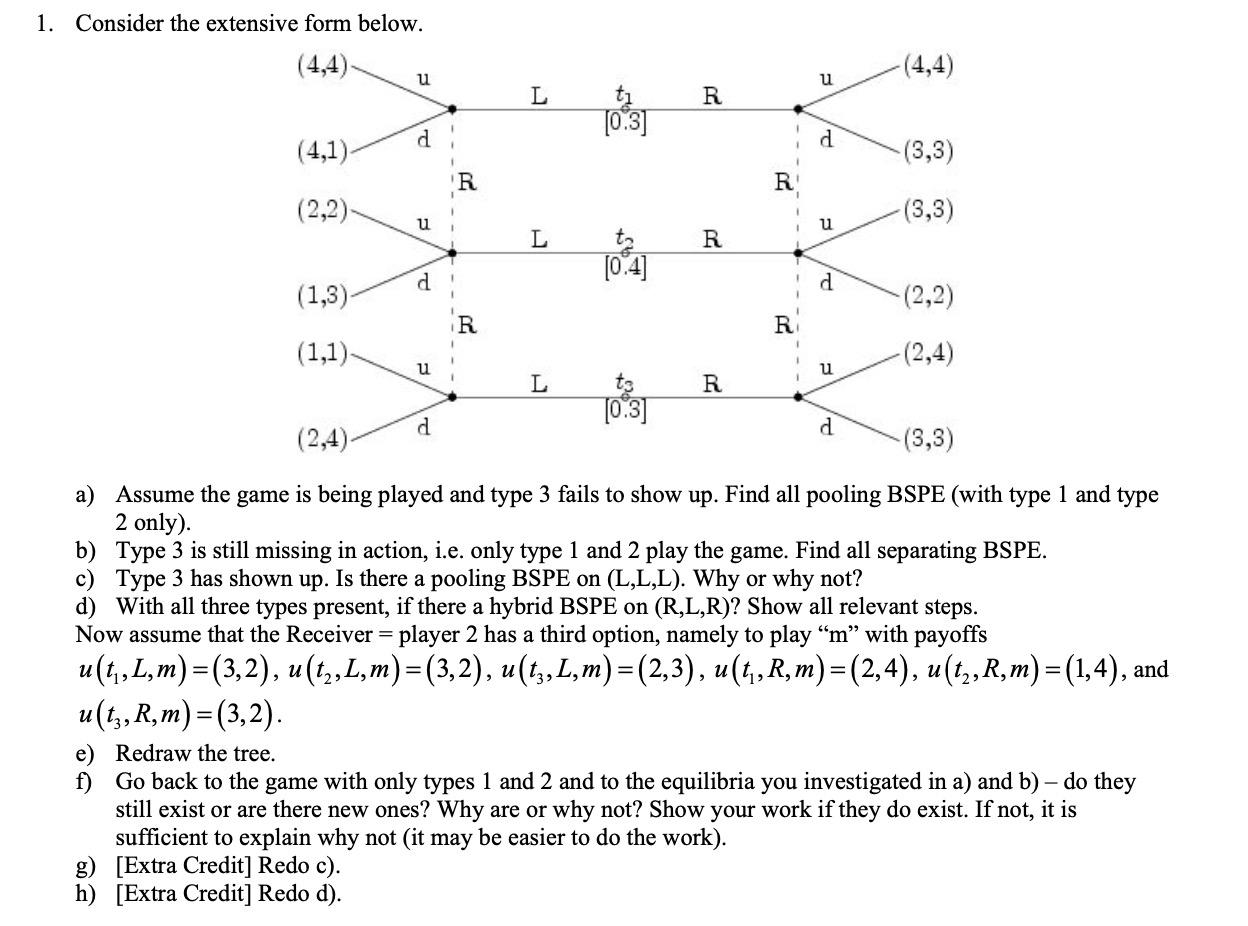
1. Consider the extensive form below. (4,4)- u L t R [0.3] d (4,1) -(3,3) (2,2)- (3,3) u L R [0.4] d (1,3) -(2,2) (1,1). -(2,4) u u L R [0.3] d d (2,4) -(3,3) a) Assume the game is being played and type 3 fails to show up. Find all pooling BSPE (with type 1 and type 2 only). b) Type 3 is still missing in action, i.e. only type 1 and 2 play the game. Find all separating BSPE. c) Type 3 has shown up. Is there a pooling BSPE on (L,L,L). Why or why not? d) With all three types present, if there a hybrid BSPE on (R,L,R)? Show all relevant steps. Now assume that the Receiver = player 2 has a third option, namely to play "m" with payoffs u(t,L,m)=(3,2), u(t,L,m)=(3,2), u(t3,L,m)=(2,3), u(t,R,m)=(2,4), u(t,R,m) = (1,4), and u(t3, R, m)=(3,2). e) Redraw the tree. f) Go back to the game with only types 1 and 2 and to the equilibria you investigated in a) and b) - do they still exist or are there new ones? Why are or why not? Show your work if they do exist. If not, it is sufficient to explain why not (it may be easier to do the work). g) [Extra Credit] Redo c). h) [Extra Credit] Redo d). R R R u d u d 1. Consider the extensive form below. (4,4)- u L t R [0.3] d (4,1) -(3,3) (2,2)- (3,3) u L R [0.4] d (1,3) -(2,2) (1,1). -(2,4) u u L R [0.3] d d (2,4) -(3,3) a) Assume the game is being played and type 3 fails to show up. Find all pooling BSPE (with type 1 and type 2 only). b) Type 3 is still missing in action, i.e. only type 1 and 2 play the game. Find all separating BSPE. c) Type 3 has shown up. Is there a pooling BSPE on (L,L,L). Why or why not? d) With all three types present, if there a hybrid BSPE on (R,L,R)? Show all relevant steps. Now assume that the Receiver = player 2 has a third option, namely to play "m" with payoffs u(t,L,m)=(3,2), u(t,L,m)=(3,2), u(t3,L,m)=(2,3), u(t,R,m)=(2,4), u(t,R,m) = (1,4), and u(t3, R, m)=(3,2). e) Redraw the tree. f) Go back to the game with only types 1 and 2 and to the equilibria you investigated in a) and b) - do they still exist or are there new ones? Why are or why not? Show your work if they do exist. If not, it is sufficient to explain why not (it may be easier to do the work). g) [Extra Credit] Redo c). h) [Extra Credit] Redo d). R R R u d u d
Step by Step Solution
There are 3 Steps involved in it

Get step-by-step solutions from verified subject matter experts
 Study Help