





Question: 1. Consider the polynomial P(I) = 214- 313 - 412 + 141- 12. (a) This polynomial has two rational zeroes. Use the rational root theorem
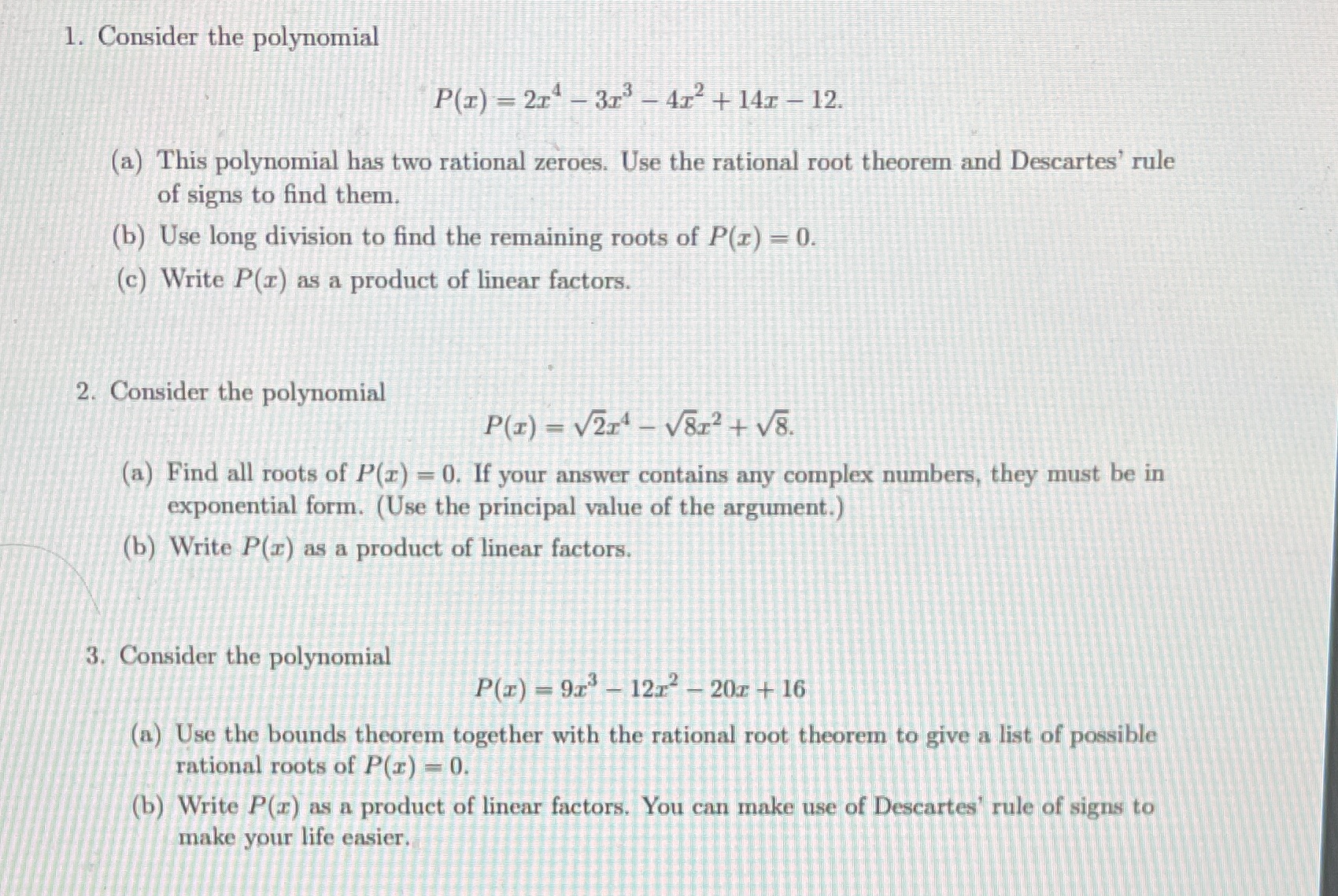
1. Consider the polynomial P(I) = 214- 313 - 412
1. Consider the polynomial P(I) = 214- 313 - 412 + 141- 12. (a) This polynomial has two rational zeroes. Use the rational root theorem and Descartes' rule of signs to find them. (b) Use long division to find the remaining roots of P(r) = 0. (c) Write P(r) as a product of linear factors. 2. Consider the polynomial P(1) = V214 - V82 + V8. (a) Find all roots of P(r) =0. If your answer contains any complex numbers, they must be in exponential form. (Use the principal value of the argument.) (b) Write P(z) as a product of linear factors. 3. Consider the polynomial P(x) =91 - 121 - 201 + 16 (a) Use the bounds theorem together with the rational root theorem to give a list of possible rational roots of P(z) = 0. (b) Write P(a) as a product of linear factors. You can make use of Descartes' rule of signs to make your life easier

Step by Step Solution

There are 3 Steps involved in it

1 Expert Approved Answer
Step: 1 Unlock blur-text-image

Question Has Been Solved by an Expert!

Get step-by-step solutions from verified subject matter experts

Step: 2 Unlock
Step: 3 Unlock

Students Have Also Explored These Related Mathematics Questions!