







Question: 1 . Consider the right arm with the upper arm pointed down and elbow flexed with the forearm pointed forward making a flexion angle of
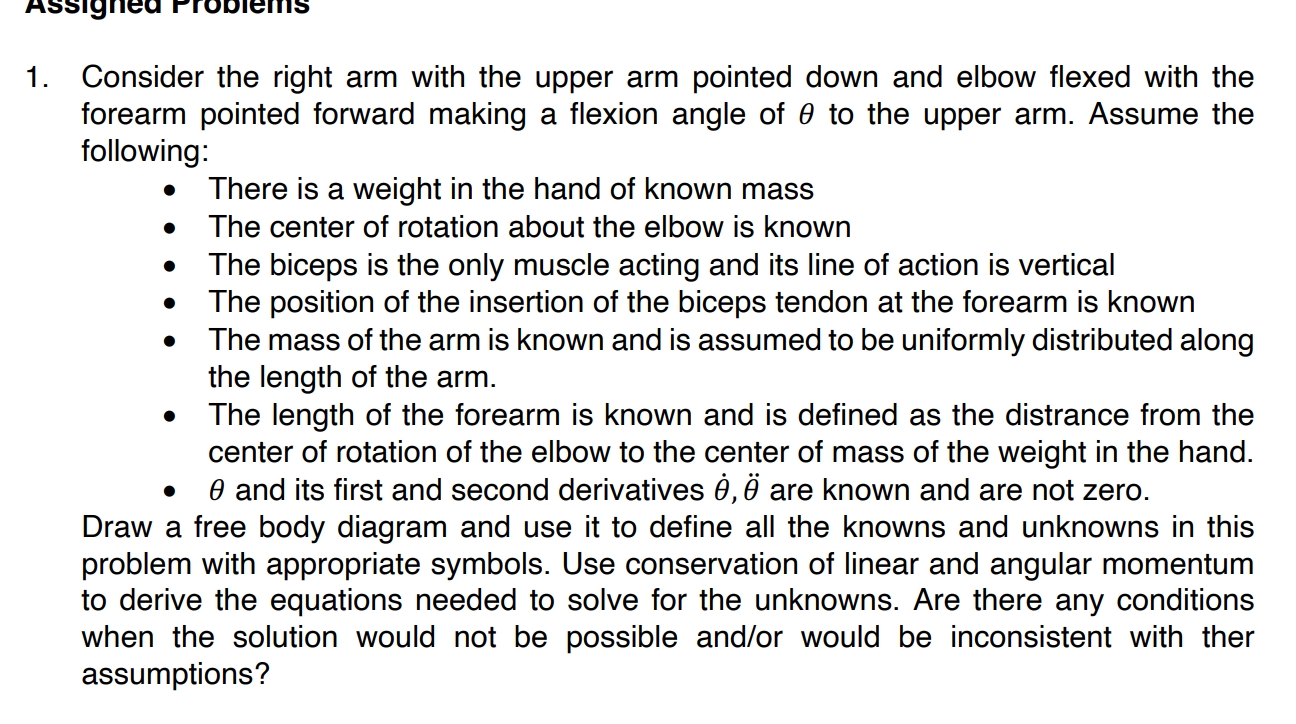
Consider the right arm with the upper arm pointed down and elbow flexed with the forearm pointed forward making a flexion angle of theta to the upper arm. Assume the following:
There is a weight in the hand of known mass
The center of rotation about the elbow is known
The biceps is the only muscle acting and its line of action is vertical
The position of the insertion of the biceps tendon at the forearm is known
The mass of the arm is known and is assumed to be uniformly distributed along the length of the arm.
The length of the forearm is known and is defined as the distrance from the center of rotation of the elbow to the center of mass of the weight in the hand.
quad theta and its first and second derivatives dotthetaddottheta are known and are not zero.
Draw a free body diagram and use it to define all the knowns and unknowns in this problem with appropriate symbols. Use conservation of linear and angular momentum to derive the equations needed to solve for the unknowns. Are there any conditions when the solution would not be possible andor would be inconsistent with ther assumptions?
Step by Step Solution
There are 3 Steps involved in it
1 Expert Approved Answer
Step: 1 Unlock

Question Has Been Solved by an Expert!
Get step-by-step solutions from verified subject matter experts
Step: 2 Unlock
Step: 3 Unlock
 Study Help