







Question: 1. Consider the TCP/IP Protocol Stack and fill in the blank: [1] IP layer is the [2] [3] HTTP is an [4] WiFi is
![1. Consider the TCP/IP Protocol Stack and fill in the blank: [1]](https://dsd5zvtm8ll6.cloudfront.net/si.experts.images/questions/2024/02/65c36111c356d_18565c36111a3741.jpg)
![IP layer is the [2] [3] HTTP is an [4] WiFi is](https://dsd5zvtm8ll6.cloudfront.net/si.experts.images/questions/2024/02/65c361122094d_18665c3611203435.jpg)
![a [5] [6] [7] [9] [10] to destination host. layer layer is](https://dsd5zvtm8ll6.cloudfront.net/si.experts.images/questions/2024/02/65c361126ca05_18665c361124b1af.jpg)
![layer 1. [12] A layer protocol. layer protocol. layer is responsible for](https://dsd5zvtm8ll6.cloudfront.net/si.experts.images/questions/2024/02/65c36112c2154_18665c36112a177c.jpg)
![moving the packets from source host layer header. [8] Transport layer data](https://dsd5zvtm8ll6.cloudfront.net/si.experts.images/questions/2024/02/65c3611371da6_18765c361135cb31.jpg)
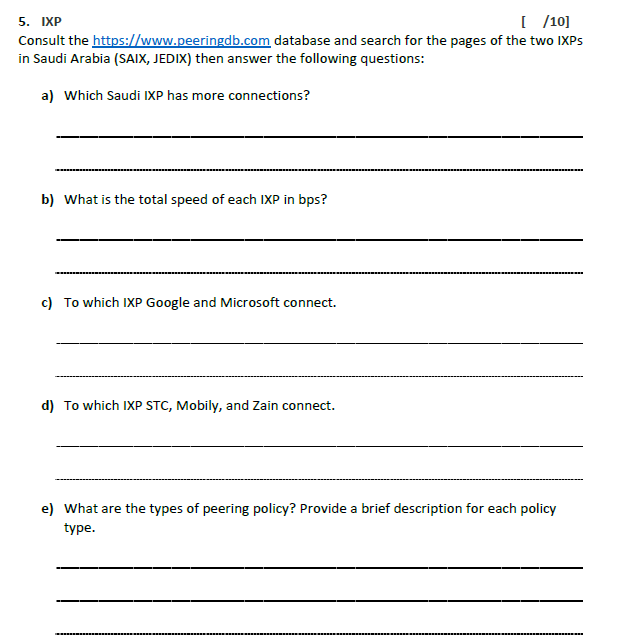
1. Consider the TCP/IP Protocol Stack and fill in the blank: [1] IP layer is the [2] [3] HTTP is an [4] WiFi is a [5] [6] [7] [9] [10] to destination host. layer layer is layer 1. [12] A layer protocol. layer protocol. layer is responsible for moving bits across wired and wireless links. is responsible for routing and moving the packets from source host layer header. [8] Transport layer data unit is commonly known as layer is responsible for data transfer between adjacent network devices across a single link. is the process of taking upper layer data and adding current running on the interacting hosts. [11] A router can process up to the layer is responsible for the communication between processes layer while a host processes layer protocol encapsulates network layer datagram. 2. Transmission & Propagation delay A packet of 1000 Byte length propagates over a 1,500 km link, with propagation speed 3x10⁸ m/s, and transmission rate 2 Mbps. (example1 & example2) [/24] Answer the following questions and show your steps. a) Calculate the propagation delay in millisecond (ms). [4] b) Calculate the transmission delay in millisecond (ms). [4] c) What is the total delay (ignoring other delay components)? [4] d) If the link is replaced by a 100 Mbps link, how this would change the total delay? [4] e) Repeat c) if there were three links separated by two routers and all the links are identical and processing time in each router is 135 s [8] 3. Network Core switching: Name the switching technology corresponding to each attribute. Attribute Resources needed for a connection must be reserved. The number of users is fixed or limited. The number of users is flexible and not limited. Each user transmits at full link speed. Each user gets a fraction of link speed. Reserved resources are wasted if not used. Guaranteed performance for a connection. Used mainly on the Internet. [ /16] Switching technology 4. Devices, Links, and Networks: [ /14] Classify the following as host, ISP, content provider, access technology, or physical medium: content Host ISP 0 0 0 0 0 0 0 FTTH Fiber cable Zain DSL YouTube Web server Coax Hybrid fiber coax (HFC) Cable-TV AT&T 5G Mobile network Radio spectrum Tablet Google Copper cables 0 0 0 0 0 0 0 0 0 0 0 0 0 0 0 0 0 0 0 0 0 provider 0 0 0 0 0 0 0 0 Access technology 0 0 0 0 0 0 0 0 0 0 0 0 0 0 Physical medium 0 0 0 0 0 0 0 0 0 0 0 0 0 0 5. IXP [ /10] Consult the https://www.peeringdb.com database and search for the pages of the two IXPs in Saudi Arabia (SAIX, JEDIX) then answer the following questions: a) Which Saudi IXP has more connections? b) What is the total speed of each IXP in bps? c) To which IXP Google and Microsoft connect. d) To which IXP STC, Mobily, and Zain connect. e) What are the types of peering policy? Provide a brief description for each policy type. 6. Security Explain how DDoS is executed? [ /10]
Step by Step Solution
There are 3 Steps involved in it
Lets go through the questions based on the TCPIP protocol stack and fill in the blanks IP layer is the Network layer Physical layer is layer 1 HTTP is an Application layer protocol WiFi is a Data Link ... View full answer

Get step-by-step solutions from verified subject matter experts
 Study Help