





Question: (1) Cross-sectional design (2) Response rate (3) Open-ended question ( Cohort study (5) Explanatory survey A. Seck to illustrate the distribution within a population of
(1) Cross-sectional design (2) Response rate (3)
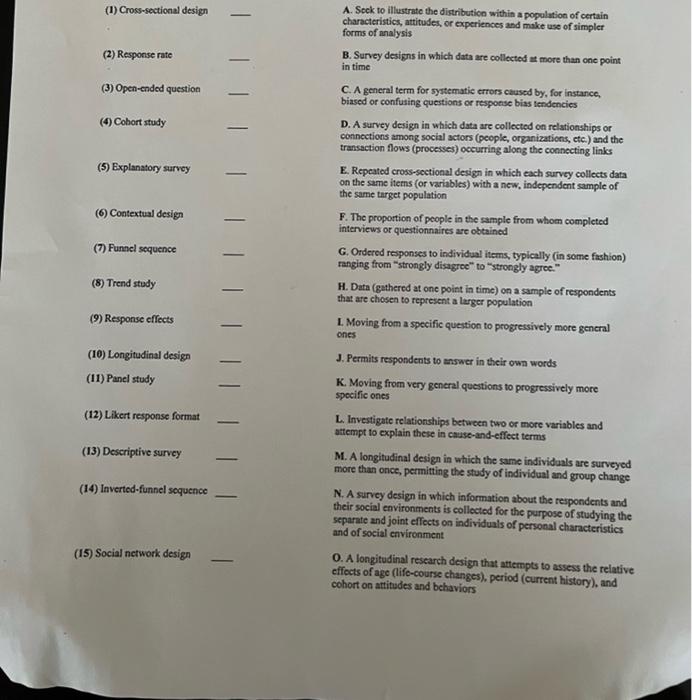
(1) Cross-sectional design (2) Response rate (3) Open-ended question ( Cohort study (5) Explanatory survey A. Seck to illustrate the distribution within a population of certain characteristics, attitudes, or experiences and make use of simpler forms of analysis B. Survey designs in which data are collected at more than one point in time C. A general term for systematic errors caused by, for instance, biased or confusing questions or response bias tendencies D. A survey design in which data are collected on relationships or connections among social actors (people, organizations, etc.) and the transaction flows (processes) occurring along the connecting links E. Repeated cross-sectional design in which each survey collects data on the same items (or variables) with a new, independent sample of the same target population F. The proportion of people in the sample from whom completed interviews or questionnaires are obtained G. Ordered responses to individual items, typically in some fashion) ranging from "strongly disagree to "strongly agree." H. Data (gathered at one point in time) on a sample of respondents that are chosen to represent a larger population 1. Moving from a specific question to progressively more general (6) Contextual design (7) Funnel sequence (8) Trend study (9) Response effects ones (10) Longitudinal design (11) Panel study (12) Likert response format J. Permits respondents to answer in their own words K. Moving from very general questions to progressively more specific ones L. Investigate relationships between two or more variables and attempt to explain these in cause-and-effect terms M. A longitudinal design in which the same individuals are surveyed more than once, permitting the study of individual and group change N. A survey design in which information about the respondents and their social environments is collected for the purpose of studying the separate and joint effects on individuals of personal characteristics and of social environment (13) Descriptive survey - (14) Inverted-funnel sequence (15) Social network design 0. A longitudinal research design that attempts to assess the relative effects of age (life-course changes), period (current history), and cohort on attitudes and bchaviors

Step by Step Solution

There are 3 Steps involved in it

1 Expert Approved Answer
Step: 1 Unlock blur-text-image

Question Has Been Solved by an Expert!

Get step-by-step solutions from verified subject matter experts

Step: 2 Unlock
Step: 3 Unlock

Students Have Also Explored These Related General Management Questions!