







Question: 1 . Defective coloring. Let ( G = ( V , E ) ) be a graph with maximum degree (
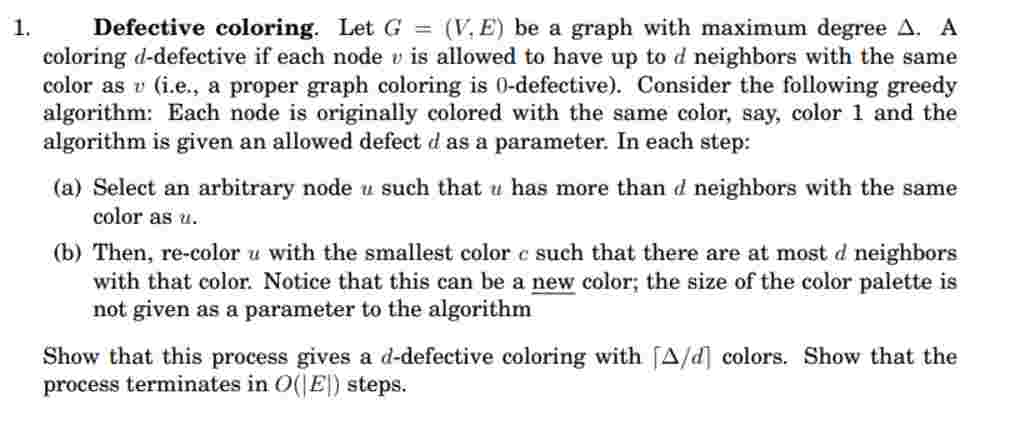
Defective coloring. Let GV E be a graph with maximum degree triangle A coloring d defective if each node v is allowed to have up to d neighbors with the same color as v ie a proper graph coloring is defective Consider the following greedy algorithm: Each node is originally colored with the same color, say, color and the algorithm is given an allowed defect d as a parameter. In each step:
a Select an arbitrary node u such that u has more than d neighbors with the same color as u
b Then, recolor u with the smallest color c such that there are at most d neighbors with that color. Notice that this can be a new color; the size of the color palette is not given as a parameter to the algorithm
Show that this process gives a d defective coloring with Delta d colors. Show that the process terminates in OE steps.
Step by Step Solution
There are 3 Steps involved in it
1 Expert Approved Answer
Step: 1 Unlock

Question Has Been Solved by an Expert!
Get step-by-step solutions from verified subject matter experts
Step: 2 Unlock
Step: 3 Unlock
 Study Help