Question: 1. Define Capacity 2. outline steps in capacity planning ised by Noise Clippers. 3. recommend one technique that can be used in capacity planning and
1. Define Capacity
2. outline steps in capacity planning ised by Noise Clippers.
3. recommend one technique that can be used in capacity planning and control by noise clippers.
*make refrence to case study
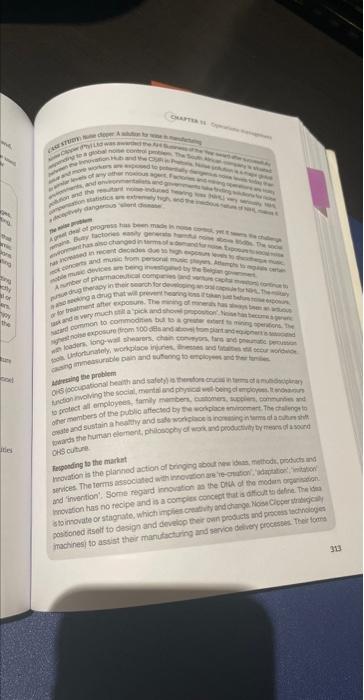
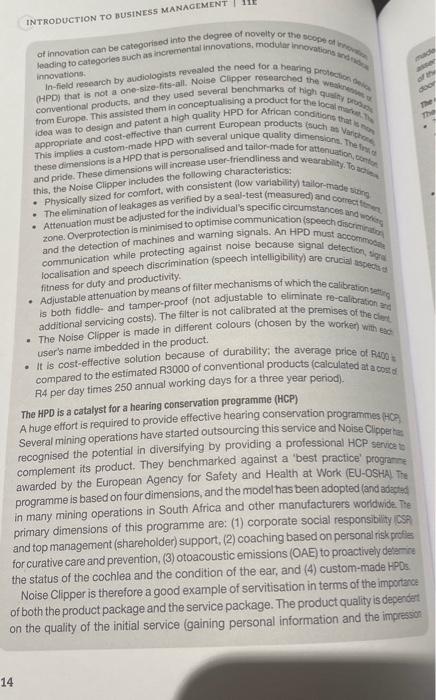
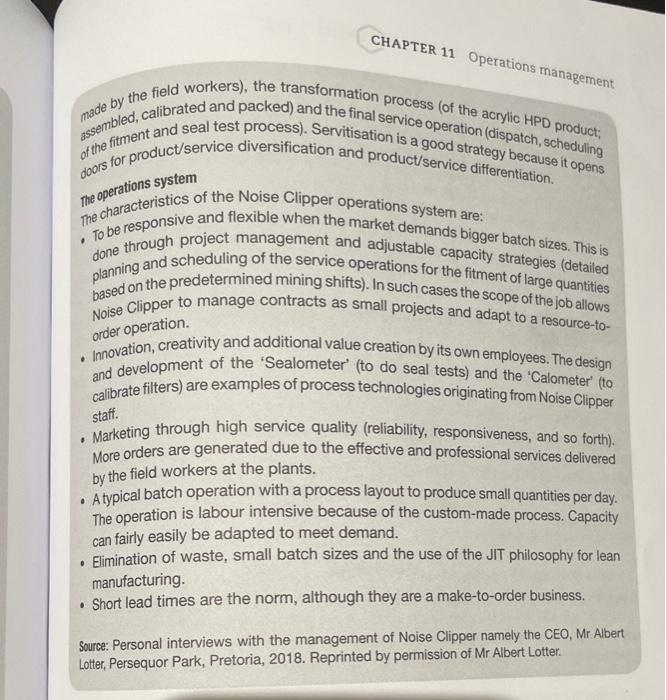
actepted the preblem a) Fakpoting to the market INTRODUCTION TO BUSINESS MANACIML lesoding to categr In-feld research by avdiologints revealed the need for a neasing profoclion of conventional products. and they used several bench conceptualising a product for the local in thos of appropriate and cost-effective than cument European products (such an Vartith then This implies a custom-made HPD with severai unique quaity dimensione, The foef of these dimensions is a HPD that is personalised and tailor-made for atienuation, tofsted of and pride. These dimensions wiff increase user-friendliness and sowing characteristics: this, the Norse Clipper includes the following characteristics: - The elimination of leakages as verified by a seal-test (measured) and cotrect to - Attenuation must be adjusted for the individual's specific circumstances and wisk zone. Overprotection is minimised to optimisa communication ispeach discremintion and the detection of machines and warning signals. An HPD must accominost communication while protecting against noise because signal detection, tifat Iocalisation and speech discriminat - Adjustable attenuation by means of filter mechanisms of which the calibration setting is both fiddle- and tamper-proof (not adjustable to eliminate re-calbration are additional servicing costs). The filter is not calibrated at the premises of the clort. - The Noise Clipper is made in different co coduct. user's name imbedded in the product. - It is cost-effective solution because of durability: the average price of Rasp R4 per day times 250 annual working days for a three year period). The HPD is a catalyst for a hearing conservation programme (HCP) A huge effort is required to provide effective hearing conservation programmes H2C3 Several mining operations have started outsourcing this service and Noise Clipper tar recognised the potential in diversifying by providing a professional HCP servica to complement its product. They benchmarked against a 'best practice' prograrce awarded by the European Agency for Safety and Health at Work (EU-OSHA) The programme is based on four dimensions, and the model has been adopted (and abacyen in many mining operations in South Africa and other manufacturers worldwite. Tte primary dimensions of this programme are: (1) corporate social responsidity css and top management (shareholder) support, (2) coaching based on personal risk prote for curative care and prevention, (3) otoacoustic emissions (OAE) to proactively desarinthe status of the cochiea and the condition of the ear, and (4) custom-made hits Noise Clipper is therefore a good example of servitisation in tems of the impsiaf of both the product package and the service package. The product quality is deperw made by the field workers), the transformation process (of the acrylic HPD product; assembled, calibrated and packed) and the final service operation (dispatch, scheduling of the fitment for product/service diversification and product/senvice strategy because it opens The operations system The characteristics of the Noise Clipper operations system are: - To be responsive and flexible when the market demands bigger batch sizes. This is done through project management and adjustable capacity strategies (detailed planning and scheduling of the service operations for the fitment of large quantities Noise Clipper to manage contracts as small projects and adapt to the job allows order operation. - Innovation, creativity and additional value creation by its own employees. The design and development of the 'Sealometer' (to do seal tests) and the 'Calometer' (to calibrate filters) are examples of process technologies originating from Noise Clipper staff. - Marketing through high service quality (reliability, responsiveness, and so forth). More orders are generated due to the effective and professional services delivered by the field workers at the plants. - A typical batch operation with a process layout to produce small quantities per day. The operation is labour intensive because of the custom-made process. Capacity can fairly easily be adapted to meet demand. - Elimination of waste, small batch sizes and the use of the JIT philosophy for lean manufacturing. - Short lead times are the norm, although they are a make-to-order business. Source: Personal interviews with the management of Noise Clipper namely the CEO, Mr Albert Lotter, Persequor Park, Pretoria, 2018. Reprinted by permission of Mr Albert Lotter