







Question: from the case study above , outline the steps in capacity planning used by Noise Clippers. from reading the extracts, what are the steps in
from the case study above , outline the steps in capacity planning used by Noise Clippers.
from reading the extracts, what are the steps in capacity planning used by the company in the case study.
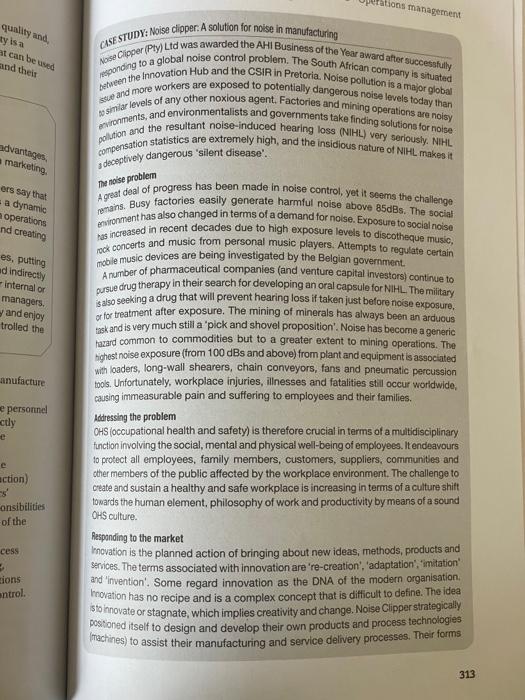
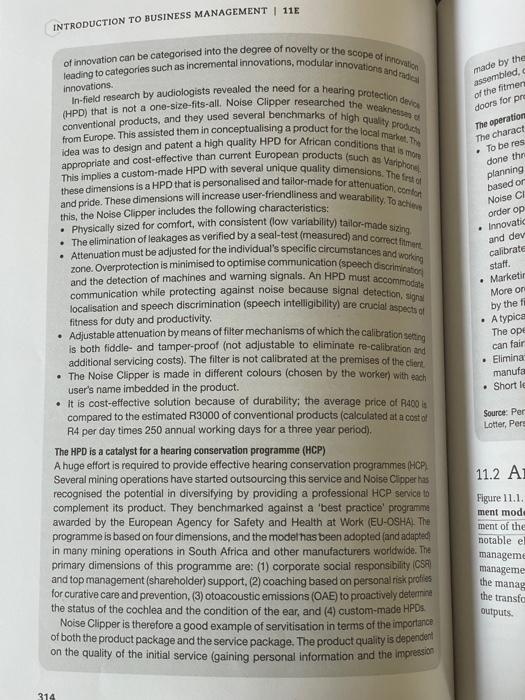
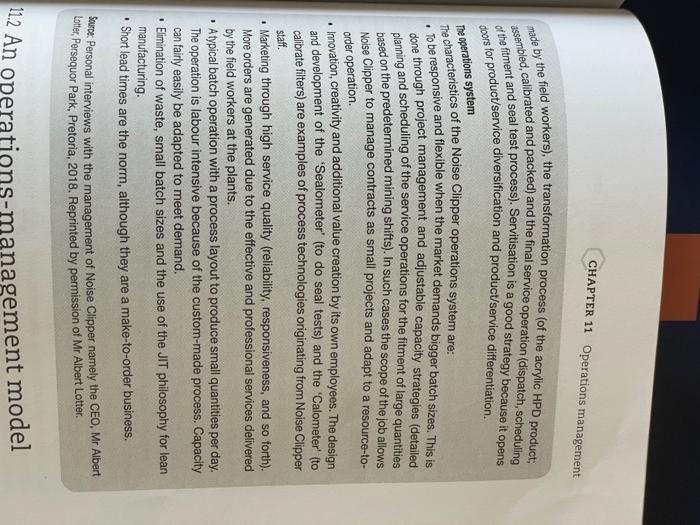
C. SE STUDY: Noise clipper: A solution for noise in manufacturing Nose Cipper (Pty) Ltd was awarded the AHI Business of the Year award after successfully popponding to a global noise control problem. The South African company is situated be tween the innovation Hub and the CSIR in Pretoria. Noise pollution is a major global nsmmir levels of any other noxious agent. Factories and mining operatis today than evronments, and environmentalists and governments take finding solutions for noisy pollition and the resultant noise-induced hearing loss (NIHL) very seriousty. noise compensation statistics are extremely high, and the insidious nature of NIHL matios. NIL 3 deceptively dangerous 'silent disease'. the noise problem A grest deal of progress has been made in noise control, yet it seems the challenge renains. Busy factories easily generate harmful noise above 85dBs. The social emironment has also changed in terms of a demand for noise. Exposure to social noise Iss increased in recent decades due to high exposure levels to discotheque music, rock concerts and music from personal music players. Attempts to regulate certain moble music devices are being investigated by the Belgian government. A trumber of pharmaceutical companies (and venture capital investors) continue to pusue drug therapy in their search for developing an oral capsule for NIHL. The military is also seeking a drug that will prevent hearing loss if taken just before noise exposure, or for treatment after exposure. The mining of minerals has always been an arduous task and is very much still a 'pick and shovel proposition'. Noise has become a generic fazard common to commodities but to a greater extent to mining operations. The highest noise exposure (from 100dBs and above) from plant and equipment is associated with loaders, long-wall shearers, chain conveyors, fans and pneumatic percussion toos. Unfortunately, workplace injuries, illnesses and fatalities still occur worldwide, cassing immeasurable pain and suffering to employees and their families. kddessing the problem OHS loccupational health and safety) is therefore crucial in terms of a multidisciplinary function involving the social, mental and physical well-being of employees. It endeavours to protect all employees, family members, customers, suppliers, communities and thermembers of the public affected by the workplace environment. The challenge to cteate and sustain a healthy and safe workplace is increasing in terms of a culture shitt towards the human element, philosophy of work and productivity by means of a sound OHS culture. Responding to the market movation is the planned action of bringing about new ideas, methods, products and sorvices. The terms associated with innovation are 're-creation', 'adaptation', 'imitation' and 'Iivention'. Some regard innovation as the DNA of the modern organisation, monation has no recipe and is a complex concept that is difficult to define. The idea isto hnovate or stagnate, which implies creativity and change. Noise Clipper strategically positoned itself to design and develop their own products and process technologies (mactines) to assist their manufacturing and service delivery processes. Their forms of innowation can be categorised into the degree of novelty or the scope of intionalion leading to categories such as incremental innovations, modular innovations and rad innovations. In-field research by audiologists revealed the need for a hearing protection devict (HPD) that is not a one-size-fits-all. Noise Clipper researched the weaknensers of conventional products, and they used several benchmarks of high quatity prostich chals from Europe. This assisted them in conceptualising a product for the local marivet.Thy idea was to design and patent a high quality HPD for African conditions that is moth This implies a custom-made HPD with several unique quality dimensions. The fryt of these dimensions is a HPD that is personalised and tallor-made for attenuation, contiont and pride. These dimensions will increase user-friendliness and wearability, To achtert this, the Noise Clipper includes the following characteristics: - Pinysically sized for comfort, with consistent (low variability) tailor-made sizing - The elimination of leakages as verified by a seal-test (measured) and correct firmmete - Attenuation must be adjusted for the individual's specific circumstances and uorkig zone. Overprotection is minimised to optimise communication (speech cescriminator) and the detection of machines and waming signals. An HPD must accominodate communication while protecting against noise because signal detectan, signs focalissation and speech discriminat - Adjustable attenuation by means of filter mechanisms of which the calibration seping is both fiddle- and tamper-proof (not adjustable to eliminate re-calibration arid additional servicing costs). The filter is not calibrated at the premises of the cliert - The Noise Clipper is made in different colours (chosen by the worker) with esch user's name imbedded in the product. - It is cost-effective solution because of durability; the average price of R400 is compared to the estimated R3000 of conventional products (calculated at a cost bl R4 per day times 250 annual working days for a three year period). The HPD is a catalyst for a hearing conservation programme (HCP) A huge effort is required to provide effective hearing conservation programmes (MCP: Several mining operations have started outsourcing this service and Noise Cipper has recognised the potential in diversifying by providing a professional HCP service to complement its product. They benchmarked against a 'best practice' programm awarded by the European Agency for Safety and Health at Work (EU-OSHA). The programme is based on four dimensions, and the model has been adopted (and adaptect. in many mining operations in South Africa and other manufacturers worldwide. The primary dimensions of this programme are: (1) corporate social responsibility (CSPi) and top management (shareholder) support, (2) coaching based on personal risk protios for curative care and prevention, (3) otoacoustic emissions (OAE) to proactively determina the status of the cochlea and the condition of the ear, and (4) custom-made HPDs. Noise Clipper is therefore a good example of servitisation in terms of the imporlarce of both the product package and the service package. The product quality is dependeri on the quality of the initial service (gaining personal information and the inpression made by the field workers), the transformation process (of the acrylic HPD product; assembled, calibrated and packed) and the final service operation (dispatch, scheduling of the fitment and seal test process). Servitisation is a good strategy because it opens doors for product/service diversification and product/service differentiation. The operations system The characteristics of the Noise Clipper operations system are: - To be responsive and flexible when the market demands bigger batch sizes. This is done through project management and adjustable capacity strategies (detailed planning and scheduling of the service operations for the fitment of large quantities based on the predetermined mining shifts). In such cases the scope of the job allows Noise Clipper to manage contracts as small projects and adapt to a resource-toorder operation. - Innovation, creativity and additional value creation by its own employees. The design and development of the 'Sealometer' (to do seal tests) and the 'Calometer' (to calibrate filters) are examples of process technologies originating from Noise Clipper staff. - Marketing through high service quality (reliability, responsiveness, and so forth). More orders are generated due to the effective and professional services delivered by the field workers at the plants. - Atypical batch operation with a process layout to produce small quantities per day. The operation is labour intensive because of the custom-made process. Capacity can fairly easily be adapted to meet demand. - Elimination of waste, small batch sizes and the use of the JIT philosophy for lean manufacturing. - Short lead times are the norm, although they are a make-to-order business. Surce: Personal interviews with the management of Noise Clipper namely the CEO, Mr Albert lotter, Persequor Park, Pretoria, 2018. Reprinted by permission of Mr Albert Lotter. 11.2 An operations-management model Step by Step Solution
There are 3 Steps involved in it
1 Expert Approved Answer
Step: 1 Unlock

Question Has Been Solved by an Expert!
Get step-by-step solutions from verified subject matter experts
Step: 2 Unlock
Step: 3 Unlock
 Study Help