







Question: 1. Define the Problem: Identify ONE key problem. While there may be several problems and a multitude of symptoms, attempt to identify one problem, the
1. Define the Problem: Identify ONE key problem. While there may be several problems and a multitude of symptoms, attempt to identify one problem, the resolution of which would alleviate most of the symptoms found in the case.
2. Develop two alternative marketing courses of action for overcoming the problem and further exploiting potential market opportunities. This should not be a laundry list of actions one could take to address every symptom, but alternative actions that could correct the problem at hand.
a. Alternative Solution 1:
b. Alternative Solution 2:
3. A discussion of the advantages and disadvantages of each proposed alternative. Give 2 advantages and 2 disadvantages PER alternative solution to the defined problem.
Alternative Solution 1:
a. Advantage 1:
b. Advantage 2:
c. Disadvantage 1:
d. Disadvantage 2:
Alternative Solution 2:
a. Advantage 1:
b. Advantage 2:
c. Disadvantage 1:
d. Disadvantage 2:
4. Select a Solution. Select one of the alternatives and explain why it would be best.
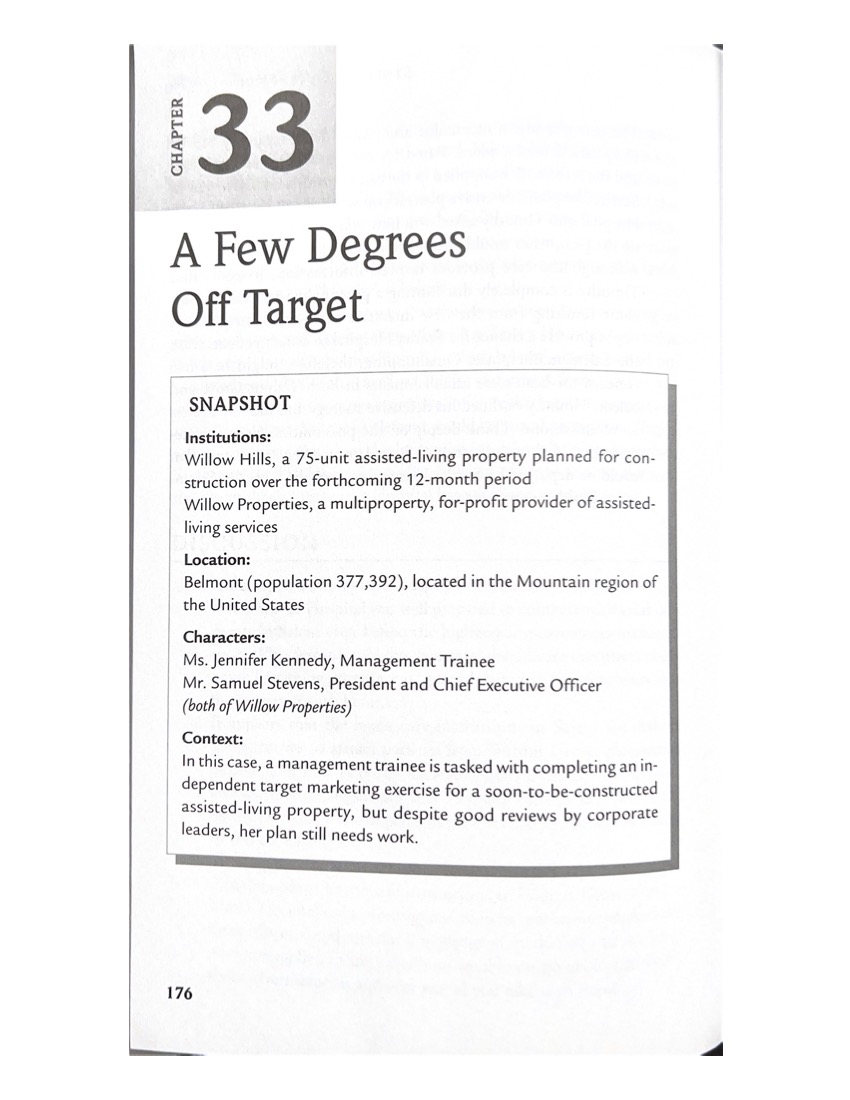

A Few Degrees Off Target Jennifer Kennedy, Management Trainee at Willow Properties, is stressed. One month ago, she was issued her first big challenge. Having worked intensively for several weeks, she now has completed the assignment and is scheduled to meet with corporate leaders to present her findings. The pressure is on as she knows that her performance will impact her future career path at Willow Properties. Jennifer was asked to engage in a target marketing exercise for Willow Hills, a 75-unit assisted-living center that will be built over the next 12 months, with its grand opening following shortly thereafter. Willow Hills is located in the city of Belmont (population 377,392), which is situated in the Mountain region of the United States. It will become the 19th assisted-living center owned and operated by Willow Properties. Located approximately 75 miles from the corporate office, Willow Hills represents the first Willow Properties' operation in Belmont, a city teeming with long-term care services, but one worthy of entry given its reputation as a highly desirable retirement community. Still, it represents a new market that Willow Properties must gain familiarity with in order to attract occupants to Willow Hills. Specifically, Jennifer was assigned the responsibility of segmenting the market and selecting target populations, upon which marketing communications then would be developed in an effort to attract the patronage of the defined audiences. This was a big assignment for her, especially given her relative inexperience. At the time of her assignment, she only had 6 months of professional employment experience, having accepted the Willow Properties opportunity just after earning her Bachelor of Business Administration from a local university. Ordinarily, such an extensive assignment would not be placed on the shoulders of a management trainee, but Willow Properties operates a somewhat unique management training program that emphasizes experiential learning, as opposed to simple observation. The training program is the brainchild of its President and Chief Executive Officer, Samuel Stevens. An educator at heart, Samuel is an advocate of learning by doing; that is, actually having trainees engage in the activities required of experienced managers. He believes that by placing trainees in roles that actually require independent thinking, a better manager emerges. Samuel and his executive team members are known for providing comprehensive guidance at the onset of major assignments, but then withdrawing that assistance at opportune moments, forcing the trainees to make independent decisions. In addition to fostering independent thought, judgment, and accountability, this approach also tests each trainee's ability to address the unknown and perform under stress. This helps corporate leaders to identify those who eventually will assume the executive ranks at Willow Properties, ensuring proper succession planning in the growing corporation. On meeting with executive team members, Jennifer was given a thorough overview of the target marketing assignment, the expectations held by the leadership of Willow Properties, and the timeline for completion. Case studies of several assisted-living centers owned by Willow Properties also were presented to enlighten her. With the assignment formally conveyed and the motivation of knowing what was at stake, Jennifer got to work immediately on her task to segment the market of Belmont and its surrounding vicinity appropriately and target desired segments of the population. Beginning her work, Jennifer first consulted a marketing textbook for guidance, specifically locating a table of segmentation variables that presented sample groupings based on geographic, demographic, behavioral, and other characteristics of populations. Calling on this to assist her in identifying potential market segments, she then crossed each of the potential segments with the product at hand-assisted-living services-and examined each of the resulting combinations seeking to identify appealing segments that would have wants or needs for Willow Hills' services and the means to extend patronage. Jennifer knew that she would be required to factor in wealth, because the population would need to be able to afford Willow Hills' expensive lease rates, and geographic region, as she envisioned that Willow Hills would primarily serve the residents of Belmont who were desirous of assisted-living services. Based on her investigation, Jennifer believed that the ideal target market for Willow Hills would be the senior population ( 60 years of age and older), possessing sufficient financial resources ($100,000+ annual income or equivalent resource access), and residing in or near the city of Belmont (within a 30 -mile radius of the Willow Hills' property). She based her opinion on several factors, including the fact that seniors were the actual users of assisted-living services, that sizeable financial resources would be required of these individuals in order for them to pay the lease amount over a sustained period of time, and that the physical location of the assisted-living center would likely attract those who resided locally. In reaching this target audience, Jennifer selected a pathway that she viewed to be obvious. Specifically, she believed that Willow Properties would do well to place Willow Hills' advertisements in media that attracted senior audiences. Consulting several advertising sales representatives in Belmont, she devised a sample campaign that involved the use of television, radio, and magazine advertising. Advertisements would run only during television shows that appealed to senior audiences, on radio stations running music formats that appealed primarily to older audiences, and in magazines that specifically focused on senior health and wellness initiatives. Jennifer, feeling as though she had thoroughly addressed her target marketing assignment, formally prepared her report and scheduled its presentation with the leadership of Willow Properties. On presentation day, Jennifer meticulously presented the task requirements, her associated methodology, and her findings and recommendations. At the conclusion of her presentation, Jennifer was asked to leave the conference room for a brief moment, permitting Willow Properties' executives to privately assess her efforts before giving her formal feedback. While waiting outside of the conference room, Jennifer's heart raced as she replayed her presentation over and over again in her head, hoping that she had addressed the target marketing assignment properly. After what seemed like an eternity, she was asked to return to the conference room for feedback. On returning for formal feedback, much to Jennifer's relief, Samuel, speaking on behalf of his fellow executives, expressed appreciation for her efforts and indicated that she made some very valid points. He further expressed that for someone who had never conducted a target marketing assessment, he was very impressed with her work. However, Samuel did indicate that there were deficiencies that she would need to address, but he noted that these are to be expected of anyone engaged in a learning experience. When Jennifer asked for insights regarding the nature of her plan's deficiencies, Samuel, seeing value in withholding some insights to force management trainees to dig deeper, gave her a simple hint, stating that her assessment was incomplete. He asked her to think on this and return in 1 week with a revised plan. Relieved on one hand, stressed on the other, Jennifer left the conference room, challenged to make sense of Samuel's modest feedback and craft a revision to her target marketing plan for Willow Hills. Much work remains
Step by Step Solution
There are 3 Steps involved in it

Get step-by-step solutions from verified subject matter experts
 Study Help