







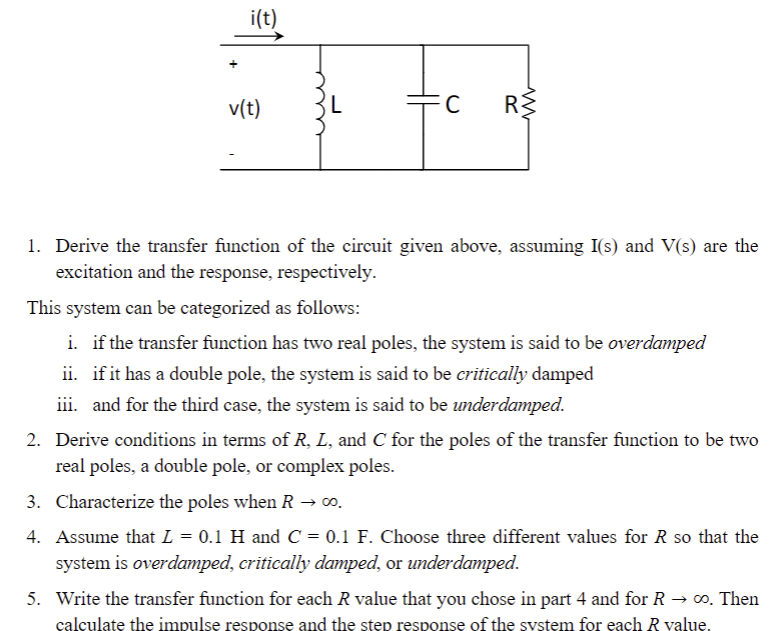
Question: 1 . Derive the transfer function of the circuit given above, assuming ( mathrm { I } ( mathrm { s }
Derive the transfer function of the circuit given above, assuming mathrmImathrms and mathrmVmathrms are the excitation and the response, respectively.
This system can be categorized as follows:
i if the transfer function has two real poles, the system is said to be overdamped
ii if it has a double pole, the system is said to be critically damped
iii. and for the third case, the system is said to be underdamped.
Derive conditions in terms of R L and C for the poles of the transfer function to be two real poles, a double pole, or complex poles.
Characterize the poles when R rightarrow infty
Assume that LmathrmH and Cmathrm~F Choose three different values for R so that the system is overdamped, critically damped, or underdamped.
Write the transfer function for each R value that you chose in part and for R rightarrow infty Then calculate the impulse response and the step response of the svstem for each R value.
Step by Step Solution
There are 3 Steps involved in it
1 Expert Approved Answer
Step: 1 Unlock

Question Has Been Solved by an Expert!
Get step-by-step solutions from verified subject matter experts
Step: 2 Unlock
Step: 3 Unlock
 Study Help