







Question: 1. Determine whether the following sentence is truth functionally true, false or indeterminate by constructing truth table. ([(C> D). (DE)].C). -E 2. Decide by
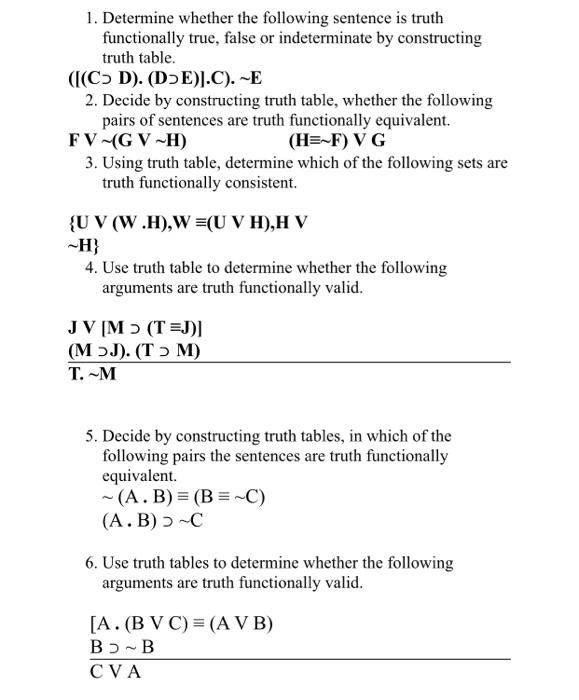
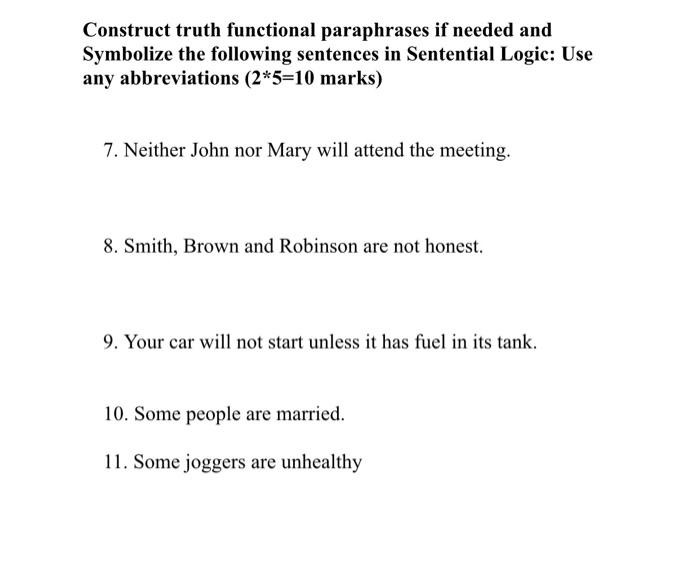
1. Determine whether the following sentence is truth functionally true, false or indeterminate by constructing truth table. ([(C> D). (DE)].C). -E 2. Decide by constructing truth table, whether the following pairs of sentences are truth functionally equivalent. (H=~F) V G FV (GV-H) 3. Using truth table, determine which of the following sets are truth functionally consistent. {U V (W.H),W =(U V H),H V ~H} 4. Use truth table to determine whether the following arguments are truth functionally valid. JV [M> (T=J)] (MJ). (TM) T. -M 5. Decide by constructing truth tables, in which of the following pairs the sentences are truth functionally equivalent. ~(A. B) = (B= ~C) (A. B) > C 6. Use truth tables to determine whether the following arguments are truth functionally valid. [A. (BVC) = (A V B) BD B CVA Construct truth functional paraphrases if needed and Symbolize the following sentences in Sentential Logic: Use any abbreviations (2*5=10 marks) 7. Neither John nor Mary will attend the meeting. 8. Smith, Brown and Robinson are not honest. 9. Your car will not start unless it has fuel in its tank. 10. Some people are married. 11. Some joggers are unhealthy
Step by Step Solution
3.35 Rating (164 Votes )
There are 3 Steps involved in it
1 The given sentence is truth functionally indeterminate To construct a truth table we first need to list out all the possible truth values of the variables C D and E C D E C D DEC E C D DEC E T T T T ... View full answer

Get step-by-step solutions from verified subject matter experts
 Study Help