







Question: 1. Discuss the Program Design Process, including selecting and preparing the training site, identifying and choosing best trainers, communicating with trainees, and deciding how trainers




1. Discuss the Program Design Process, including selecting and preparing the training site, identifying and choosing best trainers, communicating with trainees, and deciding how trainers can arranged a training site and create instructional environment that is conducive to learning.
2.If you were going to conduct a training program what would you want to know about your potential trainees that would help you design a trainee session that would be enjoyable for the trainees and help them learn? How would you conduct your audience analysis?
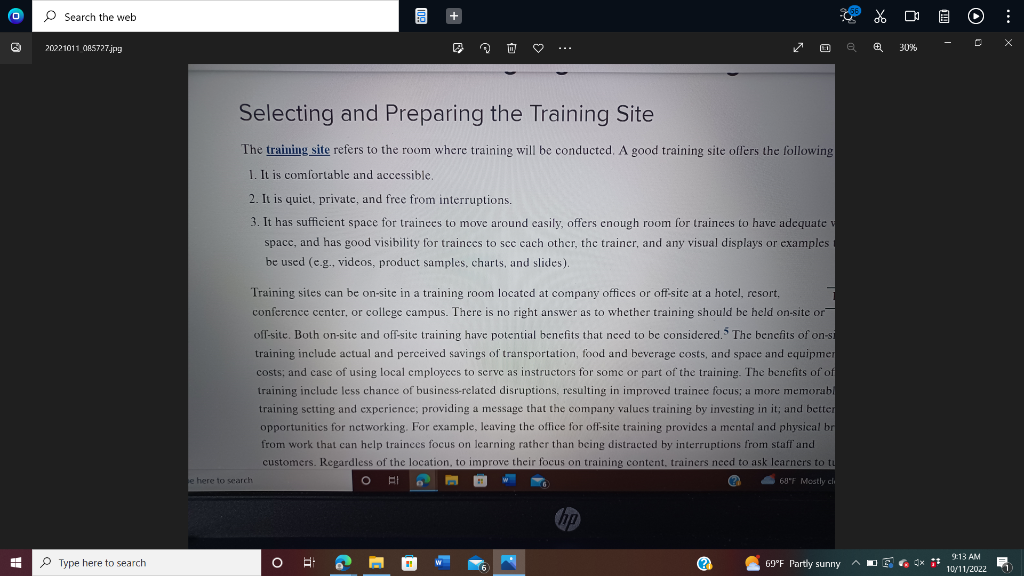
Selecting and Preparing the Training Site The training site refers to the room where training will be conducted. A good training site offers the following 1. It is comfortable and accessible. 2. It is quiet, private, and free from interruptions. 3. It has sufficient space for trainees to move around easily, offers enough room for trainees to have adequate space, and has good visibility for trainees to sec each other, the trainer, and any visual displays or examples be used (e.g., videos, product samples, charts, and slides). Training sites can be on-site in a training room located at company offices or off-site at a hotel, resort. conference center, or college campus. There is no right answer as to whether training should be held on-site or off-site. Both on-site and off-site training have potential benefits that need to be considered. 5 The benefits of ontraining include actual and perceived savings of transportation, food and beverage costs, and space and equipme costs; and case of using local employees to serve as instructors for some or part of the training. The bencits of o training include less chance of business-related disruptions, resulting in improved trainee focus; a more memorat training setting and experience; providing a message that the company values training by investing in it; and bette opportunitics for networking. For example, leaving the office for off-site training provides a mental and physical b from work that can help trainees focus on learning rather than being distracted by interruptions from staff and customers. Regardless of the location, to improve their focus on training content, trainers need to ask learners to Recognizing that trainee learning can be facilitated though both mental and physical involvement, it is important to consider this when choosing, designing, or deciding how to use a training space. For example, Blue Cross Blue Shicld of Michigan has transitioned to classrooms with spaces that can be configured as needed. 6 Because training classes might involve online learning, teamwork, physical movement, and quiet contemplation, spaces need flexible furniture and equipment that can be moved within the class (or moved out altogether to create more space). The key is to have a classroom that is able to accommodate a wide variety of activities and instructor-learner, learner-learner, and learnercontent interactions. For example, in a sales course, learners work with a partner. They physically walk through the sales process using a map on the floor outlining the steps in the process. The physical movement through the steps has helped learners better recall the sales process. When choosing training spaces-whether on-site or off-sitc at a conference site or hotel-trainers at The Economical Insurance Group (TEIG) consider the size of the room needed for the number of trainees attending and ensure that the physical space is engaging to the learner and promotes a sense of community between the facilitator and the instructor. They make certain that the training space can incorporate a blend of technology-based media (such as graphics, multimedia, flash technology, and immediate feedback tools) and face-to-face training methods (such as roundtable discussions among small groups of trainees). Also, for courses such as leadership training, the environment outside the classroom needs to be comfortable (e.g., quict areas, gardens, and lounge chairs) to encourage networking. creativity, and innovation. Sometimes, trainers may find themselves having to work in a training space that is not ideal. At Century 21 Real Estate LLC, trainers make sure that they get a look at the space before the training course to consider its strengths and limitations and how to use it to best maximize learning. For example, at one training session held at a local hotel, listening to a presentation to practicing in groups, and trainces can communicate easily with everyone in the roc type seating is also effective for training that includes trainees working in groups and teams to analyze problems synthesize information. If the training primarily involves knowledge acquisition, with lecture and audiovisual presentation being the prim training method, traditional classroom-type seating is appropriate. Traditional classroom instruction allows traing interaction with the trainer, but it also makes it difficult for trainees to work in teams (particularly if the seats are movable to other locations in the room). If training emphasizes total-group discussion with limited presentation and no small-group interaction, a confereno arrangement may be most effective. If the training requires both presentation and total-group instruction, the horst arrangement is useful. Choosing Trainers Selecting professional trainers or consultants is one obvious possibility for companies. Traincrs, whether from insid outside the company, should have expertise in the topic and experience in training. 9 Train-the-trainer programs are necessary for managers, employees, and "experts" who may have content knowledge but need to improve presentatic and communications skills, gain an understanding of the key components of the learning process (e.g., feedback. practice), or learn to develop lesson plans. This may involve having employees and managers earn a certificate verify appeals to Thinking learners, while Feeling learners need a personal reason for learning. For Thinking learne instructors can emphasize the logic of an approach, while for Feeling learners, personal needs, beliefs, values experiences should be emphasized. The extent to which learners are extroverts or introvcrts can help an instr decide whether to use a structured or flexible learning environment. If you can't assess trainees' learning styles or personality types in advance, you can still ensure that at least so: training appeal to most learners. At American Fidelity Assurance Company, training cmphasizes a learner-cer approach to reach employees with different learning styles. This means that in cach course, company trainers encouraged to include multiple activities and create a learning environment that includes toys, music, vivid figh charts, and graphs, and exercises that require working in pairs to stimulate interaction. Culture and Language If your trainees in a U.S. training program include individuals from other countries for whom English is a secor language or if you are an instructor for a training course or program in another country, you will need to custon content and instruction. There are several ways to do so. First, training content should include language, familiar names, and examples to which the audience can relate. For example, be careful with the use of slang, idioms, and sports analogies. 25 While "hitting it out of the park" or "a dime a dozen" make sense to English spei who are familiar with American culture, these analogies can be confusing and distracting for trainees from other cultures. In case studies, change American names to names that are common in the country's culture. Second, determine the trainees' level of fluency in English. This should be done during the needs assessment by talking tc n addition to understanding trainees' learning styles, discussed in Chapter Four, some companies arc using other Issessment tools to help instructors better understand the preferences and characteristics of learners who will be in the courses and programs. The Learning and Development Group within PricewaterhouseCoopers ( PwC) is using the Myers-Briggs Type Indicator (MBTI) as a tool for instructors to understand learner needs and styles. 24 The MBTI locuses on how we gather information and how we make decisions. It is an assessment tool designed to help individuals understand their personality and how to use their personality preferences at work and in their lives. MBTI theory suggests that personalities differ on four dimensions. We gather information with an emphasis on either facts and details (Sensing or S) or abstract patterns and possibilities (iNtuition or N). We make decisions based on logical analysis (Thinking or T) or personal values (Feeling or F). Also, we differ in our orientation toward and how we deal with the environment. Individuals with an Extroversion (E) preference gain energy from interpersonal interactions, while those with an Introversion (I) preference draw energy from within themselves. Individuals with a preference for Judging (J) desire structure and closure, while those with a Perceiving (P) preference prefer to have many decision options. The MBTI assessment provides a four-letter personality type that is related to each of the four personality dimensions. The dimensions combine to form 16 personality types (e.g., an individual can be an ISTJ, an ENFP, or an INFP). Instructors can have learners complete the assessment prior to attending training courses. Then, instructors can use this information about learners' personality types to help design training that the learners will find interesting, increasing their motivation to learn. For example, if an instructor has a course with trainees who are high on Sensing. this means they tend to receive and process information through a linear approach involving the five senses. As a result, theStep by Step Solution
There are 3 Steps involved in it
1 Expert Approved Answer
Step: 1 Unlock

Question Has Been Solved by an Expert!
Get step-by-step solutions from verified subject matter experts
Step: 2 Unlock
Step: 3 Unlock
 Study Help