







Question: 1. Exercise (Deriving the Transfer function) The stirred tank heating and mixing process is operating at steady state with an inlet 1 tem- perature of
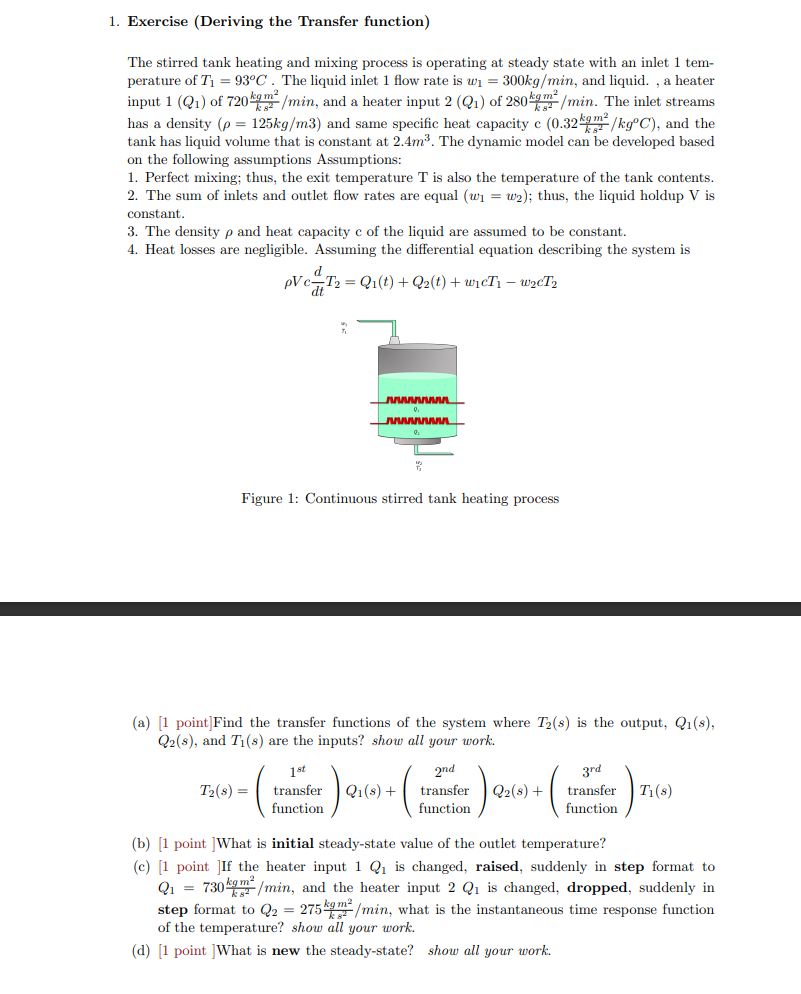
1. Exercise (Deriving the Transfer function) The stirred tank heating and mixing process is operating at steady state with an inlet 1 tem- perature of T1 = 93C. The liquid inlet 1 flow rate is w1 = 300kg/min, and liquid. , a heater input 1 (Q1) of 720kg m/min, and a heater input 2 (Q.) of 280kg men min. The inlet streams has a density (p = 125kg/m3) and same specific heat capacity c (0.326gma2/kgC), and the tank has liquid volume that is constant at 2.4m3. The dynamic model can be developed based on the following assumptions Assumptions: 1. Perfect mixing; thus, the exit temperature T is also the temperature of the tank contents. 2. The sum of inlets and outlet flow rates are equal (wi = w2); thus, the liquid holdup V is constant. 3. The density p and heat capacity c of the liquid are assumed to be constant. 4. Heat losses are negligible. Assuming the differential equation describing the system is pvc T2 = Qu(t) + Q2(t) + wct w2cT2 = www WWWL Figure 1: Continuous stirred tank heating process (a) [1 point]Find the transfer functions of the system where T2() is the output, Q1(s), Q2(3), and T1(s) are the inputs? show all your work. T2(8) = 1st transfer function 1)-() Q1(s) + 2nd transfer function Q2(8) + 3rd transfer function Ti(s) (b) [1 point ]What is initial steady-state value of the outlet temperature? (C) [1 point ]If the heater input 1 Qi is changed, raised, suddenly in step format to Q = 730km. /min, and the heater input 2 Q1 is changed, dropped, suddenly in step format to Q2 = 275 kg m-/min, what is the instantaneous time response function of the temperature? show all your work. (d) [1 point ]What is new the steady-state? show all your work
Step by Step Solution
There are 3 Steps involved in it

Get step-by-step solutions from verified subject matter experts
 Study Help