Question: 1. Hit the Reply button below to write an initial post. 2. Reply to the following prompt: Define the infancy doctrine and describe how you
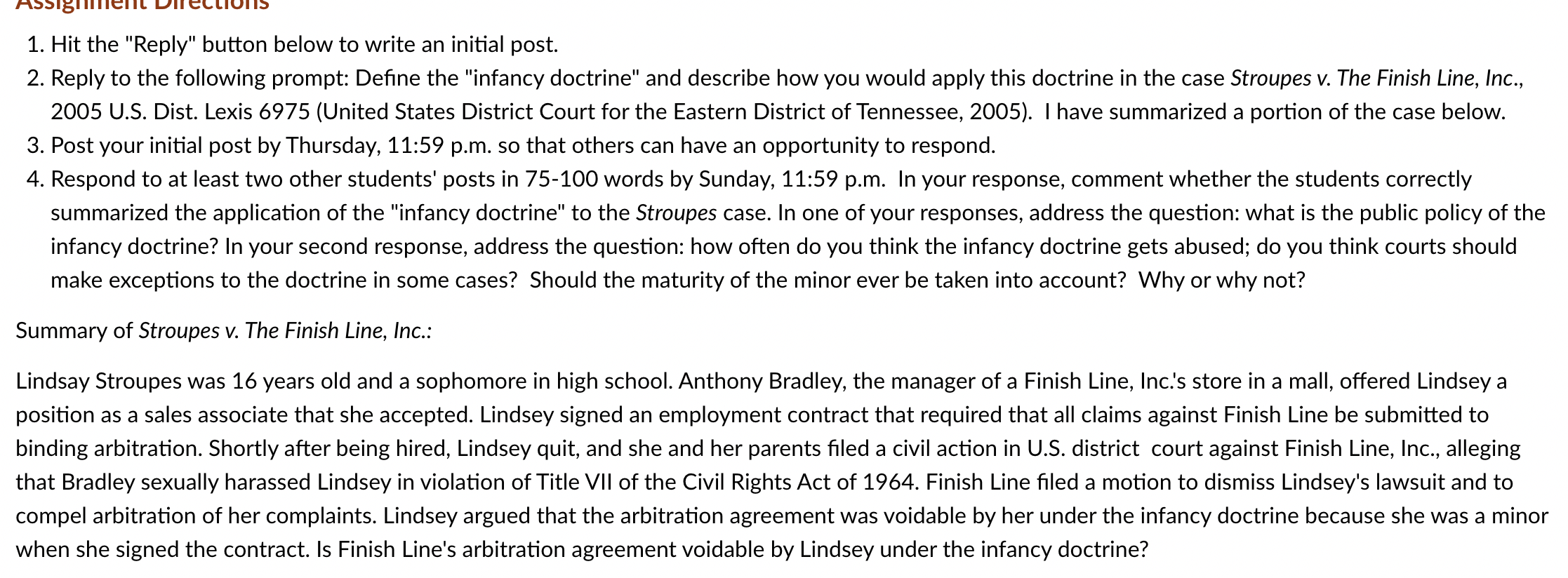
1. Hit the "Reply" button below to write an initial post. 2. Reply to the following prompt: Define the "infancy doctrine" and describe how you would apply this doctrine in the case Stroupes v. The Finish Line, Inc., 2005 U.S. Dist. Lexis 6975 (United States District Court for the Eastern District of Tennessee, 2005). I have summarized a portion of the case below. 3. Post your initial post by Thursday, 11:59 p.m. so that others can have an opportunity to respond. 4. Respond to at least two other students' posts in 75-100 words by Sunday, 11:59 p.m. In your response, comment whether the students correctly summarized the application of the "infancy doctrine" to the Stroupes case. In one of your responses, address the question: what is the public policy of the infancy doctrine? In your second response, address the question: how often do you think the infancy doctrine gets abused; do you think courts should make exceptions to the doctrine in some cases? Should the maturity of the minor ever be taken into account? Why or why not? Summary of Stroupes v. The Finish Line, Inc.: a Lindsay Stroupes was 16 years old and a sophomore in high school. Anthony Bradley, the manager of a Finish Line, Inc.'s store in a mall, offered Lindsey a position as a sales associate that she accepted. Lindsey signed an employment contract that required that all claims against Finish Line be submitted to binding arbitration. Shortly after being hired, Lindsey quit, and she and her parents filed a civil action in U.S. district court against Finish Line, Inc., alleging that Bradley sexually harassed Lindsey in violation of Title VII of the Civil Rights Act of 1964. Finish Line filed a motion to dismiss Lindsey's lawsuit and to compel arbitration of her complaints. Lindsey argued that the arbitration agreement was voidable by her under the infancy doctrine because she was a minor when she signed the contract. Is Finish Line's arbitration agreement voidable by Lindsey under the infancy doctrine? a 1. Hit the "Reply" button below to write an initial post. 2. Reply to the following prompt: Define the "infancy doctrine" and describe how you would apply this doctrine in the case Stroupes v. The Finish Line, Inc., 2005 U.S. Dist. Lexis 6975 (United States District Court for the Eastern District of Tennessee, 2005). I have summarized a portion of the case below. 3. Post your initial post by Thursday, 11:59 p.m. so that others can have an opportunity to respond. 4. Respond to at least two other students' posts in 75-100 words by Sunday, 11:59 p.m. In your response, comment whether the students correctly summarized the application of the "infancy doctrine" to the Stroupes case. In one of your responses, address the question: what is the public policy of the infancy doctrine? In your second response, address the question: how often do you think the infancy doctrine gets abused; do you think courts should make exceptions to the doctrine in some cases? Should the maturity of the minor ever be taken into account? Why or why not? Summary of Stroupes v. The Finish Line, Inc.: a Lindsay Stroupes was 16 years old and a sophomore in high school. Anthony Bradley, the manager of a Finish Line, Inc.'s store in a mall, offered Lindsey a position as a sales associate that she accepted. Lindsey signed an employment contract that required that all claims against Finish Line be submitted to binding arbitration. Shortly after being hired, Lindsey quit, and she and her parents filed a civil action in U.S. district court against Finish Line, Inc., alleging that Bradley sexually harassed Lindsey in violation of Title VII of the Civil Rights Act of 1964. Finish Line filed a motion to dismiss Lindsey's lawsuit and to compel arbitration of her complaints. Lindsey argued that the arbitration agreement was voidable by her under the infancy doctrine because she was a minor when she signed the contract. Is Finish Line's arbitration agreement voidable by Lindsey under the infancy doctrine? a









 Study Help