







Question: 1. How can the topic be defined succinctly and accurately for someone unfamiliar? 2. In what ways is the topic worth knowing about? 3. What
1. How can the topic be defined succinctly and accurately for someone unfamiliar?
2. In what ways is the topic worth knowing about?
3. What examples or cases demonstrate the topic worth knowing about?
Please answer in around 100 words each.
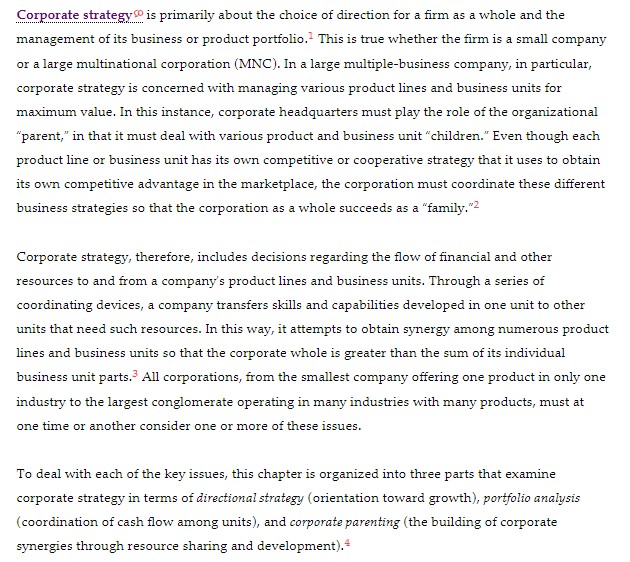
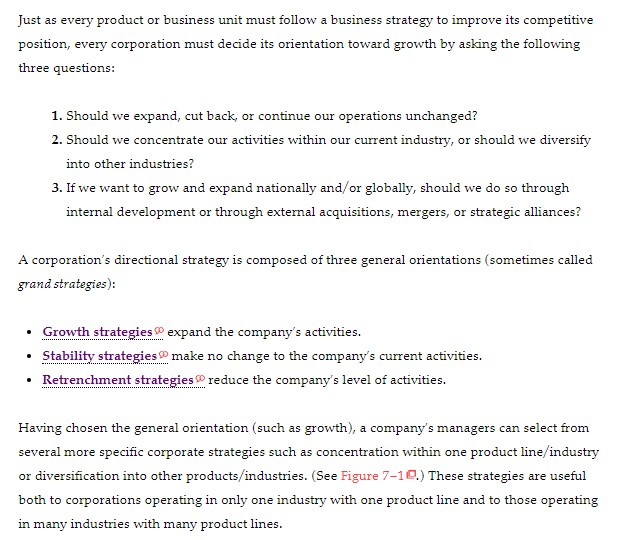
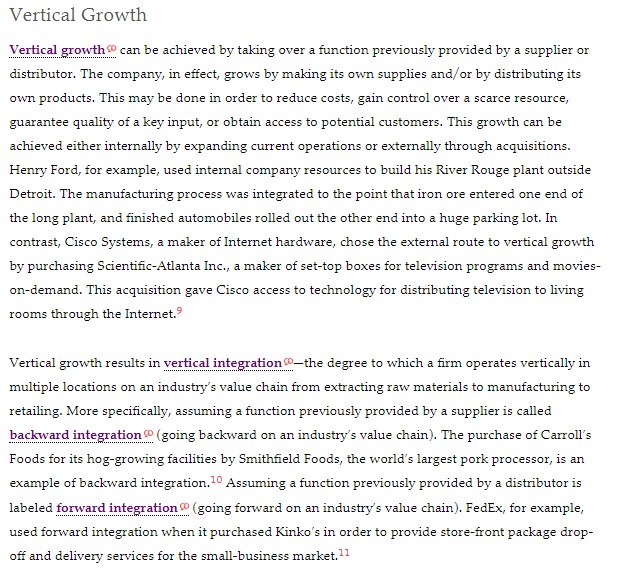
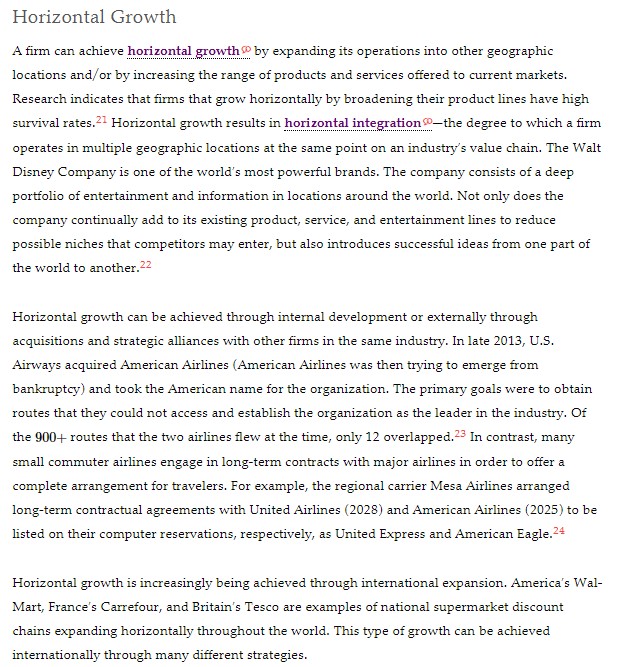
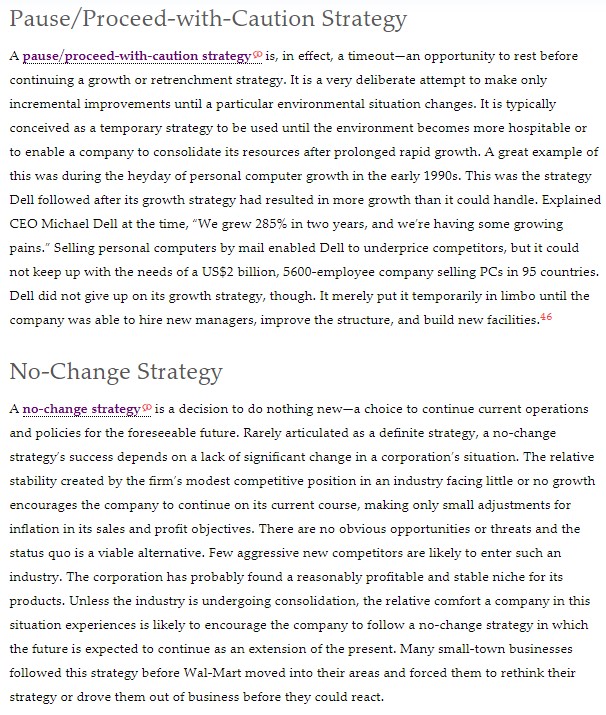
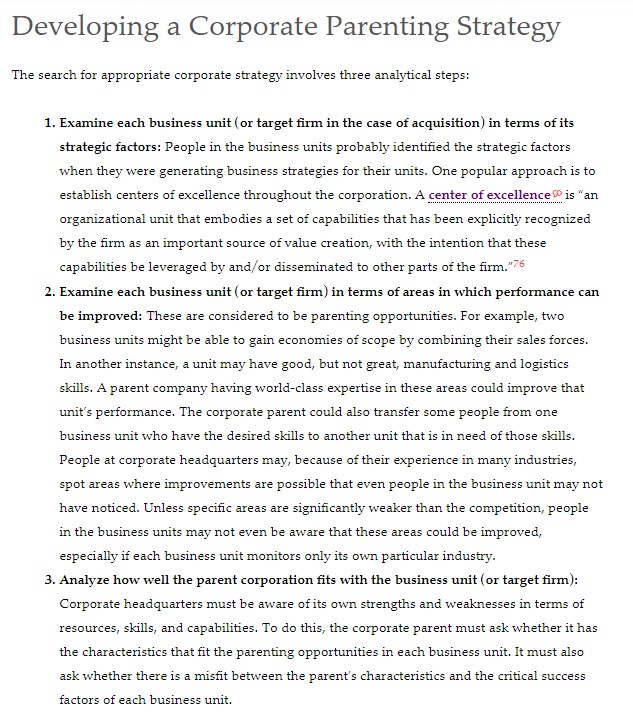
Corporate strategy @ is primarily about the choice of direction for a firm as a whole and the management of its business or product portfolio. 1 This is true whether the firm is a small company or a large multinational corporation (MNC). In a large multiple-business company, in particular, corporate strategy is concerned with managing various product lines and business units for maximum value. In this instance, corporate headquarters must play the role of the organizational "parent," in that it must deal with various product and business unit "children." Even though each product line or business unit has its own competitive or cooperative strategy that it uses to obtain its own competitive advantage in the marketplace, the corporation must coordinate these different business strategies so that the corporation as a whole succeeds as a "family." Corporate strategy, therefore, includes decisions regarding the flow of financial and other resources to and from a company's product lines and business units. Through a series of coordinating devices, a company transfers skills and capabilities developed in one unit to other units that need such resources. In this way, it attempts to obtain synergy among numerous product lines and business units so that the corporate whole is greater than the sum of its individual business unit parts. 3 All corporations, from the smallest company offering one product in only one industry to the largest conglomerate operating in many industries with many products, must at one time or another consider one or more of these issues. To deal with each of the key issues, this chapter is organized into three parts that examine corporate strategy in terms of directional strategy (orientation toward growth), portfolio analysis (coordination of cash flow among units), and corporate parenting (the building of corporate synergies through resource sharing and development). 4 Just as every product or business unit must follow a business strategy to improve its competitive position, every corporation must decide its orientation toward growth by asking the following three questions: 1. Should we expand, cut back, or continue our operations unchanged? 2. Should we concentrate our activities within our current industry, or should we diversify into other industries? 3. If we want to grow and expand nationally and/or globally, should we do so through internal development or through external acquisitions, mergers, or strategic alliances? A corporation's directional strategy is composed of three general orientations (sometimes called grand strategies): - Growth strategies expand the company's activities. - Stability strategies make no change to the company's current activities. - Retrenchment strategies @ reduce the company's level of activities. Having chosen the general orientation (such as growth), a company's managers can select from several more specific corporate strategies such as concentration within one product line/industry or diversification into other products/industries. (See Figure 7-1) These strategies are useful both to corporations operating in only one industry with one product line and to those operating in many industries with many product lines. Vertical Growth Vertical growth s0 can be achieved by taking over a function previously provided by a supplier or distributor. The company, in effect, grows by making its own supplies and/or by distributing its own products. This may be done in order to reduce costs, gain control over a scarce resource, guarantee quality of a key input, or obtain access to potential customers. This growth can be achieved either internally by expanding current operations or externally through acquisitions. Henry Ford, for example, used internal company resources to build his River Rouge plant outside Detroit. The manufacturing process was integrated to the point that iron ore entered one end of the long plant, and finished automobiles rolled out the other end into a huge parking lot. In contrast, Cisco Systems, a maker of Internet hardware, chose the external route to vertical growth by purchasing Scientific-Atlanta Inc., a maker of set-top boxes for television programs and movieson-demand. This acquisition gave Cisco access to technology for distributing television to living rooms through the Internet. 9 Vertical growth results in vertical integration -the degree to which a firm operates vertically in multiple locations on an industry's value chain from extracting raw materials to manufacturing to retailing. More specifically, assuming a function previously provided by a supplier is called backward integration (going backward on an industry's value chain). The purchase of Carroll's Foods for its hog-growing facilities by Smithfield Foods, the world's largest pork processor, is an example of backward integration. 10 Assuming a function previously provided by a distributor is labeled forward integration 0 (going forward on an industry's value chain). FedEx, for example, used forward integration when it purchased Kinko's in order to provide store-front package dropoff and delivery services for the small-business market. 11 Pause/Proceed-with-Caution Strategy A pause/proceed-with-caution strategy s is, in effect, a timeout-an opportunity to rest before continuing a growth or retrenchment strategy. It is a very deliberate attempt to make only incremental improvements until a particular environmental situation changes. It is typically conceived as a temporary strategy to be used until the environment becomes more hospitable or to enable a company to consolidate its resources after prolonged rapid growth. A great example of this was during the heyday of personal computer growth in the early 1990s. This was the strategy Dell followed after its growth strategy had resulted in more growth than it could handle. Explained CEO Michael Dell at the time, "We grew 285% in two years, and we're having some growing pains." Selling personal computers by mail enabled Dell to underprice competitors, but it could not keep up with the needs of a US\$2 billion, 5600-employee company selling PCs in 95 countries. Dell did not give up on its growth strategy, though. It merely put it temporarily in limbo until the company was able to hire new managers, improve the structure, and build new facilities. 46 No-Change Strategy A no-change strategy is a decision to do nothing new-a choice to continue current operations and policies for the foreseeable future. Rarely articulated as a definite strategy, a no-change strategy's success depends on a lack of significant change in a corporation's situation. The relative stability created by the firm's modest competitive position in an industry facing little or no growth encourages the company to continue on its current course, making only small adjustments for inflation in its sales and profit objectives. There are no obvious opportunities or threats and the status quo is a viable alternative. Few aggressive new competitors are likely to enter such an industry. The corporation has probably found a reasonably profitable and stable niche for its products. Unless the industry is undergoing consolidation, the relative comfort a company in this situation experiences is likely to encourage the company to follow a no-change strategy in which the future is expected to continue as an extension of the present. Many small-town businesses followed this strategy before Wal-Mart moved into their areas and forced them to rethink their strategy or drove them out of business before they could react. Developing a Corporate Parenting Strategy The search for appropriate corporate strategy involves three analytical steps: 1. Examine each business unit (or target firm in the case of acquisition) in terms of its strategic factors: People in the business units probably identified the strategic factors when they were generating business strategies for their units. One popular approach is to establish centers of excellence throughout the corporation. A center of excellence is "an organizational unit that embodies a set of capabilities that has been explicitly recognized by the firm as an important source of value creation, with the intention that these capabilities be leveraged by and/or disseminated to other parts of the firm. 476 2. Examine each business unit (or target firm) in terms of areas in which performance can be improved: These are considered to be parenting opportunities. For example, two business units might be able to gain economies of scope by combining their sales forces. In another instance, a unit may have good, but not great, manufacturing and logistics skills. A parent company having world-class expertise in these areas could improve that unit's performance. The corporate parent could also transfer some people from one business unit who have the desired skills to another unit that is in need of those skills. People at corporate headquarters may, because of their experience in many industries, spot areas where improvements are possible that even people in the business unit may not have noticed. Unless specific areas are significantly weaker than the competition, people in the business units may not even be aware that these areas could be improved, especially if each business unit monitors only its own particular industry. 3. Analyze how well the parent corporation fits with the business unit (or target firm): Corporate headquarters must be aware of its own strengths and weaknesses in terms of resources, skills, and capabilities. To do this, the corporate parent must ask whether it has the characteristics that fit the parenting opportunities in each business unit. It must also ask whether there is a misfit between the parent's characteristics and the critical success factors of each business unit. Horizontal Growth A firm can achieve horizontal growth by expanding its operations into other geographic locations and/or by increasing the range of products and services offered to current markets. Research indicates that firms that grow horizontally by broadening their product lines have high survival rates. 21 Horizontal growth results in horizontal integration 50 -the degree to which a firm operates in multiple geographic locations at the same point on an industry's value chain. The Walt Disney Company is one of the world's most powerful brands. The company consists of a deep portfolio of entertainment and information in locations around the world. Not only does the company continually add to its existing product, service, and entertainment lines to reduce possible niches that competitors may enter, but also introduces successful ideas from one part of the world to another. 22 Horizontal growth can be achieved through internal development or externally through acquisitions and strategic alliances with other firms in the same industry. In late 2013, U.S. Airways acquired American Airlines (American Airlines was then trying to emerge from bankruptcy) and took the American name for the organization. The primary goals were to obtain routes that they could not access and establish the organization as the leader in the industry. Of the 900 + routes that the two airlines flew at the time, only 12 overlapped. 23 In contrast, many small commuter airlines engage in long-term contracts with major airlines in order to offer a complete arrangement for travelers. For example, the regional carrier Mesa Airlines arranged long-term contractual agreements with United Airlines (2028) and American Airlines (2025) to be listed on their computer reservations, respectively, as United Express and American Eagle.24 Horizontal growth is increasingly being achieved through international expansion. America's WalMart, France's Carrefour, and Britain's Tesco are examples of national supermarket discount chains expanding horizontally throughout the world. This type of growth can be achieved internationally through many different strategies
Step by Step Solution
There are 3 Steps involved in it

Get step-by-step solutions from verified subject matter experts
 Study Help