







Question: ********************************************************************************************************************* 1. If T1 is a non-negative random time with probability density function f1(t), then f: f1(t)dt = 1. And its mean value (also called
*********************************************************************************************************************
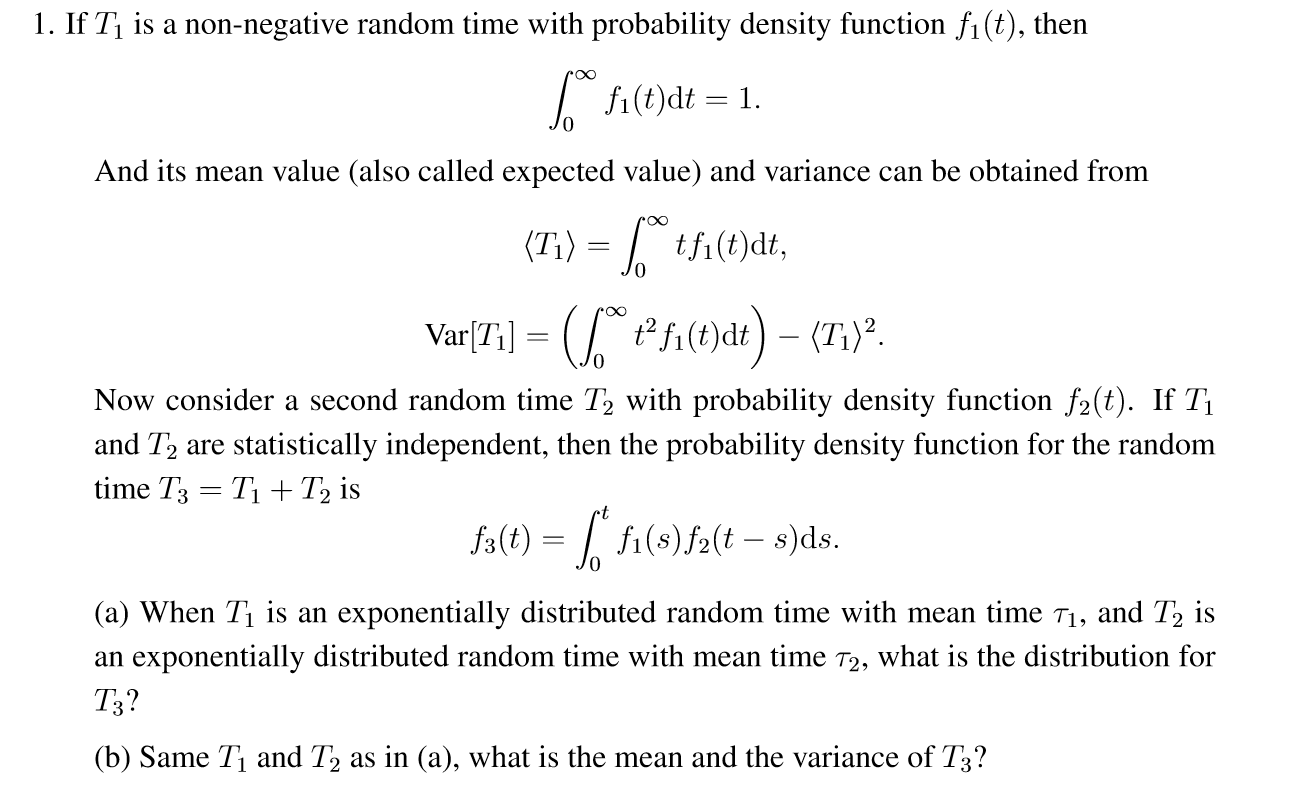
1. If T1 is a non-negative random time with probability density function f1(t), then f: f1(t)dt = 1. And its mean value (also called expected value) and variance can be obtained from (T1) = [0 tf1(t)dt, Var[T1] = ( jo :2 f1(t)dt) (T1)2. Now consider a second random time T2 with probability density function f2(t). If T1 and T2 are statistically independent, then the probability density function for the random time T3 = T1 + T2 iS 19305) = fl: f1(8)f2(t s)ds. (a) When T1 is an exponentially distributed random time with mean time 7-1, and T2 is an exponentially distributed random time with mean time 7'2, what is the distribution for T3? (b) Same T1 and T2 as in (a), what is the mean and the variance of T3
Step by Step Solution
There are 3 Steps involved in it

Get step-by-step solutions from verified subject matter experts
 Study Help