







Question: 1. In the example problems performed in class, parameters were estimated from rat plasma toluene levels measured during and after a 4 hr exposure to
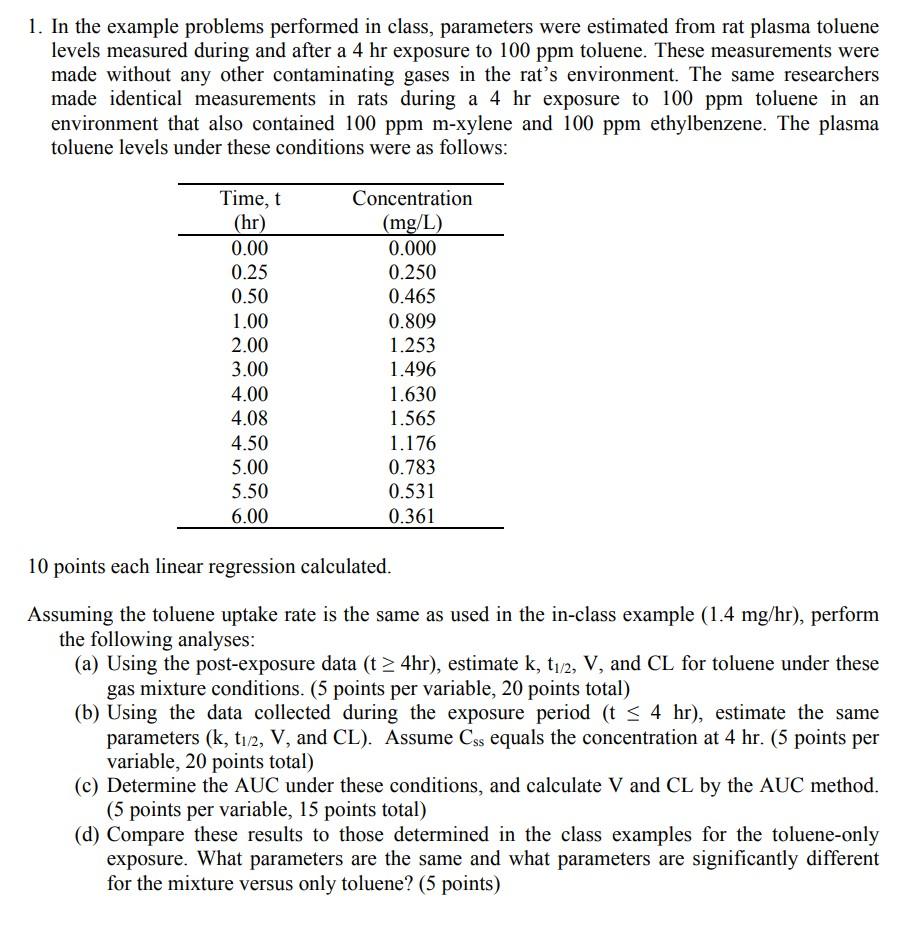
1. In the example problems performed in class, parameters were estimated from rat plasma toluene levels measured during and after a 4 hr exposure to 100 ppm toluene. These measurements were made without any other contaminating gases in the rat's environment. The same researchers made identical measurements in rats during a 4 hr exposure to 100 ppm toluene in an environment that also contained 100 ppm m-xylene and 100 ppm ethylbenzene. The plasma toluene levels under these conditions were as follows: Time, t (hr) 0.00 0.25 0.50 1.00 2.00 3.00 4.00 4.08 4.50 5.00 5.50 6.00 Concentration (mg/L) 0.000 0.250 0.465 0.809 1.253 1.496 1.630 1.565 1.176 0.783 0.531 0.361 10 points each linear regression calculated. Assuming the toluene uptake rate is the same as used in the in-class example (1.4 mg/hr), perform the following analyses: (a) Using the post-exposure data (t> 4hr), estimate k, t1/2, V, and CL for toluene under these gas mixture conditions. (5 points per variable, 20 points total) (b) Using the data collected during the exposure period (t = 4 hr), estimate the same parameters (k, t1/2, V, and CL). Assume Css equals the concentration at 4 hr. (5 points per variable, 20 points total) (c) Determine the AUC under these conditions, and calculate V and CL by the AUC method. (5 points per variable, 15 points total) (d) Compare these results to those determined in the class examples for the toluene-only exposure. What parameters are the same and what parameters are significantly different for the mixture versus only toluene? (5 points)
Step by Step Solution
There are 3 Steps involved in it

Get step-by-step solutions from verified subject matter experts
 Study Help