







Question: 1. In the following problem do not write any final answer without setting up a detailed equation that reflects the complete basis of your answer.
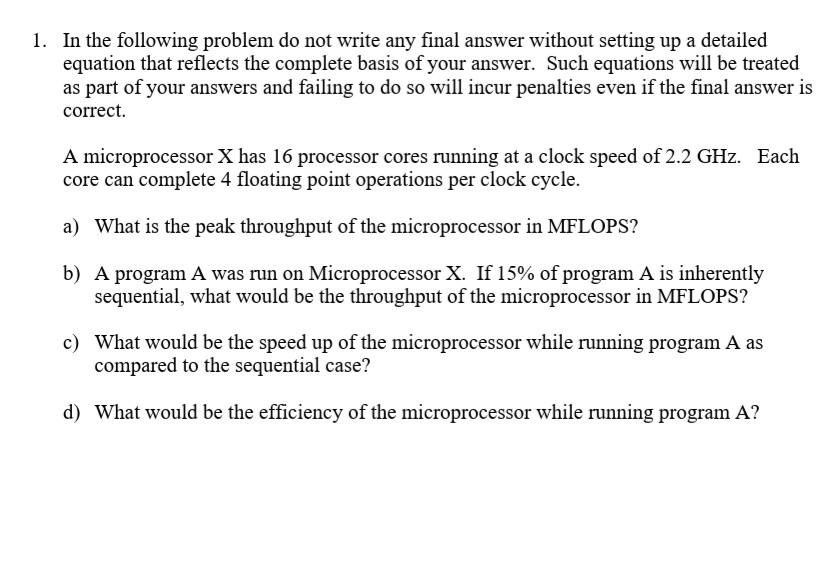
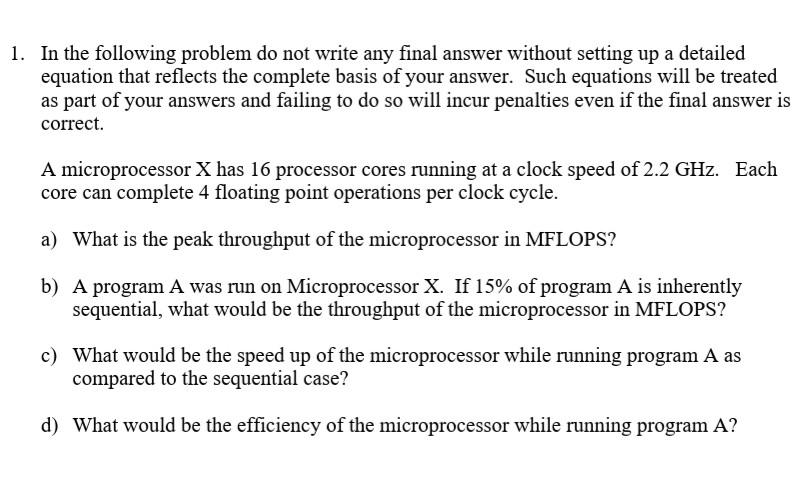
1. In the following problem do not write any final answer without setting up a detailed equation that reflects the complete basis of your answer. Such equations will be treated as part of your answers and failing to do so will incur penalties even if the final answer is correct. A microprocessor X has 16 processor cores running at a clock speed of 2.2 GHz. Each core can complete 4 floating point operations per clock cycle. a) What is the peak throughput of the microprocessor in MFLOPS? b) A program A was run on Microprocessor X. If 15% of program A is inherently sequential, what would be the throughput of the microprocessor in MFLOPS? c) What would be the speed up of the microprocessor while running program A as compared to the sequential case? d) What would be the efficiency of the microprocessor while running program A? 1. In the following problem do not write any final answer without setting up a detailed equation that reflects the complete basis of your answer. Such equations will be treated as part of your answers and failing to do so will incur penalties even if the final answer is correct. A microprocessor X has 16 processor cores running at a clock speed of 2.2 GHz. Each core can complete 4 floating point operations per clock cycle. a) What is the peak throughput of the microprocessor in MFLOPS? b) A program A was run on Microprocessor X. If 15% of program A is inherently sequential, what would be the throughput of the microprocessor in MFLOPS? c) What would be the speed up of the microprocessor while running program A as compared to the sequential case? d) What would be the efficiency of the microprocessor while running program A
Step by Step Solution
There are 3 Steps involved in it

Get step-by-step solutions from verified subject matter experts
 Study Help